Review
. 2011 Apr;1(2):883-919.
doi: 10.1002/cphy.c100039.

Physiology of endothelin and the kidney

Affiliations
Review

Physiology of endothelin and the kidney

Donald E Kohan et al. Compr Physiol. 2011 Apr.

Abstract

Since its discovery in 1988 as an endothelial cell-derived peptide that exerts the most potent vasoconstriction of any known endogenous compound, endothelin (ET) has emerged as an important regulator of renal physiology and pathophysiology. This review focuses on how the ET system impacts renal function in health; it is apparent that ET regulates multiple aspects of kidney function. These include modulation of glomerular filtration rate and renal blood flow, control of renin release, and regulation of transport of sodium, water, protons, and bicarbonate. These effects are exerted through ET interactions with almost every cell type in the kidney, including mesangial cells, podocytes, endothelium, vascular smooth muscle, every section of the nephron, and renal nerves. In addition, while not the subject of the current review, ET can also indirectly affect renal function through modulation of extrarenal systems, including the vasculature, nervous system, adrenal gland, circulating hormones, and the heart. As will become apparent, these pleiotropic effects of ET are of fundamental physiologic importance in the control of renal function in health. In addition, to help put these effects into perspective, we will also discuss, albeit to a relatively limited extent, how alterations in the ET system can contribute to hypertension and kidney disease.


Figures

Figure 1
Figure 1
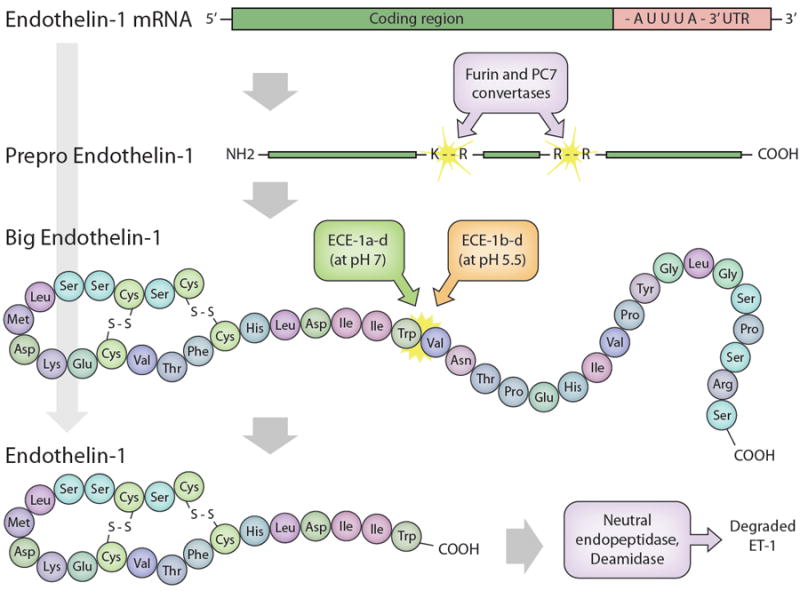
Biosynthetic and degradation pathways for ET-1. ET-1 mRNA encodes preproET-1. The short signal peptide is cleaved to yield proET-1 which, in turn, is cleaved by furin or PC7 convertases at dibasic amino acids to yield Big ET-1. Big ET-1 is cleaved by different ET converting enzymes (ECE) to mature ET-1. ET-1 is degraded by neutral endopeptidase and deamidase.
Figure 2
Figure 2
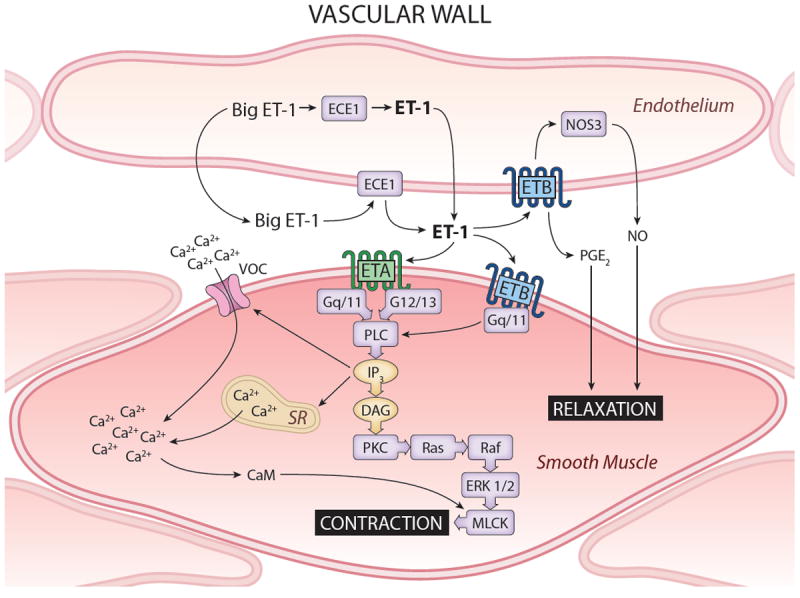
Schema of ET in vasculature. Endothelial cells express ETB exclusively and are the predominant vascular source of ET-1. ET-1 and nitric oxide synthase 3 (NOS3) can increase ETB activity or amount, respectively, leading to NO and PGE2 production with resulting vasolaxation. Activation of vascular smooth muscle ETA or ETB leads to a signaling cascade involving G-proteins, phospholipase C (PLC) and inositol triphosphate (IP3) that activate voltage-operated Ca2+ channel (VOC) and sarcoplasmic reticulum (SR)-mediated increases in [Ca2+]i and calmodulin (CaM) activation. CaM, together with activation of protein kinase C (PKC) by diacylglycerol (DAG) and Ras/Raf/ERK1/2 activation, causes myosin light chain kinase (MLCK) activation and cell contraction.
Figure 3
Figure 3
Schema of functional ET receptors in the glomerulus and renal arterioles (Panel A), nephron (Panel B) and vasa recta (Panel C). A = contractile ETA; B = contractile ETB; white B with shadow: relaxant or natriuretic ETB that stimulates NO production; white A with shadow: natriuretic ETA. The amount of ET receptor shown in a given area is representative of the level of ET receptor activity in that region. Afferent arteriolar smooth muscle has more vasoconstrictive ET receptors than do efferent arterioles, while efferent arteriole endothelium has more vasodilatory ETB than does afferent arteriole (Panel A). Podocytes and mesangial cells contain primarily contractile ETA (Panel A). The inner medullary collecting duct (IMCD) has the greatest density of natriuretic ET receptors, although natriuretic ET receptors exist in the cortical collecting duct (CCD), thick ascending limb (TAL) and proximal tubule (PT) (Panel B). Vasa recta express contractile ETA on pericytes and vasodilatory ETB on endothelial cells (Panel C).
Figure 4
Figure 4
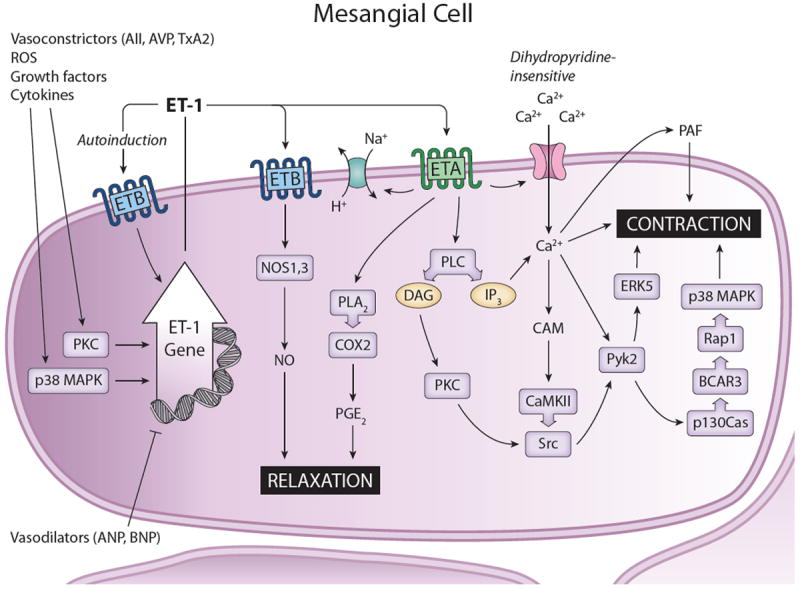
Synthesis and actions of ET-1 in mesangial cells. A large variety of substances stimulate ET-1 production, including ET-1 itself. Vasodilators tend to inhibit mesangial cell ET-1 synthesis. ET-1 likely acts in an autocrine manner. In general, ETA activation leads to cell contraction, while ETB activation causes relaxation. Please see text for definitions of abbreviations.
Figure 5
Figure 5
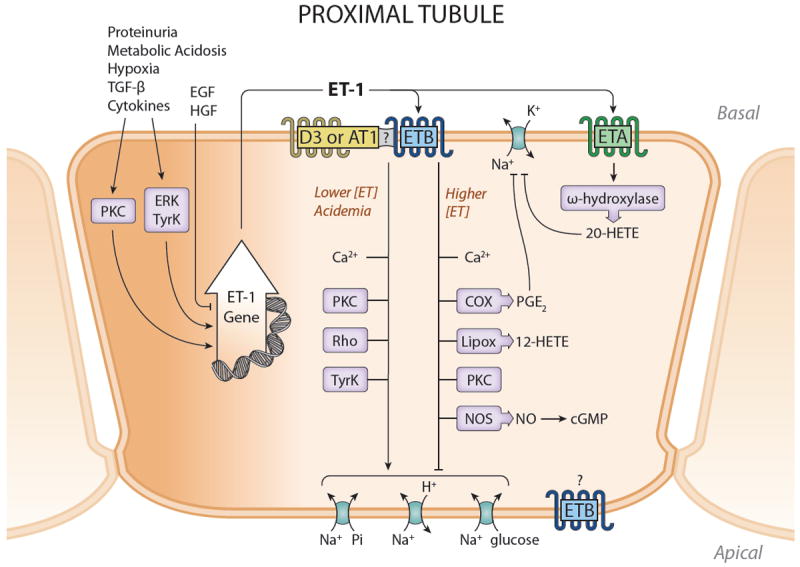
Synthesis and actions of ET-1 in the proximal tubule. ET-1 production is enhanced during inflammation, hypoxia, glomerular injury and acidemia. Most studies implicate ETB in mediating ET effects on the proximal tubule, although ETA activation may result in inhibition of Na reabsorption. ETB effects appear to depend upon the concentration of ET-1, with lower concentrations stimulating Na transport processes and higher concentrations having the opposite effect. It is likely that ET-1 exerts primary a natriuretic effect on the proximal tubule under physiologic conditions. Please see text for definitions of abbreviations.
Figure 6
Figure 6
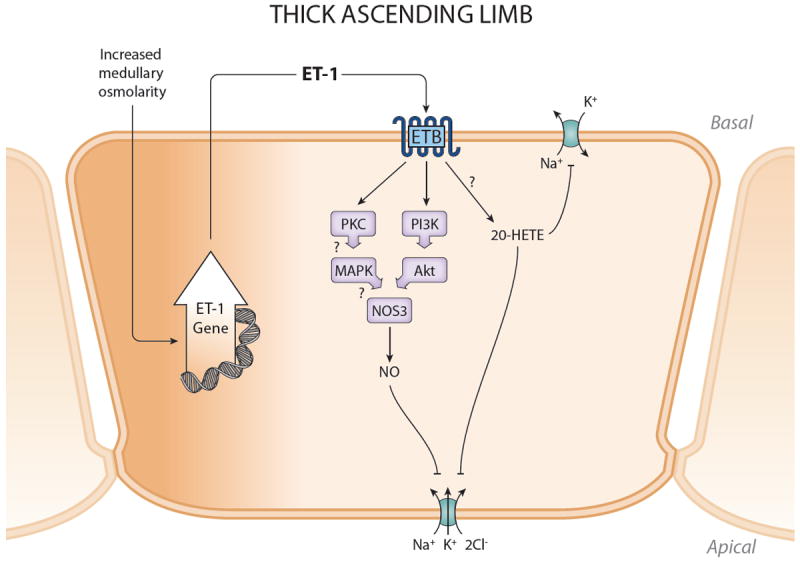
Synthesis and actions of ET-1 in the thick ascending limb. ET-1 production is stimulated by increased medullary osmolality which occurs during high Na intake. ET-1 can then act in an autocrine manner, via ETB, to stimulate NOS3 activity and inhibit NKCC2. ETB may also increased 20-HETE with possible inhibition of Na/K ATPase activity, although this is unproven. Please see text for definitions of abbreviations.
Figure 7
Figure 7
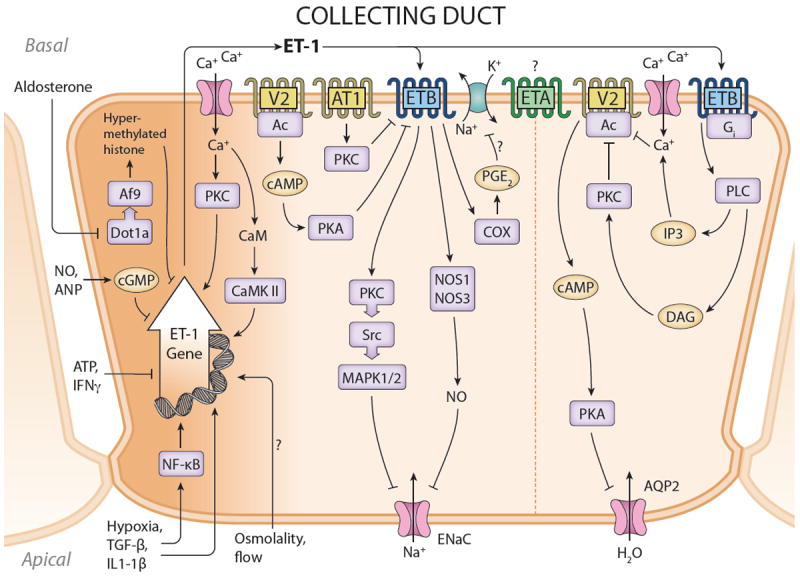
Synthesis and actions of ET-1 in the collecting duct. ET-1 gene transcription is under complex control, involving transactivators binding to cis elements in the ET-1 promoter, as well as histone methylation. The latter effect mediates aldosterone stimulation of collecting duct ET-1 production; this may serve as a negative feedback regulator of aldosterone-stimulated Na transport in this nephron segment. ETB mediates ET-1 inhibition of water transport, primarily through inhibition of AVP-stimulated adenylyl cyclase (AC) activity. ETB also mediates ET-1 inhibition of ENaC activity; this involves both NO and MAPK. V2 and AT1 receptors have been reported to inhibit ETB expression in this nephron segment. The role of ETA in regulating collecting duct Na and water transport is uncertain. Please see text for definitions of abbreviations.
Figure 8
Figure 8
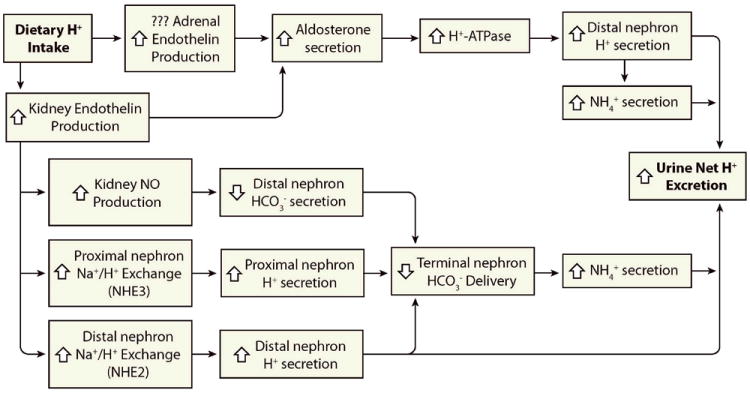
Role of the renal ET system in control of urinary acid excretion. Dietary acid intake stimulates renal and possibly adrenal ET-1 production. Renal ET-1 increases proximal tubule H+ secretion and distal nephron H+ secretion and bicarbonate reabsorption. Adrenal ET-1 increases aldosterone which stimulates distal nephron H+ secretion. Please see text for definitions of abbreviations.
Figure 9
Figure 9
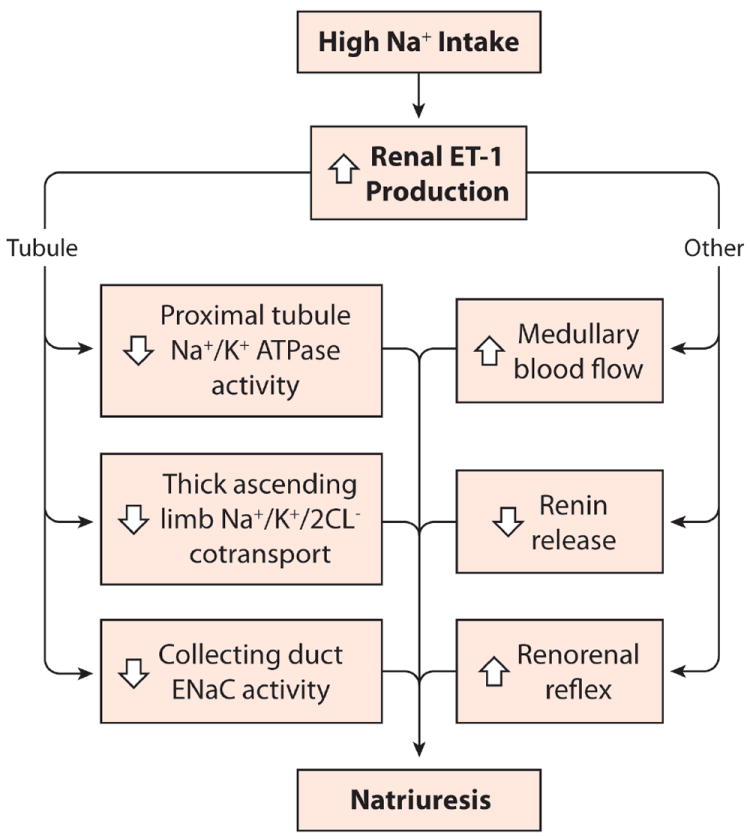
Integrated renal response to high Na intake. High Na intake increases renal ET-1 synthesis, particularly in the nephron. This can reduced tubule Na reabsorption by inhibiting Na transport mechanisms in the proximal tubule, thick ascending limb and collecting duct. ET-1, most likely derived from the medullary collecting duct and/or medullary thick ascending limb, may also increase medullary blood flow through vasodilation of vasa recta.

References

    1. Abassi Z, Ellahham S, Winaver J, Hoffman A. The intrarenal endothelin system and hypertension. News Physiol Sci. 2001;16:152–156. - PubMed
    1. Abassi ZA, Tate JE, Golomb E, Keiser HR. Role of neutral endopeptidase in the metabolism of endothelin. Hypertension. 1992;20:89–95. - PubMed
    1. Ackermann M, Ritthaler T, Riegger G, Kurtz A, Kramer BK. Endothelin inhibits cAMP-induced renal release from isolated renal juxtaglomerular cells. Journal of Cardiovascular Pharmacology. 1995;26:S135–S137. - PubMed
    1. Ahn D, Ge Y, Stricklett PK, Gill P, Taylor D, Hughes AK, Yanagisawa M, Miller L, Nelson RD, Kohan DE. Collecting duct-specific knockout of endothelin-1 causes hypertension and sodium retention. J Clin Invest. 2004;114:504–511. - PMC - PubMed
    1. Akabane S, Yoshimi H, Yoshida K, Kawano Y, Ashida T, Kinoshita O, Matsushima Y, Kawamura M, Imanishi M, Kuramochi M, Omae T. Differential effects of endothelin-1 and big endothelin on canine kidneys. J Cardiovasc Pharmacol. 1991;17(Suppl. 7):S302–S304. - PubMed

Publication types