


Review
doi: 10.1371/journal.pntd.0002161.
Print 2013.
Potential non-invasive urine-based antigen (protein) detection assay to diagnose active visceral leishmaniasis
Affiliations
- PMID: 23738023
- PMCID: PMC3667753
- DOI: 10.1371/journal.pntd.0002161
Item in Clipboard
Review
Potential non-invasive urine-based antigen (protein) detection assay to diagnose active visceral leishmaniasis
PLoS Negl Trop Dis.
.
No abstract available
Conflict of interest statement
I have read the journal's policy and have the following conflicts: CA is an employee of DetectoGen Inc. and has no ownership or ownership option in the company. ACN is a consultant for DetectoGen Inc.
Figures
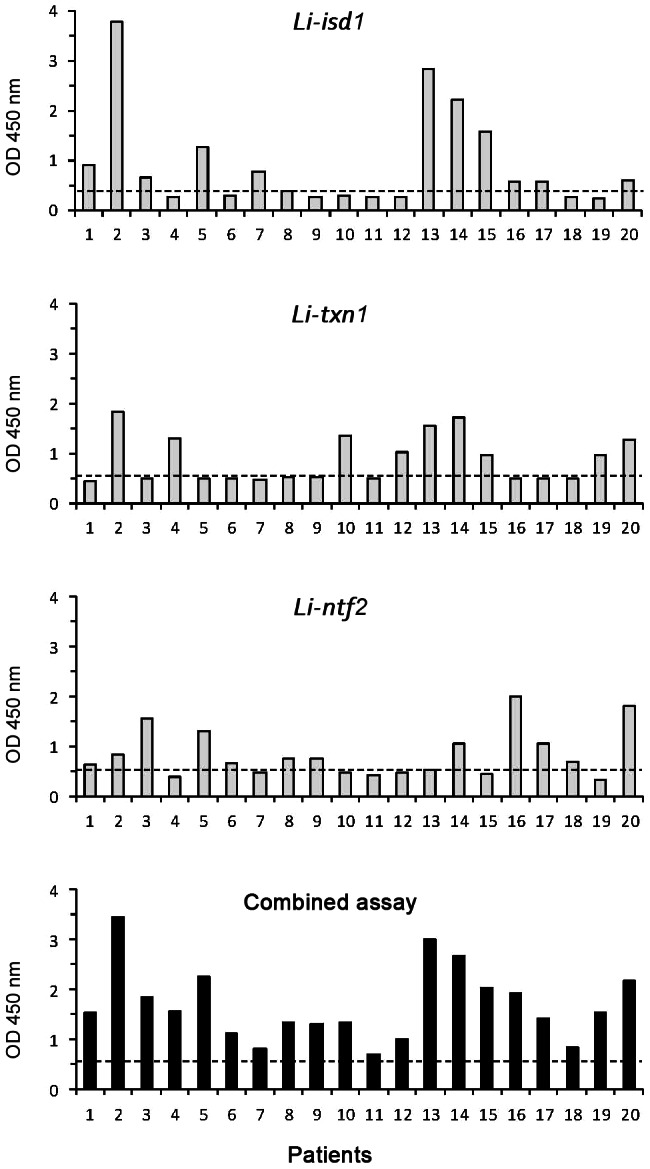
Urine specimens were from VL patients and normal, healthy control subjects. The following predetermined capture antibodies concentrations were used to coat the ELISA plates: antigen affinity-purified IgY anti-Li-isd1, 100 ng/well; antigen affinity-purified rabbit anti-Li-txn1 antibodies, 875 ng/well; and purified rabbit IgG anti-Li-ntf2 antibody (2,000 ng/well), or the combination of the three antibodies/well. Samples from VL patients (n = 20) were from Teresina, PI, Brazil. Control samples were from healthy individuals from countries where VL is endemic who were living in the United States. Dashed lines represent the cutoff values calculated as described in the text. These are representative results of at least three experiments performed at different times with the same urine samples and same capture ELISA.
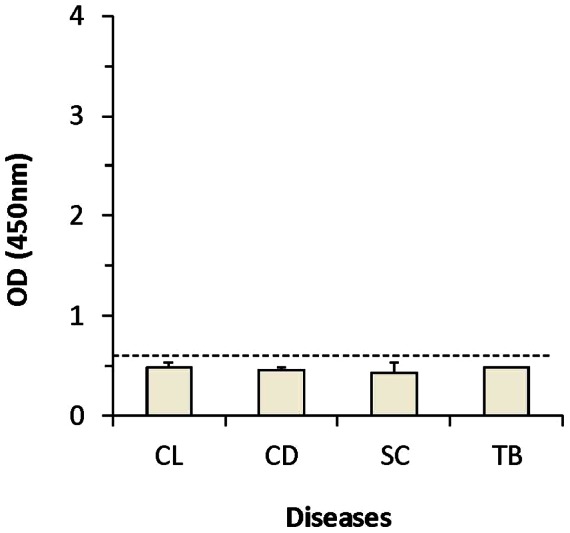
Urine specimens were from patients with cutaneous leishmaniasis (CL) (n = 10), Chagas disease (CD) (n = 8), schistosomiasis (SC) (n = 14), or tuberculosis (TB) (n = 10). Assay performed using capture ELISAs assembled all three antibodies in a single well as described in the legend for Figure 1. Dashed line represents the cutoff values, which was calculated using the average of the ODs obtained from the urine specimens from 20 normal, healthy control subjects plus 3 SDs.
References
-
- Guerin PJ, Olliaro P, Sundar S, Boelaert M, Croft Sl, et al. (2002) Visceral leishmaniasis: current status of control, diagnosis, and treatment, and a proposed research and development agenda. Lancet Infect Dis 2: 494–501. - PubMed
-
- Ho EA, Soong TH, Li Y (1948) Comparative merits of sternum, spleen and liver punctures in the study of human visceral leishmaniasis. Trans R Soc Trop Med Hyg 41: 629–636. - PubMed
-
- Melby PC (2002) Recent developments in leishmaniasis. Curr Opin Infect Dis 15: 485–490. - PubMed
-
- Srivastava P, Mehrotra S, Tiwary P, Chakravarty J, Sundar S (2011) Diagnosis of indian visceral leishmaniasis by nucleic acid detection using PCR. PLoS ONE 6: e19304 doi:10.1371/journal.pone.0019304. - DOI - PMC - PubMed
-
- Badaro R, Lobo I, Munos A, Netto EM, Modabber F, et al. (2006) Immunotherapy for drug-refractory mucosal leishmaniasis. J Infect Dis 194: 1151–1159. - PubMed
Publication types
MeSH terms
Substances
Grants and funding
LinkOut - more resources
Full Text Sources
Other Literature Sources
Medical
