


Mental fatigue and cognitive impairment after an almost neurological recovered stroke
- PMID: 23738208
- PMCID: PMC3658493
- DOI: 10.5402/2012/686425
Mental fatigue and cognitive impairment after an almost neurological recovered stroke
Abstract
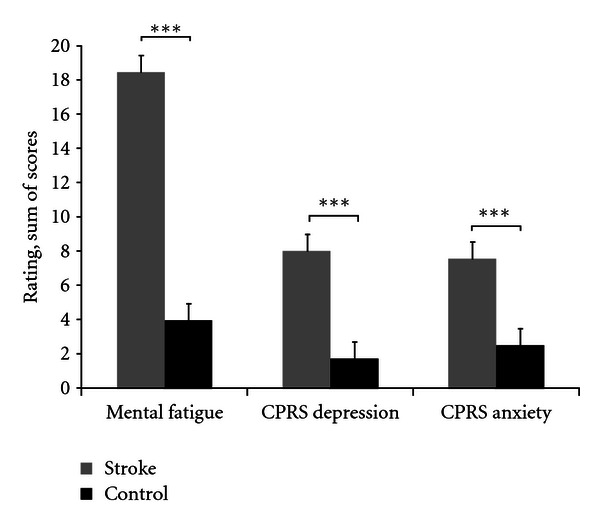
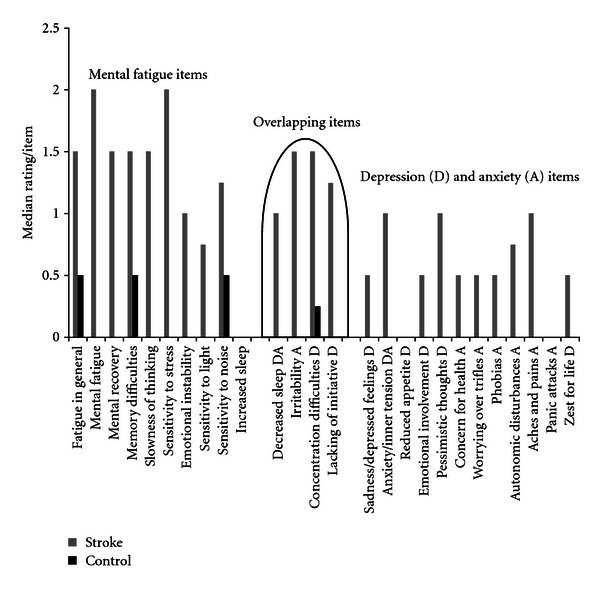
Mental fatigue is for many a distressing and long-term problem after stroke. This mental fatigue will make it more difficult for the person to return to work and previous activities. The intention with this study is to investigate mental fatigue in relation to depression and cognitive functions. We examined 24 well-rehabilitated stroke subjects, who suffered from mental fatigue one year or more after a stroke, and 24 healthy controls. Subjects were examined using self-assessment scales for mental fatigue, depression and anxiety, and cognitive tests. The results showed a highly increased rating for mental fatigue for the stroke group (P < 0.001). These participants also had a significantly higher rating on the depression (P < 0.001) and anxiety (P < 0.001) scales. Furthermore, they had a slower information processing speed (P < 0.001) and made more errors in a demanding attention and speed test (P < 0.05). Among the cognitive tests, processing speed and errors made in an attention and speed test were significant predictors for mental fatigue. We suggest mental fatigue following a stroke to be related to cognitive impairments, primarily information processing speed. Mental fatigue should also be treated as a separate phenomenon and should be differentiated from, and not confused with, depression, even if overlapping symptoms exist.
Figures

References
-
- Carlsson GE, Möller A, Blomstrand C. A qualitative study of the consequences of “hidden dysfunctions” one year after a mild stroke in person <75 years. Disability and Rehabilitation. 2004;26(23):1373–1380. - PubMed
-
- Glader EL, Stegmayr B, Asplund K. Poststroke fatigue: a 2-year follow-up study of stroke patients in Sweden. Stroke. 2002;33(5):1327–1333. - PubMed
-
- de Groot MH, Phillips SJ, Eskes GA. Fatigue associated with stroke and other neurologic conditions: implications for stroke rehabilitation. Archives of Physical Medicine and Rehabilitation. 2003;84(11):1714–1720. - PubMed
-
- Ingles JL, Eskes GA, Phillips SJ. Fatigue after stroke. Archives of Physical Medicine and Rehabilitation. 1999;80(2):173–178. - PubMed
-
- Naess H, Nyland HI, Thomassen L, Aarseth J, Myhr K-M. Fatigue at long-term follow-up in young adults with cerebral infarction. Cerebrovascular Diseases. 2005;20(4):245–250. - PubMed
LinkOut - more resources
Full Text Sources
