


Biological aspects of rotator cuff healing
- PMID: 23738265
- PMCID: PMC3666482
Biological aspects of rotator cuff healing
Abstract
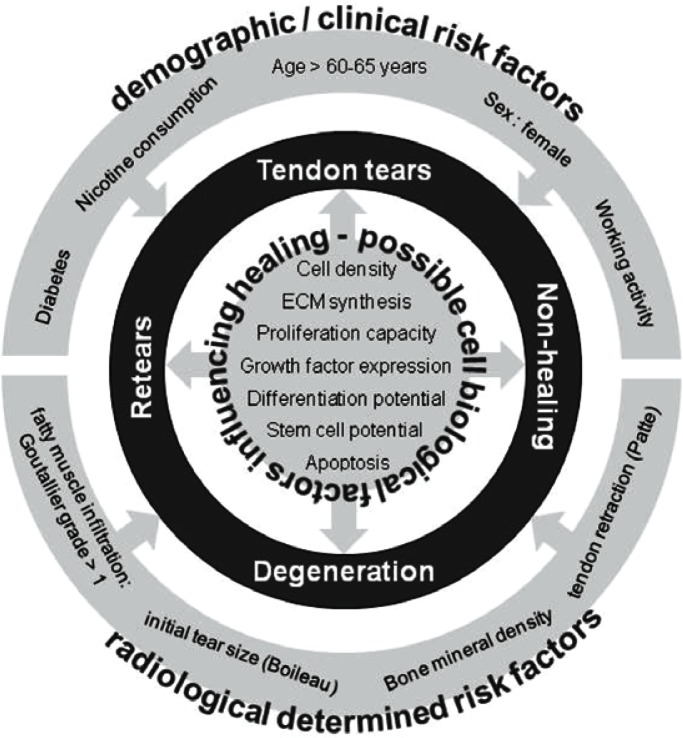
Tendon tears of the rotator cuff show a high prevalence in today's population. Patients suffer from permanent pain and disability, and surgical reconstruction may be the only possibility for abatement. The complex process of tendon-bone healing leads to mechanically inferior scar-tissue, which often results in retears or non-healing. In the current literature, factors such as patients age, sex and fatty muscle infiltration are highly correlated to the presence of rotator cuff tears and the incidence of retears. To improve the tendon tissue quality after surgical reconstructions biologically based strategies with use of growth factors arouse more and more interest in the last years. However, to optimize the treatment of rotator cuff tears the biological background of tears and retears must be investigated in more detail. This article will elucidate different aspects that have an impact on rotator cuff healing and give a brief insight in tendon/ligament cell culture and animal studies focusing on growth factor treatments.
Keywords: age; fatty infiltration; growth factors; rotator cuff rupture; sex; tenocytes.
Figures
References
-
- Yamaguchi K, Ditsios K, Middleton WD, Hildebolt CF, Galatz LM, Teefey SA. The demographic and morphological features of rotator cuff disease. A comparison of asymptomatic and symptomatic shoulders. J Bone Joint Surg Am. 2006;88(8):1699–1704. - PubMed
-
- Rodeo SA. Biologic augmentation of rotator cuff tendon repair. J Shoulder Elbow Surg. 2007;16(5 Suppl):S191–197. - PubMed
-
- Pauly S, Fiebig D, Kieser B, Albrecht B, Schill A, Scheibel M. Biomechanical comparison of four double-row speed-bridging rotator cuff repair techniques with or without me-dial or lateral row enhancement. Knee Surg Sports Traumatol Arthrosc. 2011;19(12):2090–2097. - PubMed
-
- Pauly S, Kieser B, Schill A, Gerhardt C, Scheibel M. Bio-mechanical comparison of 4 double-row suture-bridging rotator cuff repair techniques using different medial-row configurations. Arthroscopy. 2010;26(10):1281–1288. - PubMed
-
- Murray TF, Lajtai G, Mileski RM, Snyder SJ. Arthroscopic repair of medium to large full-thickness rotator cuff tears: outcome at 2- to 6-year follow-up. J Shoulder Elbow Surg. 2002;11(1):19–24. - PubMed
LinkOut - more resources
Full Text Sources