


Atrial fibrillation and cognitive decline: a longitudinal cohort study
- PMID: 23739229
- PMCID: PMC3770176
- DOI: 10.1212/WNL.0b013e31829a33d1
Atrial fibrillation and cognitive decline: a longitudinal cohort study
Abstract
Objective: We sought to determine whether in the absence of clinical stroke, people with atrial fibrillation experience faster cognitive decline than people without atrial fibrillation.
Methods: We conducted a longitudinal analysis in the Cardiovascular Health Study, a community-based study of 5,888 men and women aged 65 years and older, enrolled in 1989/1990 or 1992/1993. Participants did not have atrial fibrillation or a history of stroke at baseline. Participants were censored when they experienced incident clinical stroke. Incident atrial fibrillation was identified by hospital discharge diagnosis codes and annual study ECGs. The main outcome was rate of decline in mean scores on the 100-point Modified Mini-Mental State Examination (3MSE), administered annually up to 9 times.
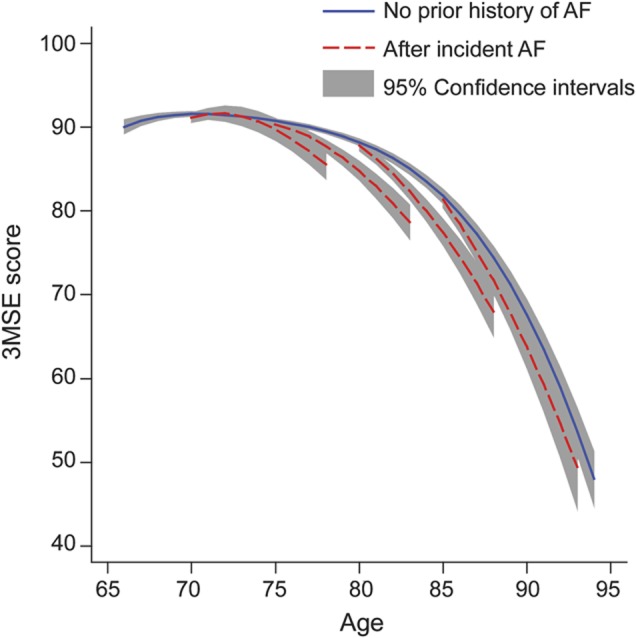
Results: Analyses included 5,150 participants, of whom 552 (10.7%) developed incident atrial fibrillation during a mean of 7 years of follow-up. Mean 3MSE scores declined faster after incident atrial fibrillation compared with no prior atrial fibrillation. For example, the predicted 5-year decline in mean 3MSE score from age 80 to age 85 was -6.4 points (95% confidence interval [CI]: -7.0, -5.9) for participants without a history of atrial fibrillation, but was -10.3 points (95% CI: -11.8, -8.9) for participants experiencing incident atrial fibrillation at age 80, a 5-year difference of -3.9 points (95% CI: -5.3, -2.5).
Conclusions: In the absence of clinical stroke, people with incident atrial fibrillation are likely to reach thresholds of cognitive impairment or dementia at earlier ages than people with no history of atrial fibrillation.
Figures
Comment in
-
Vorhofflimmern kann kognitiven Abbau fördern.MMW Fortschr Med. 2013 Nov 7;155(19):34. doi: 10.1007/s15006-013-2327-5. MMW Fortschr Med. 2013. PMID: 24475665 German. No abstract available.
References
-
- Kwok CS, Loke YK, Hale R, Potter JF, Myint PK. Atrial fibrillation and incidence of dementia: a systematic review and meta-analysis. Neurology 2011;76:914–922 - PubMed
-
- Elias MF, Sullivan LM, Elias PK, et al. Atrial fibrillation is associated with lower cognitive performance in the Framingham offspring men. J Stroke Cerebrovasc Dis 2006;15:214–222 - PubMed
-
- Jozwiak A, Guzik P, Mathew A, Wykretowicz A, Wysocki H. Association of atrial fibrillation and focal neurologic deficits with impaired cognitive function in hospitalized patients ≥65 years of age. Am J Cardiol 2006;98:1238–1241 - PubMed
Publication types
MeSH terms
Grants and funding
- N01HC55222/HC/NHLBI NIH HHS/United States
- N01HC85080/HC/NHLBI NIH HHS/United States
- K23AG028954/AG/NIA NIH HHS/United States
- T32HL007902/HL/NHLBI NIH HHS/United States
- N01HC85081/HC/NHLBI NIH HHS/United States
- N01HC85079/HC/NHLBI NIH HHS/United States
- N01HC85086/HC/NHLBI NIH HHS/United States
- HL102214/HL/NHLBI NIH HHS/United States
- N01HC85082/HC/NHLBI NIH HHS/United States
- HHSN268200800007C/PHS HHS/United States
- HHSN268201200036C/PHS HHS/United States
- HL080295/HL/NHLBI NIH HHS/United States
- N01HC85083/HC/NHLBI NIH HHS/United States
- AG023629/AG/NIA NIH HHS/United States
LinkOut - more resources
Full Text Sources
Other Literature Sources
Medical
