


The association between motor vehicle injuries and health-related quality of life: a longitudinal study of a population-based sample in the United States
- PMID: 23740168
- PMCID: PMC6546419
- DOI: 10.1007/s11136-013-0444-3
The association between motor vehicle injuries and health-related quality of life: a longitudinal study of a population-based sample in the United States
Abstract
Purpose: As many as 3 million US residents are injured in traffic-related incidents every year leaving many victims with disabling conditions. To date, limited numbers of studies have examined the effects of traffic-related injuries on self-reported health. This study aims to examine the association between health-related quality of life (HRQOL) and traffic-related injuries longitudinally in a nationally representative sample of US adult population.
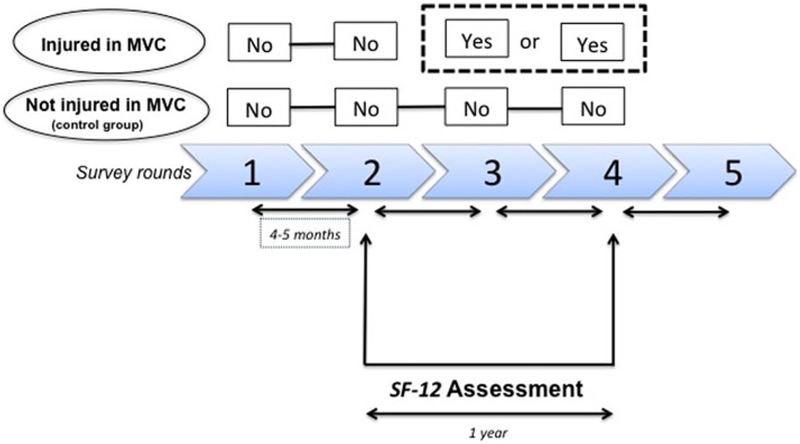
Methods/approach: This is a longitudinal study of adult participants (age ≥18) from seven panels (2000-2007) of the Medical Expenditure Panel Survey. The dependent variables included the physical and mental components of the SF-12, a measure of self-reported health. The outcome was assessed twice during the follow-up period: round 2 (~4-5 months into the study) and round 4 (~18 months into the study) for 62,298 individuals. Two methods estimate the association between traffic-related injuries and HRQOL: a within person change using paired tests and a between person change using multivariable regression adjusting for age, sex, income and educational level.
Results: Nine hundred and ninety-three participants reported traffic-related injuries during the follow-up period. Compared to their pre-crash HRQOL, these participants lost 2.7 of the physical component score while their mental component did not change. Adjusted results showed significant deficits in the physical component (-2.84, p value = <.001) but not the mental component (-0.07, p value = .83) of HRQOL after controlling for potential confounders.
Conclusion: Traffic injuries were significantly associated with the physical component of HRQOL. These findings highlight the individual and societal burden associated with motor vehicle crash-related disability in the United States.
Figures
References
-
- Road Safety Status; World Health Organization website. Accessed November 5 http://www.who.int/violence_injury_prevention/road_safety_status/2009/en....
-
- Murray CJ, Vos T, & Lozano RNM (2013). Global burden of disease. (Seatle, 2013) at http://www.healthmetricsandevaluation.org/gbd/visualizations/gbd-2010-ch....
-
- National Highway Traffic Safety Administration [NHTSA]. (2003). Motor vehicle traffic crash injury and fatality estimates: 2002 early assessment. (Report No. DOT HS 809 586). Washington, DC: U.S. Department of Transportation.
-
- Shults RA, Jones BH, Kresnow MJ, Langlois JA, & Guerrero JL (2004). Disability among adults injured in motor vehicle crashes in the United States. Journal of Safety Research, 35(4), 447–452. - PubMed
-
- Fu AZ, Qiu Y, Radican L, & Luo N (2011). Marginal differences in health-related quality of life of diabetic patients with and without macrovascular comorbid conditions in the United States. Quality of Life Research, 20(6), 825–832. - PubMed
MeSH terms
Grants and funding
LinkOut - more resources
Full Text Sources
Other Literature Sources
Medical
Research Materials
