


Evaluation of the RABBIT Risk Score for serious infections
- PMID: 23740236
- PMCID: PMC4145466
- DOI: 10.1136/annrheumdis-2013-203341
Evaluation of the RABBIT Risk Score for serious infections
Abstract
Objective: To evaluate the Rheumatoid Arthritis Observation of Biologic Therapy (RABBIT) Risk Score for serious infections in patients with rheumatoid arthritis (RA).
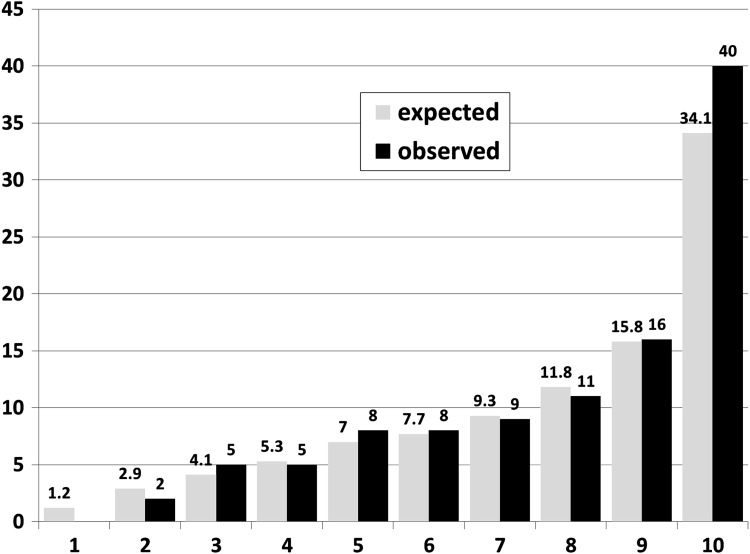
Methods: The RABBIT Risk Score for serious infections was developed in 2011 on a cohort of RA patients enrolled in the German biologics register RABBIT between 2001 and 2007. To evaluate this score, we used data from patients enrolled in RABBIT after 1 January 2009. Expected numbers of serious infections and expected numbers of patients with at least one serious infection per year were calculated by means of the RABBIT Risk Score and compared with observed numbers in the evaluation sample.
Results: The evaluation of the score in an independent cohort of 1522 RA patients treated with tumour necrosis factor α (TNFα) inhibitors and 1468 patients treated with non-biological disease-modifying antirheumatic drugs (DMARDs) showed excellent agreement between observed and expected rates of serious infections. For patients exposed to TNF inhibitors, expected as well as observed numbers of serious infections were 3.0 per 100 patient-years (PY). For patients on non-biological DMARDs the expected and observed numbers were 1.5/100 PY and 1.8/100 PY, respectively. The score was highly predictive in groups of patients with low as well as with high infection risk.
Conclusions: The RABBIT Risk Score is a reliable instrument which determines the risk of serious infection in individual patients based on clinical and treatment information. It helps the rheumatologist to balance benefits and risks of treatment, to avoid high-risk treatment combinations and thus to make informed clinical decisions.
Keywords: Anti-TNF; Infections; Rheumatoid Arthritis.
Published by the BMJ Publishing Group Limited. For permission to use (where not already granted under a licence) please go to http://group.bmj.com/group/rights-licensing/permissions.
Figures
References
-
- Martin-Mola E, Balsa A. Infectious complications of biologic agents. Rheum Dis Clin North Am 2009;35:183–99 - PubMed
-
- Bongartz T, Sutton AJ, Sweeting MJ, et al. Anti-TNF antibody therapy in rheumatoid arthritis and the risk of serious infections and malignancies: systematic review and meta-analysis of rare harmful effects in randomized controlled trials. JAMA 2006;295:2275–85 - PubMed
-
- Leombruno JP, Einarson TR, Keystone EC. The safety of anti-tumour necrosis factor treatments in rheumatoid arthritis: meta and exposure-adjusted pooled analyses of serious adverse events. Ann Rheum Dis 2009;68:1136–45 - PubMed
-
- Galloway JB, Hyrich KL, Mercer LK, et al. Anti-TNF therapy is associated with an increased risk of serious infections in patients with rheumatoid arthritis especially in the first 6 months of treatment: updated results from the British Society for Rheumatology Biologics Register with special emphasis on risks in the elderly. Rheumatology (Oxford) 2010;50:124–31 - PMC - PubMed
Publication types
MeSH terms
Substances
LinkOut - more resources
Full Text Sources
Other Literature Sources
Medical
