Comparative Study
. 2013 Jun 5;280(1763):20130593.
doi: 10.1098/rspb.2013.0593. Print 2013 Jul 22.

Clocks for the city: circadian differences between forest and city songbirds

Affiliations
Comparative Study

Clocks for the city: circadian differences between forest and city songbirds

D M Dominoni et al. Proc Biol Sci. .

Abstract

To keep pace with progressing urbanization organisms must cope with extensive habitat change. Anthropogenic light and noise have modified differences between day and night, and may thereby interfere with circadian clocks. Urbanized species, such as birds, are known to advance their activity to early morning and night hours. We hypothesized that such modified activity patterns are reflected by properties of the endogenous circadian clock. Using automatic radio-telemetry, we tested this idea by comparing activity patterns of free-living forest and city European blackbirds (Turdus merula). We then recaptured the same individuals and recorded their activity under constant conditions. City birds started their activity earlier and had faster but less robust circadian oscillation of locomotor activity than forest conspecifics. Circadian period length predicted start of activity in the field, and this relationship was mainly explained by fast-paced and early-rising city birds. Although based on only two populations, our findings point to links between city life, chronotype and circadian phenotype in songbirds, and potentially in other organisms that colonize urban habitats, and highlight that urban environments can significantly modify biologically important rhythms in wild organisms.

Keywords: birds; chronotype; circadian rhythms; light at night; radio-telemetry; urbanization.


Figures
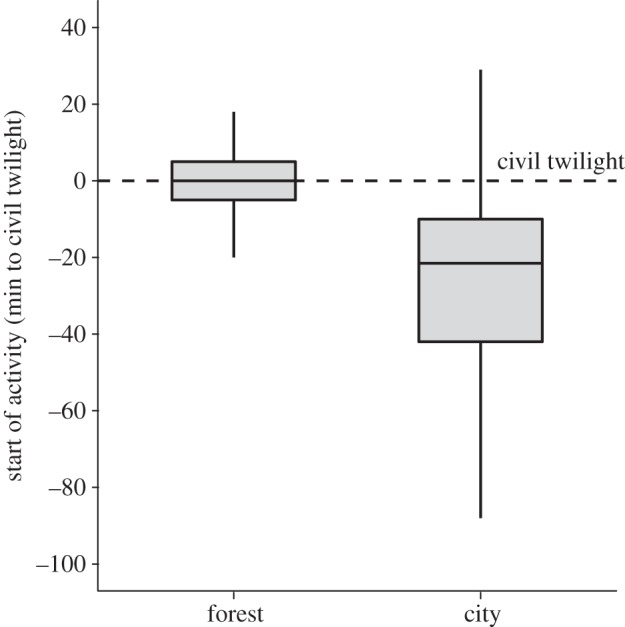
Figure 1.
Figure 1.
Differences in daily start of activity between forest and city European blackbirds in the wild. Daily activity was continuously recorded on free-living forest (n = 6) and city (n = 6) birds by an automated telemetry system. Start of activity was standardized to the onset of civil twilight (dashed horizontal line) to correct for daily changes in photoperiod. Values indicate minutes before (negative values) or after (positive values) the morning onset of civil twilight. Box plots represent, from bottom to top: one standard deviation (s.d.) below the mean, lower quartile, median, upper quartile and one s.d. above the mean.
Figure 2.
Figure 2.
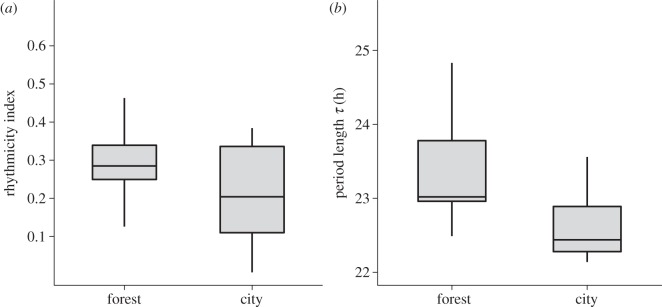
Differences in rhythmicity index and circadian period length between forest and city blackbirds. Forest (n = 14) and city (n = 14) birds were held in constant dim light of 0.3 lux and their activity was continuously recorded for at least a week (10 ± 2 days). From these recordings, we estimated (a) robustness of the rhythmicity and (b) period length τ. Since five city birds showed a statistically non-significant rhythmicity index, they were excluded from the analysis of period length. For box plot specification see figure 1.
Figure 3.
Figure 3.
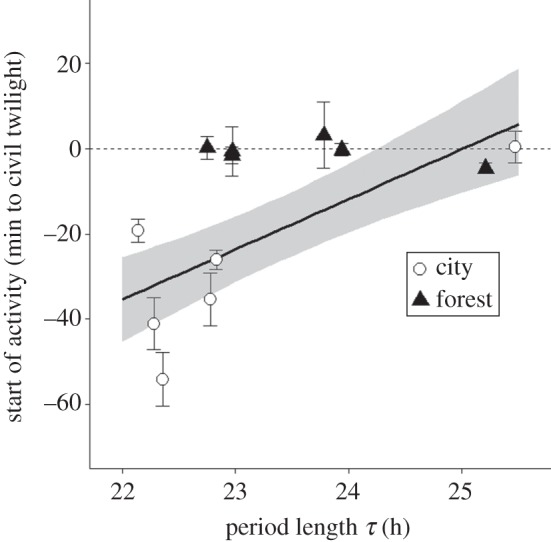
Relationship between τ and chronotype. Circadian period length predicted the time of start of morning activity in the field, relative to morning twilight. Most of the relationship is explained by city birds (white dots, n = 6), while forest birds (black triangles, n = 6) seem to be closely synchronized with dawn. Values indicate minutes before (negative values) or after (positive values) the onset of morning civil twilight (dashed horizontal line). Error bars represent mean of raw data ± s.e.m. for each individual.
Figure 4.
Figure 4.
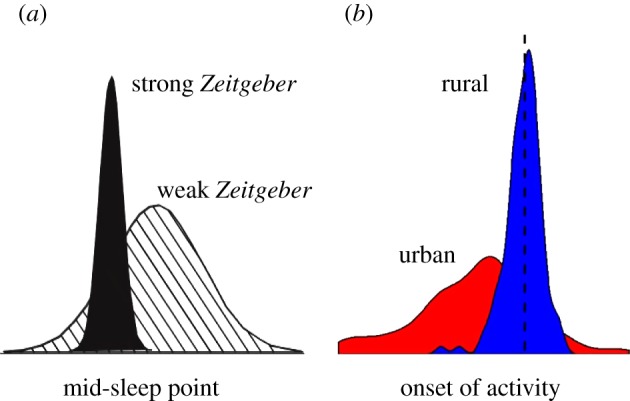
Chronotype distribution in (a) humans and (b) European blackbirds in relation to Zeitgeber strength and city or forest environmental conditions. (a) Analysis of empirical data from human beings and application of classical oscillator theory led Roenneberg et al. [12] to postulate that chronotype distribution should depend on the Zeitgeber conditions a population experiences. Under strong Zeitgebers chronotypes should be less variable and more closely synchronized than chronotypes under weak Zeitgebers (graph adapted from original manuscript). x-axis shows time of mid sleep point, y-axis shows the relative frequency of chronotype. (b) Chronotype distributions for free-roaming city and forest blackbirds based on recordings by an automated telemetry system resemble those theorized by Roenneberg et al. [12]. City birds showed much higher variation and a lower peak in frequency of timing of start of activity than forest birds, which in turn appeared to be highly synchronized to the onset of morning twilight (dashed vertical line). x-axis shows time of start of activity, y-axis shows relative frequency of chronotype. (Online version in colour.)

References

    1. Grimm NB, Faeth SH, Golubiewski NE, Redman CL, Wu J, Bai X, Briggs JM. 2008. Global change and the ecology of cities. Science 319, 756–760.10.1126/science.1150195 (doi:10.1126/science.1150195) - DOI - DOI - PubMed
    1. Shochat E, Warren PS, Faeth SH, McIntyre NE, Hope D. 2006. From patterns to emerging processes in mechanistic urban ecology. Trends Ecol. Evol. 21, 186–191.10.1016/j.tree.2005.11.019 (doi:10.1016/j.tree.2005.11.019) - DOI - DOI - PubMed
    1. Longcore T, Rich C. 2006. Ecological consequences of artificial night lighting. Washington, DC: Island Press.
    1. Kempenaers B, Borgström P, Loës P, Schlicht E, Valcu M. 2010. Artificial night lighting affects dawn song, extra-pair siring success, and lay date in songbirds. Curr. Biol. 20, 1735–1739.10.1016/j.cub.2010.08.028 (doi:10.1016/j.cub.2010.08.028) - DOI - DOI - PubMed
    1. Rotics S, Dayan T, Kronfeld-Schor N. 2011. Effect of artificial night lighting on temporally partitioned spiny mice. J. Mammol. 92, 159–168.10.1644/10-MAMM-A-112.1 (doi:10.1644/10-MAMM-A-112.1) - DOI - DOI

Publication types

LinkOut - more resources