


High prevalence of HIV-1 intersubtype B'/C recombinants among injecting drug users in Dehong, China
- PMID: 23741489
- PMCID: PMC3669332
- DOI: 10.1371/journal.pone.0065337
High prevalence of HIV-1 intersubtype B'/C recombinants among injecting drug users in Dehong, China
Abstract
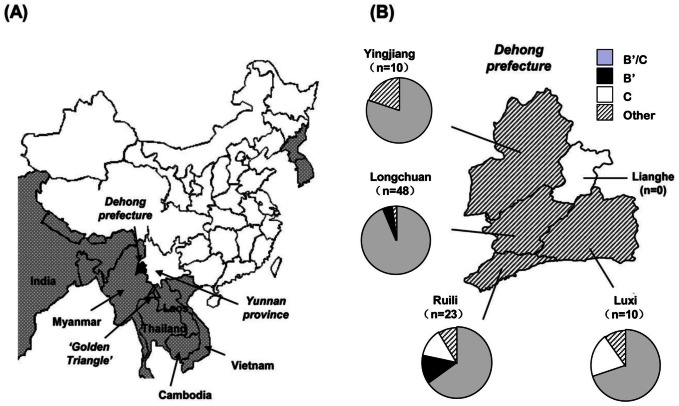
Objective: To examine the distribution of HIV-1 genotypes among injecting drug users (IDUs) from Dehong, Yunnan province.
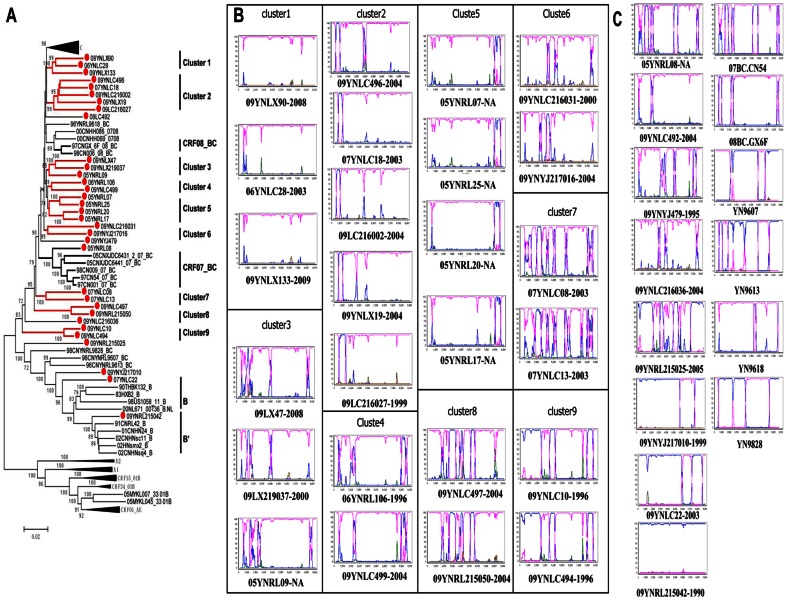
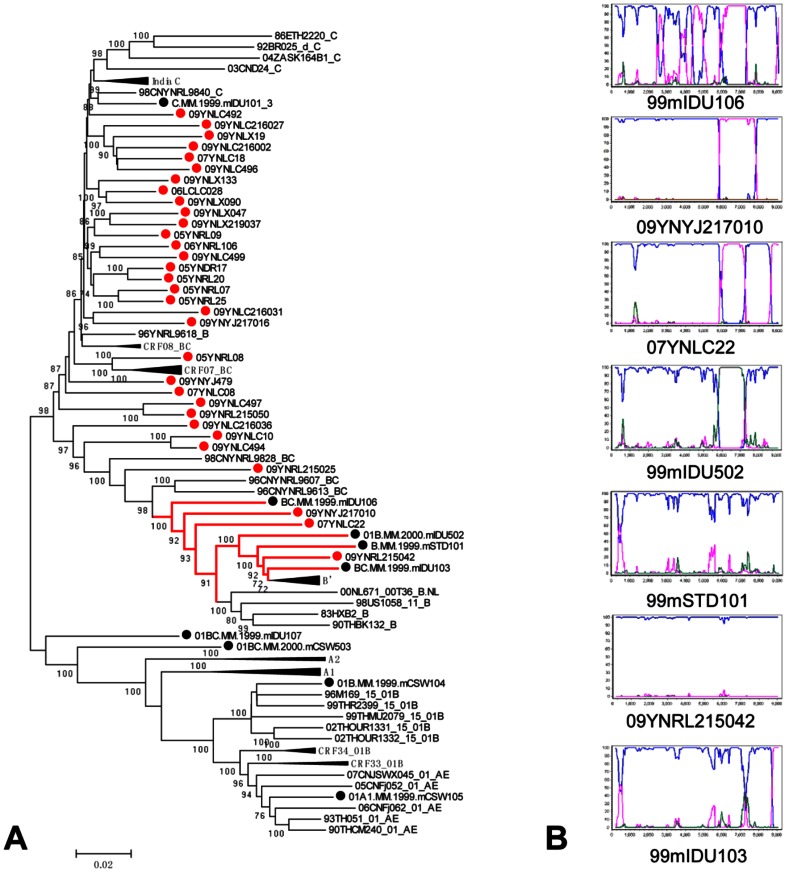
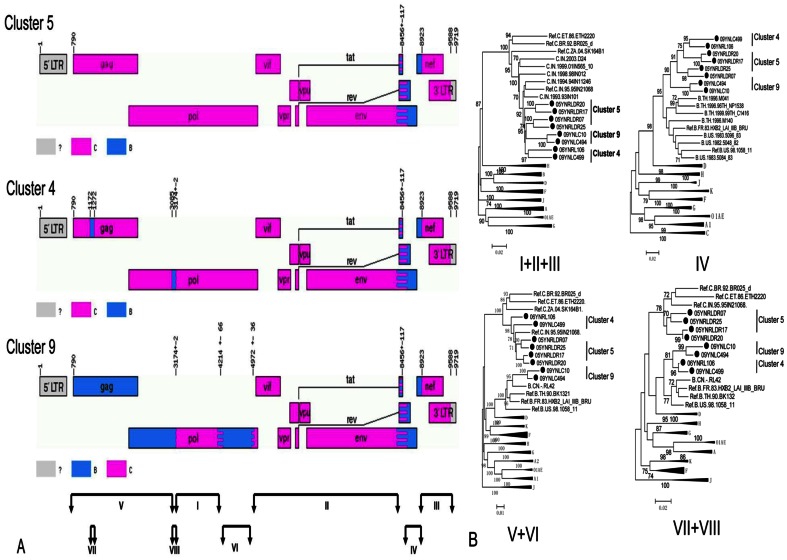
Materials and methods: Blood samples from a total of 95 HIV-positive IDUs were retrospectively analyzed. Samples were collected between 2005 and 2009 from four cities in Dehong prefecture, western Yunnan province, the geographical origin of the HIV epidemic in China. HIV-1 gag, partial pol, vpr-env fragment, half-genome, or near-full-length sequences were analyzed to determine the HIV-1 genotypes of each subject. Results were compared with findings from past studies of IDUs in Dehong and in neighboring Myanmar.
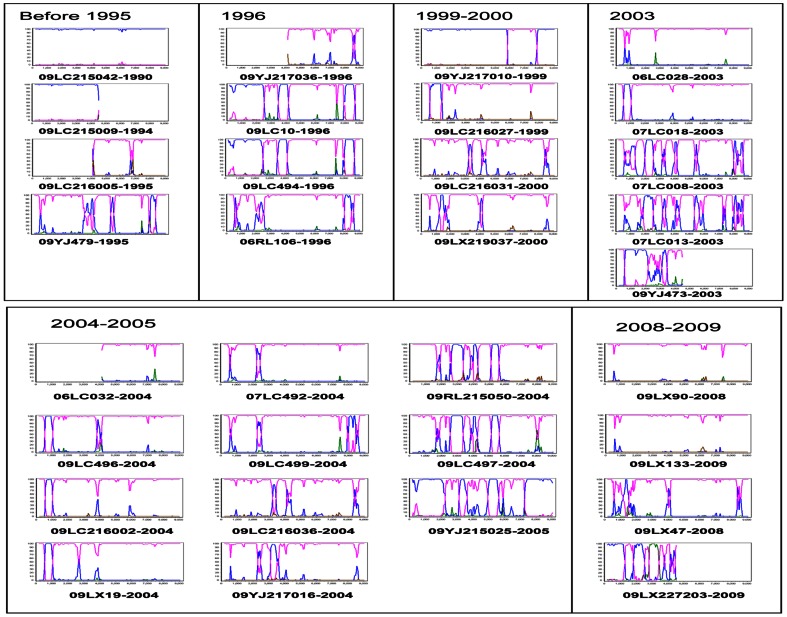
Results: We observed a high prevalence of B'/C recombinants (82.4%) among IDUs in Dehong, the structural profiles of which do not match those previously reported in Dehong or in Myanmar. Furthermore, statistically significant differences in geographical and temporal distributions of HIV-1 genotypes were characterized by a predominance of HIV-1 B'/C recombinant forms among older subjects(p = 0.034), subjects from Longchuan district (p = 0.022), and subjects diagnosed between 2000 and 2004 (p = 0.004).
Conclusions: The increasing prevalence of multiple, new B'/C recombinant forms suggest that HIV-1 intersubtype recombination is substantial and ongoing in western Yunnan. This reflects the high-risk behavior of IDUs in this region and argues the need for stronger monitoring and prevention measures in Dehong and other high-prevalence areas around China.
Conflict of interest statement
Figures
References
-
- Ma Y, Li Z, Zhang K, Yang W, Ren X, et al. (1990) [HIV infections detected in drug users for the first time in our country]. Chinese Journal of Epidemiology 11: 184–185.
-
- Zhang J, Cheng H, Zhano S, Yang W, Ma Y, et al. (1991) [Epidemiological survey on HIV infected cases in Ruili, Yunnan]. Chinese Journal of Epidemiology 12: 9.
-
- Zheng X, Zhu L, G Y, Zhang G (1989) [China AIDS monitoring reports(1985–1989)]. Chinese Journal of Epidemiology 10: 65.
-
- Y S, Zeng Y, Chen Z, Zhao S, Ma Y, et al. (1991) [Isolation of viruses from HIV infected individuals in Yunnan]. Chinese Journal of Epidemiology 12: 129–135.
-
- X Z, C T, Yang G, Xia M, Zhu L, et al. (1991) [A preliminary study on the behavior of 225 drug abusers and the risk factors of HIV infection in Ruili county Yunnan Province]. Zhonghua Liu Xing Bing Xue Za Zhi 12: 12–14. - PubMed
Publication types
MeSH terms
Substances
Associated data
- Actions
- Actions
- Actions
- Actions
- Actions
- Actions
- Actions
- Actions
- Actions
- Actions
- Actions
- Actions
- Actions
- Actions
- Actions
- Actions
- Actions
- Actions
- Actions
- Actions
- Actions
- Actions
- Actions
- Actions
- Actions
- Actions
- Actions
- Actions
- Actions
- Actions
- Actions
- Actions
- Actions
- Actions
- Actions
- Actions
- Actions
- Actions
- Actions
- Actions
- Actions
- Actions
- Actions
- Actions
- Actions
- Actions
- Actions
- Actions
- Actions
- Actions
- Actions
- Actions
- Actions
- Actions
- Actions
- Actions
- Actions
- Actions
- Actions
- Actions
- Actions
- Actions
- Actions
- Actions
- Actions
- Actions
- Actions
- Actions
- Actions
- Actions
- Actions
- Actions
- Actions
- Actions
- Actions
- Actions
- Actions
- Actions
- Actions
- Actions
- Actions
- Actions
- Actions
- Actions
- Actions
- Actions
- Actions
- Actions
- Actions
- Actions
- Actions
- Actions
- Actions
- Actions
- Actions
- Actions
- Actions
- Actions
- Actions
- Actions
- Actions
- Actions
- Actions
- Actions
- Actions
- Actions
- Actions
- Actions
- Actions
- Actions
- Actions
- Actions
- Actions
- Actions
- Actions
- Actions
- Actions
- Actions
- Actions
- Actions
- Actions
- Actions
- Actions
- Actions
- Actions
- Actions
- Actions
- Actions
- Actions
- Actions
- Actions
- Actions
- Actions
- Actions
- Actions
- Actions
- Actions
- Actions
- Actions
- Actions
- Actions
- Actions
- Actions
- Actions
- Actions
- Actions
- Actions
- Actions
- Actions
- Actions
- Actions
- Actions
- Actions
- Actions
- Actions
- Actions
- Actions
- Actions
- Actions
- Actions
- Actions
- Actions
- Actions
- Actions
- Actions
- Actions
- Actions
- Actions
- Actions
- Actions
- Actions
- Actions
- Actions
- Actions
- Actions
- Actions
- Actions
- Actions
- Actions
- Actions
- Actions
- Actions
- Actions
- Actions
- Actions
- Actions
- Actions
- Actions
- Actions
- Actions
- Actions
- Actions
- Actions
- Actions
- Actions
- Actions
- Actions
- Actions
- Actions
- Actions
- Actions
- Actions
- Actions
- Actions
- Actions
- Actions
- Actions
- Actions
- Actions
- Actions
- Actions
- Actions
- Actions
- Actions
- Actions
- Actions
- Actions
- Actions
- Actions
- Actions
- Actions
- Actions
- Actions
- Actions
- Actions
- Actions
- Actions
- Actions
LinkOut - more resources
Full Text Sources
Other Literature Sources
Medical
Molecular Biology Databases
Miscellaneous
