


Mesoporous bioactive glasses: structure characteristics, drug/growth factor delivery and bone regeneration application
- PMID: 23741607
- PMCID: PMC3363021
- DOI: 10.1098/rsfs.2011.0121
Mesoporous bioactive glasses: structure characteristics, drug/growth factor delivery and bone regeneration application
Abstract
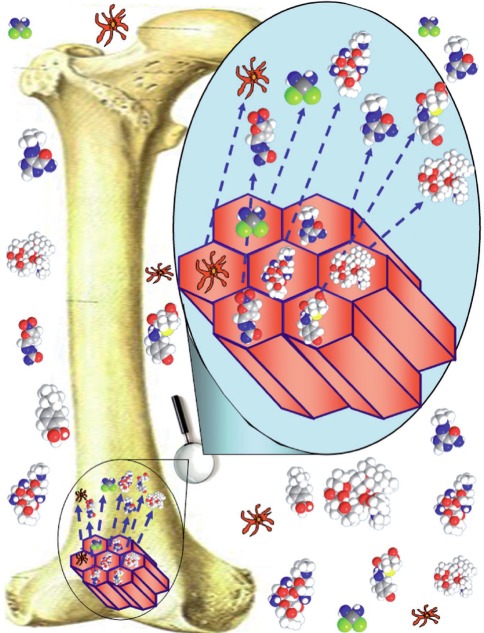
The impact of bone diseases and trauma in the whole world has increased significantly in the past decades. Bioactive glasses are regarded as an important bone regeneration material owing to their generally excellent osteoconductivity and osteostimulativity. A new class of bioactive glass, referred to as mesoporous bioglass (MBG), was developed 7 years ago, which possess a highly ordered mesoporous channel structure and a highly specific surface area. The study of MBG for drug/growth factor delivery and bone tissue engineering has grown significantly in the past several years. In this article, we review the recent advances of MBG materials, including the preparation of different forms of MBG, composition-structure relationship, efficient drug/growth factor delivery and bone tissue engineering application. By summarizing our recent research, the interaction of MBG scaffolds with bone-forming cells, the effect of drug/growth factor delivery on proliferation and differentiation of tissue cells and the in vivo osteogenesis of MBG scaffolds are highlighted. The advantages and limitations of MBG for drug delivery and bone tissue engineering have been compared with microsize bioactive glasses and nanosize bioactive glasses. The future perspective of MBG is discussed for bone regeneration application by combining drug delivery with bone tissue engineering and investigating the in vivo osteogenesis mechanism in large animal models.
Keywords: bioactivity; bone tissue engineering; drug/growth factor delivery; mesoporous bioglass scaffolds; osteogenesis.
Figures
References
-
- Misra S. K., et al. 2010. Effect of nanoparticulate bioactive glass particles on bioactivity and cytocompatibility of poly(3-hydroxybutyrate) composites. J. R. Soc. Interface 7, 453–465 10.1098/rsif.2009.0255 (doi:10.1098/rsif.2009.0255) - DOI - PMC - PubMed
-
- Hench L. L., Thompson I. 2010. Twenty-first century challenges for biomaterials. J. R. Soc. Interface 7(Suppl 4), S379–S391 10.1098/rsif.2010.0151.focus (doi:10.1098/rsif.2010.0151.focus) - DOI - PMC - PubMed
-
- Chen Q. Z., Thompson I. D., Boccaccini A. R. 2006. 45S5 Bioglass-derived glass–ceramic scaffolds for bone tissue engineering. Biomaterials 27, 2414–2425 10.1016/j.biomaterials.2005.11.025 (doi:10.1016/j.biomaterials.2005.11.025) - DOI - PubMed
-
- Jones J. R., Tsigkou O., Coates E. E., Stevens M. M., Polak J. M., Hench L. L. 2007. Extracellular matrix formation and mineralization on a phosphate-free porous bioactive glass scaffold using primary human osteoblast (HOB) cells. Biomaterials 28, 1653–1663 10.1016/j.biomaterials.2006.11.022 (doi:10.1016/j.biomaterials.2006.11.022) - DOI - PubMed
-
- Jones J. R., Ehrenfried L. M., Hench L. L. 2006. Optimising bioactive glass scaffolds for bone tissue engineering. Biomaterials 27, 964–973 10.1016/j.biomaterials.2005.07.017 (doi:10.1016/j.biomaterials.2005.07.017) - DOI - PubMed
LinkOut - more resources
Full Text Sources
Miscellaneous