


Comment
doi: 10.7554/eLife.00895.
Less translational control, more memory
Affiliations
- PMID: 23741622
- PMCID: PMC3667575
- DOI: 10.7554/eLife.00895
Item in Clipboard
Comment
Less translational control, more memory
Elife.
.
Abstract
A small molecule can enhance the memories of rats and mice by blocking the integrated stress response in these animals.
Keywords: ATF4; Human; Mouse; Rat; eIF2; eIF2B; integrated stress response; memory consolidation; unfolded protein response.
Conflict of interest statement
Figures
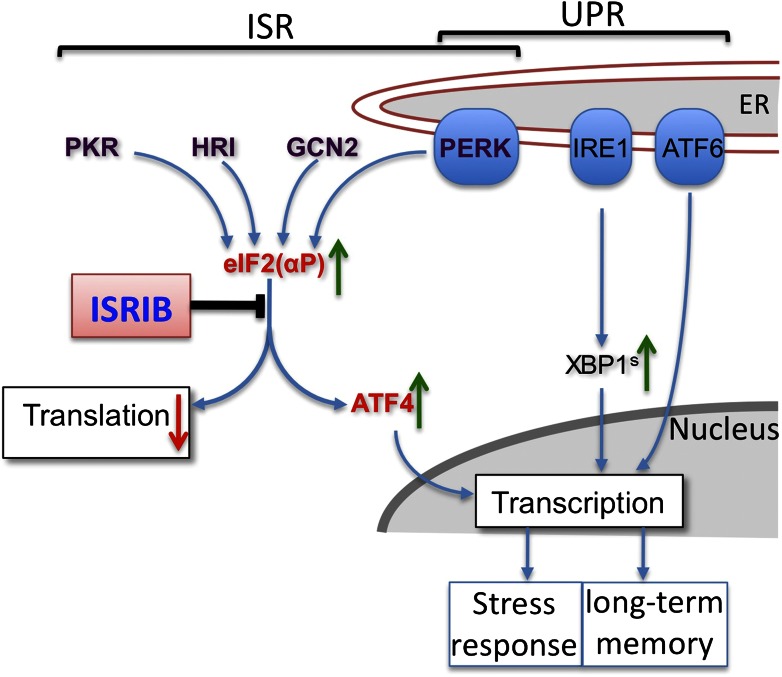
Cells respond to stress through the unfolded protein response (UPR; right)—which is caused by high levels of unfolded or misfolded proteins—and the integrated stress response (ISR; left)—which has multiple activators. ISRIB is a small molecule that acts at the intersection of these two responses. UPR stress sensors (blue ovals) localized at the endoplasmic reticulum (ER) and ISR kinases (purple text) receive stress signals (not shown) and relay these (blue arrows) to the cytoplasm and nucleus to reduce the expression of genes. The PERK pathway is involved in both responses; the signal from IRE1 is relayed via a protein called XBP1. ISRIB acts downstream of the phosphorylation of eIF2 (eIF2(αP)) and upstream of the activation of ATF4 (green arrow) and the repression of bulk protein synthesis (red down arrow). Sidrauski et al. show that ISRIB also enhances memory in rats and mice.
Comment on
-
Pharmacological brake-release of mRNA translation enhances cognitive memory.Elife. 2013 May 28;2:e00498. doi: 10.7554/eLife.00498. Elife. 2013. PMID: 23741617 Free PMC article.
References
-
- Axten JM, Medina JR, Feng Y, Shu A, Romeril SP, Grant SW, et al. 2012. Discovery of 7-methyl-5-(1-{[3-(trifluoromethyl)phenyl]acetyl}-2,3-dihydro-1H-indol-5-yl)-7H-pyrrolo[2,3-d]pyrimidin-4-amine (GSK2606414), a potent and selective first-in-class inhibitor of protein kinase R (PKR)-like endoplasmic reticulum kinase (PERK). J Med Chem 55:7193–207 doi: 10.1021/jm300713s - DOI - PubMed
Publication types
MeSH terms
Substances
LinkOut - more resources
Full Text Sources
Other Literature Sources
Medical
