. 2013 Oct;49(4):680-7.
doi: 10.1165/rcmb.2013-0002OC.

Ephrin-B2 reverse signaling increases α5β1 integrin-mediated fibronectin deposition and reduces distal lung compliance

Affiliations

Ephrin-B2 reverse signaling increases α5β1 integrin-mediated fibronectin deposition and reduces distal lung compliance

Katherine M Bennett et al. Am J Respir Cell Mol Biol. 2013 Oct.

Abstract

Alveolar growth abnormalities and severe respiratory dysfunction are often fatal. Identifying mechanisms that control epithelial proliferation and enlarged, poorly septated airspaces is essential in developing new therapies for lung disease. The membrane-bound ligand ephrin-B2 is strongly expressed in lung epithelium, and yet in contrast to its known requirement for arteriogenesis, considerably less is known regarding the function of this protein in the epithelium. We hypothesize that the vascular mediator ephrin-B2 governs alveolar growth and mechanics beyond the confines of the endothelium. We used the in vivo manipulation of ephrin-B2 reverse signaling to determine the role of this vascular mediator in the pulmonary epithelium and distal lung mechanics. We determined that the ephrin-B2 gene (EfnB2) is strongly expressed in alveolar Type 2 cells throughout development and into adulthood. The role of ephrin-B2 reverse signaling in the lung was assessed in Efnb2(LacZ/6YFΔV) mutants that coexpress the intracellular truncated ephrin-B2-β-galactosidase fusion and an intracellular point mutant ephrin-B2 protein that is unable to become tyrosine-phosphorylated or to interact with either the SH2 or PDZ domain-containing downstream signaling proteins. In these viable mice, we observed pulmonary hypoplasia and altered pulmonary mechanics, as evidenced by a marked reduction in lung compliance. Associated with the reduction in lung compliance was a significant increase in insoluble fibronectin (FN) basement membrane matrix assembly with FN deposition, and a corresponding increase in the α5 integrin receptor required for FN fibrillogenesis. These experiments indicate that ephrin-B2 reverse signaling mediates distal alveolar formation, fibrillogenesis, and pulmonary compliance.


Figures

<i>Figure 1.</i>
Figure 1.
Ephrin-B2 (EfnB2) is strongly expressed in the distal alveolar region throughout development and during adulthood. Fetal lungs were isolated from timed pregnant wild-type (WT; +/+) and Efnb2LacZ/+ transgenic mice. The analysis of sections from different time points in lung development indicated that Efnb2 is expressed throughout lung development in distal epithelial regions on embryological (E) Day 11.5 in whole-mount (B) and paraffin-embedded (D) sections, and was maintained throughout development, as seen on representative Days E13.5 and E15.5 (F and H; arrows denote epithelial regions, and asterisks denote vascular regions), in contrast to littermate WT control mice (A, C, E, and G). The distal alveolar expression of EfnB2 was maintained into adulthood (8 wk), when distal lung tissue demonstrated striking regional Efnb2–LacZ expression in collapsed (J and L) and inflation-fixed (N and P) lungs, compared with WT (I, K, M, and O) littermates. Magnification, A and B, scale bar = 250 μm; C–H, scale bar = 50 μm; I, J, M, and N, scale bar = 100 μm.
<i>Figure 2.</i>
Figure 2.
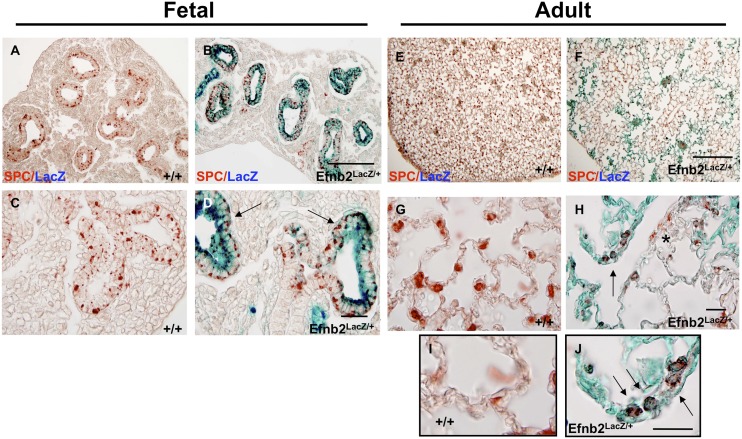
Alveolar Type II cell surfactant protein C (SPC) colocalizes with EfnB2 in the fetal and adult lung. Colocalization of β-galactosidase (β-gal) with the Type II alveolar cell marker surfactant protein C (immunohistochemistry, red AEC staining) in EfnB2LacZ/+ mice confirms fetal epithelial cell Efnb2 expression (B and D, arrows indicate SPC/β-gal–positive cells), which was maintained into adulthood in some regions (F, H, and J, arrows, but not all SPC-positive cells are β-gal–positive, because SPC-positive cells occur with β-gal staining, as indicated by the asterisk in H), compared with littermate WT control mice (A, C, E, G, and I). Magnification in A and B, scale bar = 50 μm; in C and D, scale bar = 20 μm; in E and F, scale bar = 50 μm; in G and H, scale bar = 20 μm; and in I and J, scale bar = 20 μm.
<i>Figure 3.</i>
Figure 3.
EfnB2 does not colocalize with α–smooth muscle actin (α-SMA) in the lung. Colocalization using β-gal and the smooth muscle marker α-SMA suggests that within the fetal lung (Day E13.5, A–D) or adult lung (age 8 wk, E–G), EfnB2 is not expressed in smooth muscle cells. Magnification in A, B, E, and F, scale bar = 50 μm; and in C, D, F, and G, scale bar = 20 μm.
<i>Figure 4.</i>
Figure 4.
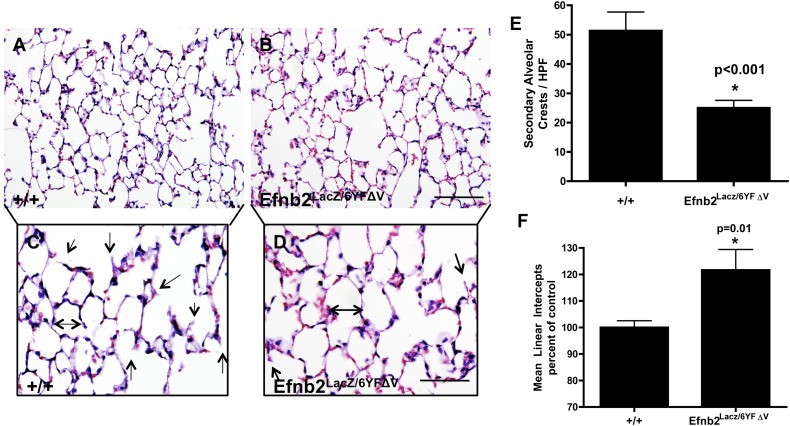
Alterations of EfnB2 reverse signaling disrupted distal lung morphometry. Hematoxylin-and-eosin–stained sections from EfnB2LacZ/6YFΔV adult inflation-fixed lungs (at age 8 wk) indicated that alterations of reverse Efnb2 signaling exhibited a significant (P < 0.001) reduction in secondary alveolar crests at age 8 weeks (B and D, arrows identify alveolar crests) compared with wild-type control mice (A and C, arrows identify alveolar crests; see also E). Furthermore, the mean linear intercept was significantly (P = 0.01) increased at age 8 weeks in EfnB2LacZ/6YFΔV mice (B and D, double-headed arrow; see also F), consistent with alveolar hypoplasia, compared with WT control mice (A and C, double-headed arrow; see also F). An asterisk denotes that statistical significance was reached. Magnification in A and B, scale bar = 50 μm; and in C and D, scale bar = 25 μm.
<i>Figure 5.</i>
Figure 5.
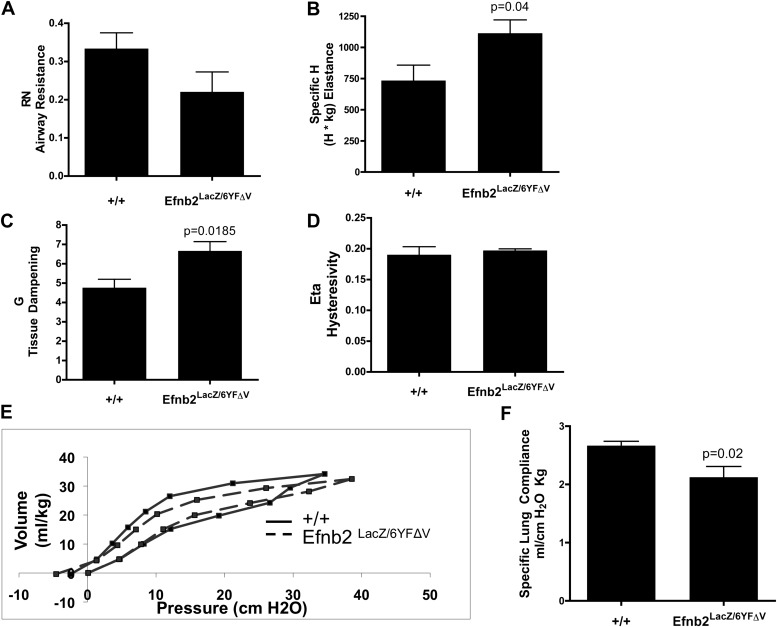
Altered EfnB2 reverse signaling significantly affects lung mechanics. Pulmonary function tests determined that 8-week-old mice with disrupted reverse Efnb2 signaling exhibited a significant increase in elastance (B, P = 0.04) and tissue damping (C, P = 0.0185). Consistent with these findings, a marked decrease in lung compliance (F, P = 0.02) was evident, with a shift down and to the right, and diminished hysteresis of the volume–pressure loops (E, dotted lines) in Efnb2LacZ/6YFΔV mice compared with WT littermates (E, solid lines), consistent with lungs that demonstrate increased resistance. Airway resistance (A), tissue damping (C), and hysteresivity (D) were similar between the groups.
<i>Figure 6.</i>
Figure 6.
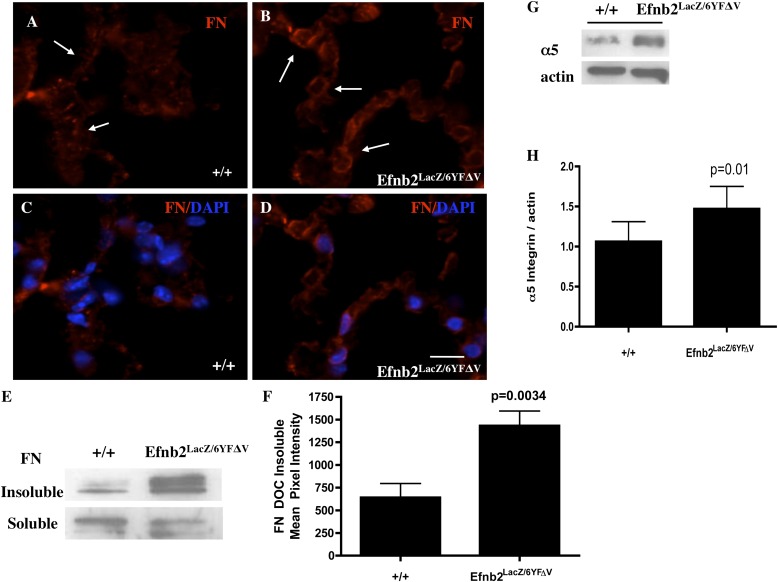
Ephrin-B2 reverse signaling mediates distal lung fibrillar fibronectin (FN) deposition. Insoluble fibrillar FN expression was markedly increased in immunofluorescent analyses of distal alveoli cell–cell junctions (in B and D, arrows identify the insoluble fibrillar FN that is laid down as strands of FN; Cy3 was the secondary antibody, and 4′6-diamidino-2-phenylindole [DAPI] denotes a nucleus) and immunoblotting (E and F, equal protein loading, and soluble Fn serves as loading control) in 8-week-old Efnb2LacZ/6YFΔV mice compared with WT mice (A, arrows demonstrate minimal fibrillar FN; C, immunofluorescence; E and F, Western Blot analysis). In addition, α5 integrin expression was markedly increased (G and H, P = 0.01) in Efnb2LacZ/6YFΔV mice, compared with WT control mice (G and H). Magnification in A–D, scale bar = 20 μm.

References

    1. Schwarz M, Cleaver O.Development of the pulmonary endothelium in development of the pulmonary circulation: vasculogenesis and angiogenesisVoelkel NF, Rounds S, editors. The pulmonary endothelium Chichester, United Kingdom: John Wiley and Sons, Ltd; 2009. pp. 3–24.
    1. Chen Y, Legan SK, Mahan A, Thornton J, Xu H, Schwarz MA. Endothelial monocyte activating polypeptide II disrupts alveolar epithelial Type II to Type I cell transdifferentiation. Respir Res. 2012;13:1. - PMC - PubMed
    1. Schwarz MA, Wan Z, Liu J, Lee MK. Epithelial–mesenchymal interactions are linked to neovascularization. Am J Respir Cell Mol Biol. 2004;30:784–792. - PubMed
    1. Schwarz MA, Zhang F, Gebb S, Starnes V, Warburton D. EMAP II inhibits lung neovascularization and airway epithelial morphogenesis. Mech Dev. 2000;95:123–132. - PubMed
    1. Schwarz MA, Zheng H, Legan S, Foty RA. Lung self-assembly is modulated by tissue surface tensions. Am J Respir Cell Mol Biol. 2011;44:682–691. - PMC - PubMed

Publication types

MeSH terms

Supplementary concepts

LinkOut - more resources