


An electrochemiluminescence assay for analysis of rabies virus glycoprotein content in rabies vaccines
- PMID: 23742991
- PMCID: PMC4568986
- DOI: 10.1016/j.vaccine.2013.05.081
An electrochemiluminescence assay for analysis of rabies virus glycoprotein content in rabies vaccines
Abstract
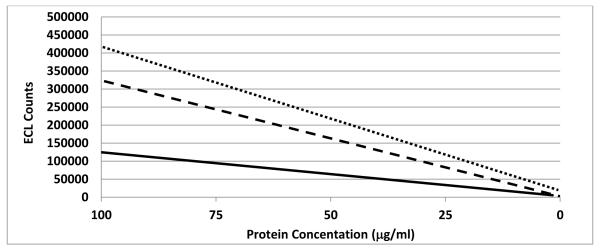
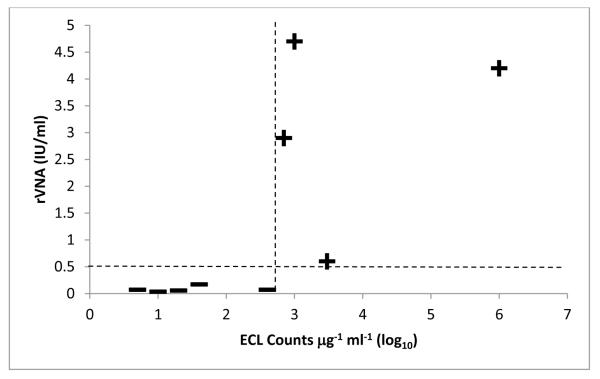
Vaccine potency testing is necessary to evaluate the immunogenicity of inactivated rabies virus (RABV) vaccine preparations before human or veterinary application. Currently, the NIH test is recommended by the WHO expert committee to evaluate RABV vaccine potency. However, numerous disadvantages are inherent concerning cost, number of animals and biosafety requirements. As such, several in vitro methods have been proposed for the evaluation of vaccines based on RABV glycoprotein (G) quality and quantity, which is expected to correlate with vaccine potency. In this study an antigen-capture electrochemiluminescent (ECL) assay was developed utilizing anti-RABV G monoclonal antibodies (MAb) to quantify RABV G. One MAb 2-21-14 was specific for a conformational epitope so that only immunogenic, natively folded G was captured in the assay. MAb 2-21-14 or a second MAb (62-80-6) that binds a linear epitope was used for detection of RABV G. Vaccine efficacy was also assessed in vivo using pre-exposure vaccination of mice. Purified native RABV G induced a RABV neutralizing antibody (rVNA) response with a geometric mean titer of 4.2IU/ml and protected 100% of immunized mice against RABV challenge, while an experimental vaccine with a lower quality and quantity of G induced a rVNA titer<0.05IU/ml and protected <50% of immunized mice. These preliminary results support the hypothesis that in vivo immunogenicity may be predicted from the in vitro measurement of RABV G using an ECL assay. Based upon these results, the ECL assay may have utility in replacement of the NIH test.
Keywords: Antigenicity; ECL; ED(50); Electrochemiluminescent assay; G; Glycoprotein; IM; IU; Immunogenicity; MAb; MSD; Meso Scale Discovery; RABV; RFFIT; Rabies virus; Vaccine; effective dose; electrochemiluminescent; glycoprotein; international units; intramuscular; monoclonal antibody; p.i.; post challenge or post infection; rVNA; rabies virus; rabies virus neutralizing antibody; rapid fluorescent focus inhibition test.
Published by Elsevier Ltd.
Figures

References
-
- Tsiang H, Koulakoff A, Bizzini B, Berwald-Netter Y. Neurotropism of rabies virus: an in vitro study. J Neuropathol Exp Neurol. 1983;42(4):439–52. - PubMed
-
- Baloul L, Camelo S, Lafon M. Up-regulation of Fas ligand (FasL) in the central nervous system: a mechanism of immune evasion by rabies virus. J NeuroVirol. 2004;10(6):372–82. - PubMed
-
- WHO . Expert Committee on Biological Standardization Thirty-seventh report. World Health Organization; Geneva: 1987. WHO Technical Report Series. - PubMed
-
- WHO . WHO Expert Committee on Rabies: Eighth Report. World Health Organization; 1992. - PubMed
Publication types
MeSH terms
Substances
Grants and funding
LinkOut - more resources
Full Text Sources
Other Literature Sources
Research Materials
