Review
. 2013 Aug 28;337(1):41-8.
doi: 10.1016/j.canlet.2013.05.038. Epub 2013 Jun 3.

Tight junction proteins: from barrier to tumorigenesis

Affiliations
Review

Tight junction proteins: from barrier to tumorigenesis

E Aaron Runkle et al. Cancer Lett. .

Abstract

The tight junction is a multi-protein complex and is the apical most junctional complex in certain epithelial and endothelial cells. A great deal of attention has been devoted to the understanding of these proteins in contributing to the barrier function - that is, regulating the paracellular flux or permeability between adjacent cells. However, tight junction proteins are now recognized as having functions beyond the barrier. The focus of this review is to discuss the barrier function of the tight junction and to summarize the literature with a focus on the role of tight junction proteins in proliferation, transformation, and metastasis.

Keywords: Cancer; Claudin; Metastasis; Occludin; Tight junction.


Conflict of interest statement

Conflict of Interest Statement

None

Figures

Fig. 1
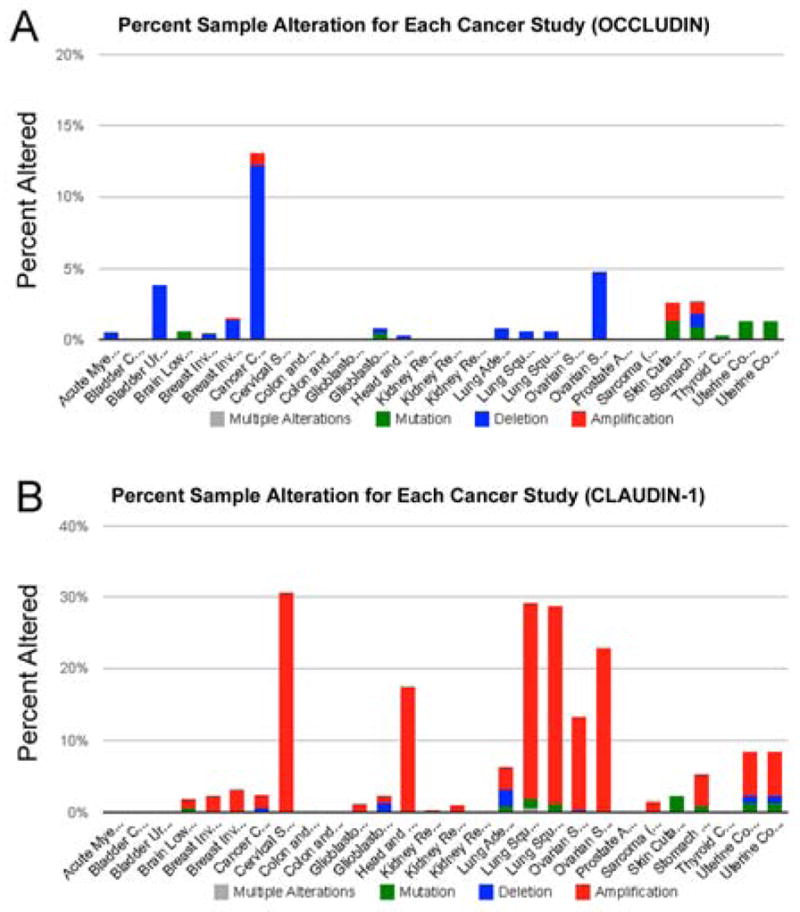
Fig. 1. Cancer genetic alteration profiles of OCCLUDIN and CLAUDIN-1
(A) The OCCLUDIN gene profile was interrogated in these studies: Acute Myeloid Leukemia (TCGA, Provisional) altered in 0.5% of 187 cases; Bladder Cancer (MSKCC, JCO 2013) altered in 0% of 97 cases; Bladder Urothelial Carcinoma (TCGA, Provisional) altered in 3.8% of 26 cases; Brain Lower Grade Glioma (TCGA, Provisional) altered in 0.6% of 169 cases; Breast Invasive Carcinoma (TCGA [125]) altered in 0.4% of 482 cases; Breast Invasive Carcinoma (TCGA, Provisional) altered in 1.6% of 760 cases; Cancer Cell Line Encyclopedia [126] altered in 13.2% of 882 cases; Cervical Squamous Cell Carcinoma and Endocervical Adenocarcinoma (TCGA, Provisional) altered in 0% of 36 cases; Colon and Rectum Adenocarcinoma [127] altered in 0% of 212 cases; Colon and Rectum Adenocarcinoma (TCGA, Provisional) altered in 0% of 221 cases; Glioblastoma [128] altered in 0% of 91 cases; Glioblastoma Multiforme (TCGA, Provisional) altered in 0.8% of 236 cases; Head and Neck Squamous Cell Carcinoma (TCGA, Provisional) altered in 0.3% of 302 cases; Kidney Renal Clear Cell Carcinoma (TCGA, Provisional) altered in 0% of 290 cases; Kidney Renal Clear Cell Carcinoma (TCGA, in revision) altered in 0% of 418 cases; Kidney Renal Papillary Cell Carcinoma (TCGA, Provisional) altered in 0% of 100 cases; Lung Adenocarcinoma (TCGA, Provisional) altered in 0.8% of 129 cases; Lung Squamous Cell Carcinoma [129] altered in 0.6% of 178 cases; Lung Squamous Cell Carcinoma (TCGA, Provisional) altered in 0.6% of 177 cases; Ovarian Serous Cystadenocarcinoma [130] altered in 0% of 316 cases; Ovarian Serous Cystadenocarcinoma (TCGA, Provisional) altered in 4.8% of 311 cases; Prostate Adenocarcinoma [131] altered in 0% of 103 cases; Sarcoma [132] altered in 0% of 207 cases; Skin Cutaneous Melanoma (TCGA, Provisional) altered in 2.7% of 225 cases; Stomach Adenocarcinoma (TCGA, Provisional) altered in 2.6% of 115 cases; Thyroid Carcinoma (TCGA, Provisional) altered in 0.3% of 318 cases; Uterine Corpus Endometrioid Carcinoma [133] altered in 1.2% of 240 cases; Uterine Corpus Endometrioid Carcinoma (TCGA, Provisional) altered in 1.2% of 240 cases. (B) The Claudin-1 gene profile was interrogated in these studies: Acute Myeloid Leukemia (TCGA, Provisional) altered in 0% of 187 cases; Bladder Cancer (MSKCC, JCO 2013) altered in 0% of 97 cases; Bladder Urothelial Carcinoma (TCGA, Provisional) altered in 0% of 26 cases; Brain Lower Grade Glioma (TCGA, Provisional) altered in 1.8% of 169 cases; Breast Invasive Carcinoma (TCGA [125]) altered in 2.1% of 482 cases; Breast Invasive Carcinoma (TCGA, Provisional) altered in 3% of 760 cases; Cancer Cell Line Encyclopedia [126] altered in 2.3% of 882 cases; Cervical Squamous Cell Carcinoma and Endocervical Adenocarcinoma (TCGA, Provisional) altered in 30.6% of 36 cases; Colon and Rectum Adenocarcinoma [127] altered in 0% of 212 cases; Colon and Rectum Adenocarcinoma (TCGA, Provisional) altered in 0% of 221 cases; Glioblastoma [128] altered in 1.1% of 91 cases; Glioblastoma Multiforme (TCGA, Provisional) altered in 2.1% of 236 cases; Head and Neck Squamous Cell Carcinoma (TCGA, Provisional) altered in 17.5% of 302 cases; Kidney Renal Clear Cell Carcinoma (TCGA, Provisional) altered in 0.3% of 290 cases; Kidney Renal Clear Cell Carcinoma (TCGA, in revision) altered in 1% of 418 cases; Kidney Renal Papillary Cell Carcinoma (TCGA, Provisional) altered in 0% of 100 cases; Lung Adenocarcinoma (TCGA, Provisional) altered in 6.2% of 129 cases; Lung Squamous Cell Carcinoma [129] altered in 29.2% of 178 cases; Lung Squamous Cell Carcinoma (TCGA, Provisional) altered in 28.8% of 177 cases; Ovarian Serous Cystadenocarcinoma [130] altered in 13.3% of 316 cases; Ovarian Serous Cystadenocarcinoma (TCGA, Provisional) altered in 22.8% of 311 cases; Prostate Adenocarcinoma [131] altered in 0% of 103 cases; Sarcoma [132] altered in 1.4% of 207 cases; Skin Cutaneous Melanoma (TCGA, Provisional) altered in 2.2% of 225 cases; Stomach Adenocarcinoma (TCGA, Provisional) altered in 5.2% of 115 cases; Thyroid Carcinoma (TCGA, Provisional) altered in 0% of 318 cases; Uterine Corpus Endometrioid Carcinoma [133] altered in 8.3% of 240 cases; Uterine Corpus Endometrioid Carcinoma (TCGA, Provisional) altered in 8.3% of 240 cases. The analyses were conducted using the cBio Cancer Genomics Portal [119]. TCGA, The Cancer Genome Atlas.

References

    1. Mineta K, Yamamoto Y, Yamazaki Y, Tanaka H, Tada Y, Saito K, Tamura A, Igarashi M, Endo T, Takeuchi K, Tsukita S. Predicted expansion of the claudin multigene family. FEBS Lett. 2011;585:606–612. - PubMed
    1. Farquhar MG, Palade GE. Junctional complexes in various epithelia. J Cell Biol. 1963;17:375–412. - PMC - PubMed
    1. van Meer G, Gumbiner B, Simons K. The tight junction does not allow lipid molecules to diffuse from one epithelial cell to the next. Nature. 1986;322:639–641. - PubMed
    1. Balda MS, Matter K. Tight junctions and the regulation of gene expression. Biochim Biophys Acta. 2009;1788:761–767. - PubMed
    1. Balda MS, Garrett MD, Matter K. The ZO-1-associated Y-box factor ZONAB regulates epithelial cell proliferation and cell density. J Cell Biol. 2003;160:423–432. - PMC - PubMed

Publication types

LinkOut - more resources