


Single-nucleotide polymorphism array genotyping is equivalent to metaphase cytogenetics for diagnosis of Turner syndrome
- PMID: 23743550
- PMCID: PMC3883919
- DOI: 10.1038/gim.2013.77
Single-nucleotide polymorphism array genotyping is equivalent to metaphase cytogenetics for diagnosis of Turner syndrome
Erratum in
- Genet Med. 2014 Jan;16(1):117
Abstract
Purpose: Turner syndrome is a developmental disorder caused by partial or complete monosomy for the X chromosome in 1 in 2,500 females. We hypothesized that single-nucleotide polymorphism (SNP) array genotyping could provide superior resolution in comparison to metaphase karyotype analysis to facilitate genotype-phenotype correlations.
Methods: We genotyped 187 Turner syndrome patients with 733,000 SNP marker arrays. All cases met diagnostic criteria for Turner syndrome based on karyotypes (60%) or characteristic physical features. The SNP array results confirmed the diagnosis of Turner syndrome in 100% of cases.
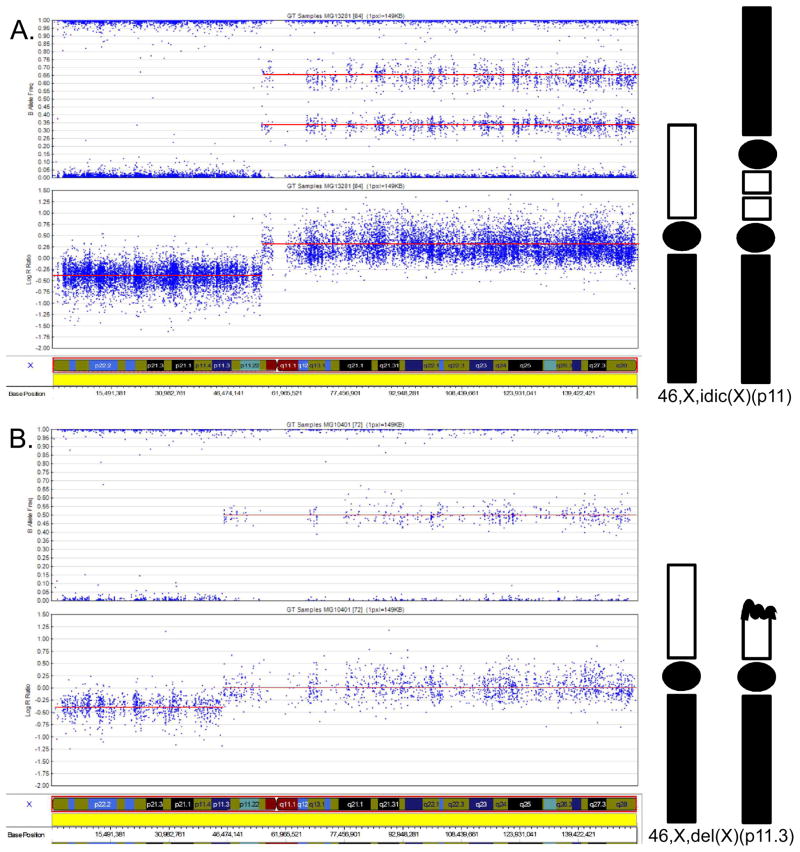
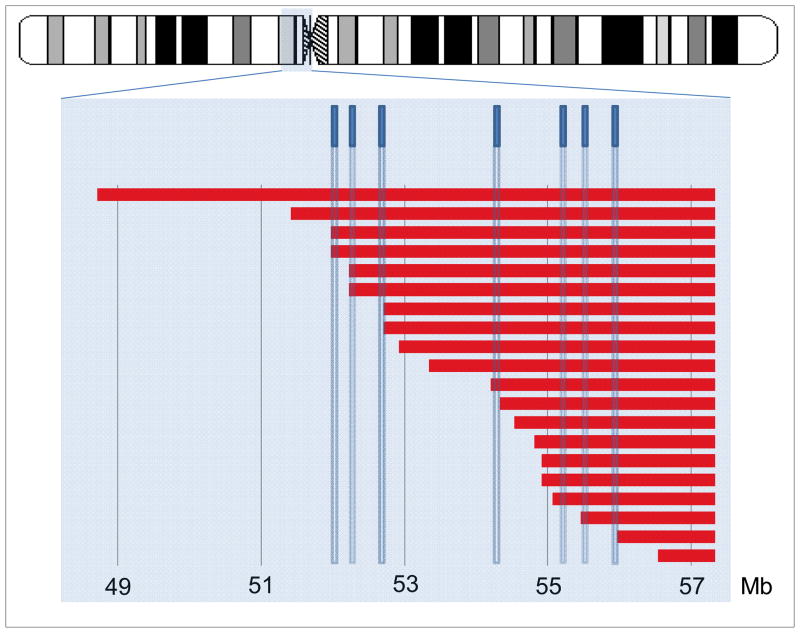
Results: We identified a single X chromosome (45,X) in 113 cases. In 58 additional cases (31%), other mosaic cell lines were present, including isochromosomes (16%), rings (5%), and Xp deletions (8%). The remaining cases were mosaic for monosomy X and normal male or female cell lines. Array-based models of X chromosome structure were compatible with karyotypes in 104 of 116 comparable cases (90%). We found that the SNP array data did not detect X-autosome translocations (three cases) but did identify two derivative Y chromosomes and 13 large copy-number variants that were not detected by karyotyping.
Conclusion: Our study is the first systematic comparison between the two methods and supports the utility of SNP array genotyping to address clinical and research questions in Turner syndrome.
Conflict of interest statement
S.P. Nothing to disclose
D.G. Nothing to disclose
D.M.M. Nothing to disclose
C.L.M Nothing to disclose
M.S Nothing to disclose
C.A.B Nothing to disclose
Figures
References
-
- Matura LA, Ho VB, Rosing DR, Bondy CA. Aortic dilatation and dissection in Turner syndrome. Circulation. 2007 Oct 9;116(15):1663–1670. - PubMed
-
- Rao E, Weiss B, Fukami M, et al. Pseudoautosomal deletions encompassing a novel homeobox gene cause growth failure in idiopathic short stature and Turner syndrome. Nature genetics. 1997 May;16(1):54–63. - PubMed
-
- Hirschfeldova K, Solc R, Baxova A, et al. SHOX gene defects and selected dysmorphic signs in patients of idiopathic short stature and Leri-Weill dyschondrosteosis. Gene. 2012 Jan 10;491(2):123–127. - PubMed
-
- El-Zein R, Gu Y, Sierra MS, Spitz MR, Strom SS. Chromosomal instability in peripheral blood lymphocytes and risk of prostate cancer. Cancer epidemiology, biomarkers & prevention: a publication of the American Association for Cancer Research, cosponsored by the American Society of Preventive. Oncology. 2005 Mar;14(3):748–752. - PubMed
-
- Salas C, Niembro A, Lozano V, et al. Persistent genomic instability in peripheral blood lymphocytes from Hodgkin lymphoma survivors. Environmental and molecular mutagenesis. 2012 May;53(4):271–280. - PubMed
Publication types
MeSH terms
Grants and funding
- U01HG004438/HG/NHGRI NIH HHS/United States
- WT_/Wellcome Trust/United Kingdom
- R01 HL062594/HL/NHLBI NIH HHS/United States
- UL1RR024996/RR/NCRR NIH HHS/United States
- R01EY018246/EY/NEI NIH HHS/United States
- HHSN268200648199C/HI/NHLBI NIH HHS/United States
- U01 HG004446/HG/NHGRI NIH HHS/United States
- HHSN268200782096C/HG/NHGRI NIH HHS/United States
- UL1 RR024148/RR/NCRR NIH HHS/United States
- UL1 TR000371/TR/NCATS NIH HHS/United States
- U10 AA008401/AA/NIAAA NIH HHS/United States
- UL1 RR024996/RR/NCRR NIH HHS/United States
- KL2 TR000370/TR/NCATS NIH HHS/United States
- U01 HG004422/HG/NHGRI NIH HHS/United States
- P01 CA089392/CA/NCI NIH HHS/United States
- UL1 RR024140/RR/NCRR NIH HHS/United States
- HHSN268201000048C/HL/NHLBI NIH HHS/United States
- Z01 CP 010200/CP/NCI NIH HHS/United States
- R01 DA013423/DA/NIDA NIH HHS/United States
- UL1 TR000457/TR/NCATS NIH HHS/United States
- P50 HL083794/HL/NHLBI NIH HHS/United States
LinkOut - more resources
Full Text Sources
Other Literature Sources
Medical
Miscellaneous
