


Whole-body cryostimulation as an effective method of reducing low-grade inflammation in obese men
- PMID: 23744123
- PMCID: PMC3751373
- DOI: 10.1007/s12576-013-0269-4
Whole-body cryostimulation as an effective method of reducing low-grade inflammation in obese men
Abstract
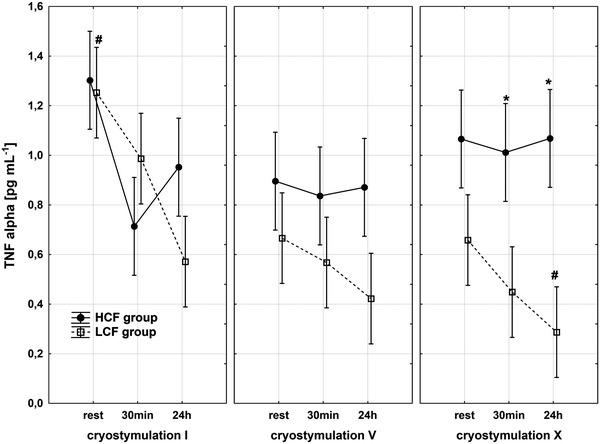
This study was aimed to evaluate anti-inflammatory effect of the whole body cryostimulation in obese men. Fourteen subjects (BMI >30 kg m(-2)), divided into two subgroups according to cardiorespiratory fitness: higher (HCF) or lower (LCF), have been exposed to 10 sessions in a cryogenic chamber (-110 °C). Blood samples were collected before, 30 min and 24 h after the first, fifth and last cryostimulation. Coldness exposures affected blood cytokine profile; however, the response depended on subjects' fitness capacity. Concentrations of pro-inflammatory cytokines in the LCF decreased by 19, 6.8, and 7.4 % in IL-6, resistin, and visfatin, respectively. TNFα in the LCF dropped 4.3-fold compared to baseline, while in the HCF, changes were smaller, yet significant. Anti-inflammatory cytokine IL-10 increased in both groups. No changes in adiponectin and leptin were observed in either group. Obtained results suggest that whole body cryostimulation can be a supplementary method for obese in reducing systemic inflammation.
Conflict of interest statement
No conflict of interest occurs.
Figures

References
-
- von Ruesten A, Steffen A, Floegel A, van der AD, Masala G, Tjonneland A, Halkjaer J, Palli D, Wareham NJ, Loos RJ, Sorensen TI, Boeing H (2011) Trend in Obesity Prevalence in European Adult Cohort Populations during Follow-up since 1996 and Their Predictions to 2015. PLoS ONE 6: e27455 - PMC - PubMed
-
- Kanda H, Tateya S, Tamori Y, Kotani K, Hiasa K, Kitazawa R, Kitazawa S, Miyachi H, Maeda S, Egashira K, Kasuga M. MCP-1 contributes to macrophage infiltration into adipose tissue, insulin resistance, and hepatic steatosis in obesity. J Clin Invest. 2006;116:1494–1505. doi: 10.1172/JCI26498. - DOI - PMC - PubMed
Publication types
MeSH terms
Substances
LinkOut - more resources
Full Text Sources
Other Literature Sources
Medical
Research Materials
