


Lack of reduction of left ventricular mass in treated hypertension: the strong heart study
- PMID: 23744404
- PMCID: PMC3698775
- DOI: 10.1161/JAHA.113.000144
Lack of reduction of left ventricular mass in treated hypertension: the strong heart study
Abstract
Background: Hypertensive left ventricular mass (LVM) is expected to decrease during antihypertensive therapy, based on results of clinical trials.
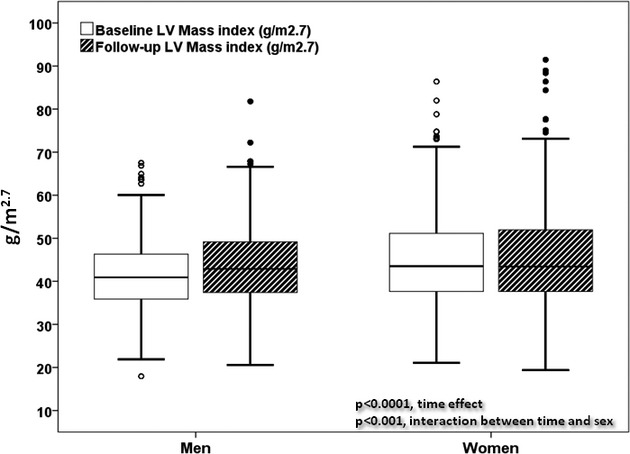
Methods and results: We assessed 4-year change of echocardiographic LVM in 851 hypertensive free-living participants of the Strong Heart Study (57% women, 81% treated). Variations of 5% or more of the initial systolic blood pressure (SBP) and LVM were categorized for analysis. At baseline, 23% of men and 36% of women exhibited LV hypertrophy (LVH, P<0.0001). At the follow-up, 3% of men and 10% of women had regression of LVH (P<0.0001 between genders); 14% of men and 15% of women, free of baseline LVH, developed LVH. There was an increase in LVM over time, more in men than in women (P<0.001). Participants whose LVM did not decrease had similar baseline SBP and diastolic BP, but higher body mass index (BMI), waist/hip ratio, heart rate (all P<0.008), and urinary albumin/creatinine excretion (P<0.001) than those whose LVM decreased. After adjusting for field center, initial LVM index, target BP, and kinship degree, lack of decrease in LVM was predicted by higher baseline BMI and urinary albumin/creatinine excretion, independently of classes of antihypertensive medications, and significant effects of older age, male gender, and percentage increase in BP over time. Similar findings were obtained in the subpopulation (n=526) with normal BP at follow-up.
Conclusions: In a free-living population, higher BMI is associated with less reduction of hypertensive LVH; lack of reduction of LVM is independent of BP control and of types of antihypertensive treatment, but is associated with renal damage.
Keywords: antihypertensive therapy; blood pressure; obesity; proteinuria; ventricular hypertrophy.
Figures
References
-
- Devereux RB, Dahlof B, Gerdts E, Boman K, Nieminen MS, Papademetriou V, Rokkedal J, Harris KE, Edelman JM, Wachtell K. Regression of hypertensive left ventricular hypertrophy by losartan compared with atenolol: the Losartan Intervention for Endpoint Reduction in Hypertension (LIFE) trial. Circulation. 2004; 110:1456-1462 - PubMed
-
- De Luca N, Mallion JM, O'Rourke MF, O'Brien E, Rahn KH, Trimarco B, Romero R, de Leeuw PW, Hitzenberger G, Battegay E, Duprez D, Sever P, Safar ME. Regression of left ventricular mass in hypertensive patients treated with perindopril/indapamide as a first‐line combination: the REASON echocardiography study. Am J Hypertens. 2004; 17:660-667 - PubMed
-
- Gosse P, Sheridan DJ, Zannad F, Dubourg O, Gueret P, Karpov Y, de Leeuw PW, Palma‐Gamiz JL, Pessina A, Motz W, Degaute JP, Chastang C. Regression of left ventricular hypertrophy in hypertensive patients treated with indapamide SR 1.5 mg versus enalapril 20 mg: the LIVE study. J Hypertens. 2000; 18:1465-1475 - PubMed
-
- Dahlof B, Gosse P, Gueret P, Dubourg O, de Simone G, Schmieder R, Karpov Y, Garcia‐Puig J, Matos L, de Leeuw PW, Degaute JP, Magometschnigg D. Perindopril/indapamide combination more effective than enalapril in reducing blood pressure and left ventricular mass: the PICXEL study. J Hypertens. 2005; 23:2063-2070 - PubMed
-
- Malmqvist K, Kahan T, Edner M, Held C, Hagg A, Lind L, Muller‐Brunotte R, Nystrom F, Ohman KP, Osbakken MD, Ostergern J. Regression of left ventricular hypertrophy in human hypertension with irbesartan. J Hypertens. 2001; 19:1167-1176 - PubMed
Publication types
MeSH terms
Substances
Grants and funding
LinkOut - more resources
Full Text Sources
Other Literature Sources
Medical
