


Long-term decline in intelligence among adult survivors of childhood acute lymphoblastic leukemia treated with cranial radiation
- PMID: 23744583
- PMCID: PMC3724191
- DOI: 10.1182/blood-2013-03-487744
Long-term decline in intelligence among adult survivors of childhood acute lymphoblastic leukemia treated with cranial radiation
Abstract
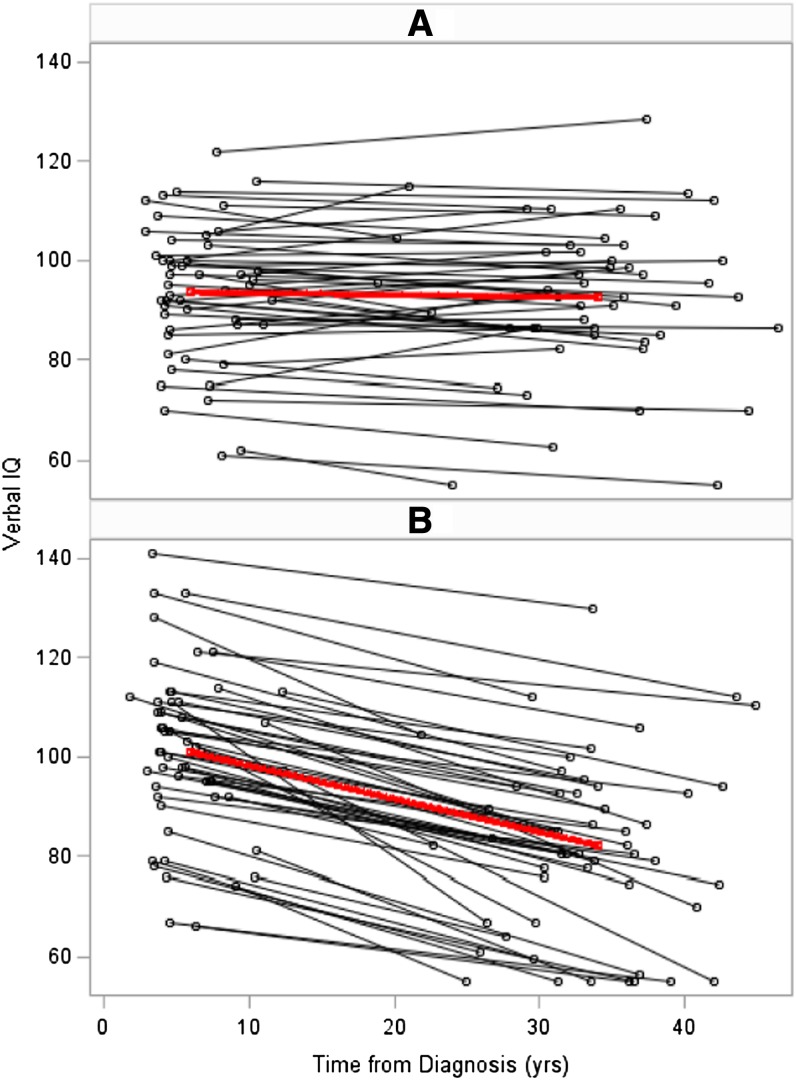
Survivors of childhood acute lymphoblastic leukemia (ALL) treated with cranial radiation therapy (CRT) are at risk for cognitive impairment, although whether impairment progresses with age into adulthood is unknown. We report change in intelligence for 102 adult survivors of childhood ALL (age range, 26.6-54.7 years) during a median interval of 28.5 years. Survivors demonstrated lower Performance intelligence (mean, 95.3; standard deviation, 16.5; P = .005) but not Verbal IQ (mean, 97.4; standard deviation, 15.44; P = .09) at initial testing. Verbal intelligence declined an average of 10.3 points (P < .0001) during the follow-up interval with no decline in Performance intelligence. Decline was associated with current attention problems (P = .002) but not gender, CRT dose, age at CRT exposure, or years between testing. Results suggest long-term survivors of childhood ALL treated with CRT are at risk for progressive decline in verbal intellect, which may be driven by attention deficits. This trial was registered at clinicaltrials.gov as no. NCT00760656.
Figures
References
-
- Meadows AT, Gordon J, Massari DJ, Littman P, Fergusson J, Moss K. Declines in IQ scores and cognitive dysfunctions in children with acute lymphocytic leukaemia treated with cranial irradiation. Lancet. 1981;2(8254):1015–1018. - PubMed
-
- Ochs J, Mulhern R, Fairclough D, et al. Comparison of neuropsychologic functioning and clinical indicators of neurotoxicity in long-term survivors of childhood leukemia given cranial radiation or parenteral methotrexate: a prospective study. J Clin Oncol. 1991;9(1):145–151. - PubMed
-
- Jankovic M, Brouwers P, Valsecchi MG, et al. International Study Group on Psychosocial Aspects of Childhood Cancer. Association of 1800 cGy cranial irradiation with intellectual function in children with acute lymphoblastic leukaemia. ISPACC. Lancet. 1994;344(8917):224–227. - PubMed
-
- Campbell LK, Scaduto M, Sharp W, et al. A meta-analysis of the neurocognitive sequelae of treatment for childhood acute lymphocytic leukemia. Pediatr Blood Cancer. 2007;49(1):65–73. - PubMed
-
- Lancashire ER, Frobisher C, Reulen RC, Winter DL, Glaser A, Hawkins MM. Educational attainment among adult survivors of childhood cancer in Great Britain: a population-based cohort study. J Natl Cancer Inst. 2010;102(4):254–270. - PubMed
Publication types
MeSH terms
Associated data
Grants and funding
LinkOut - more resources
Full Text Sources
Other Literature Sources
Medical
Research Materials
