


Performance of chronic kidney disease epidemiology collaboration creatinine-cystatin C equation for estimating kidney function in cirrhosis
- PMID: 23744636
- PMCID: PMC3883887
- DOI: 10.1002/hep.26556
Performance of chronic kidney disease epidemiology collaboration creatinine-cystatin C equation for estimating kidney function in cirrhosis
Abstract
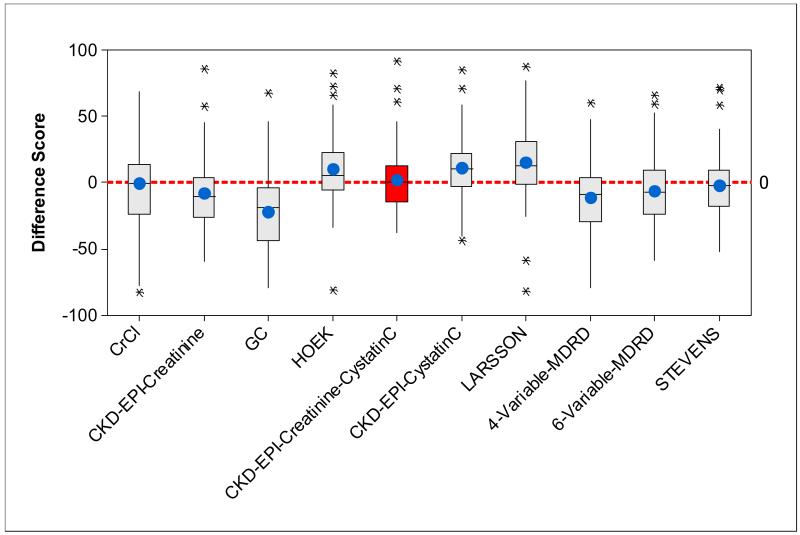
Conventional creatinine-based glomerular filtration rate (GFR) equations are insufficiently accurate for estimating GFR in cirrhosis. The Chronic Kidney Disease Epidemiology Collaboration (CKD-EPI) recently proposed an equation to estimate GFR in subjects without cirrhosis using both serum creatinine and cystatin C levels. Performance of the new CKD-EPI creatinine-cystatin C equation (2012) was superior to previous creatinine- or cystatin C-based GFR equations. To evaluate the performance of the CKD-EPI creatinine-cystatin C equation in subjects with cirrhosis, we compared it to GFR measured by nonradiolabeled iothalamate plasma clearance (mGFR) in 72 subjects with cirrhosis. We compared the "bias," "precision," and "accuracy" of the new CKD-EPI creatinine-cystatin C equation to that of 24-hour urinary creatinine clearance (CrCl), Cockcroft-Gault (CG), and previously reported creatinine- and/or cystatin C-based GFR-estimating equations. Accuracy of CKD-EPI creatinine-cystatin C equation as quantified by root mean squared error of difference scores (differences between mGFR and estimated GFR [eGFR] or between mGFR and CrCl, or between mGFR and CG equation for each subject) (RMSE = 23.56) was significantly better than that of CrCl (37.69, P = 0.001), CG (RMSE = 36.12, P = 0.002), and GFR-estimating equations based on cystatin C only. Its accuracy as quantified by percentage of eGFRs that differed by greater than 30% with respect to mGFR was significantly better compared to CrCl (P = 0.024), CG (P = 0.0001), 4-variable MDRD (P = 0.027), and CKD-EPI creatinine 2009 (P = 0.012) equations. However, for 23.61% of the subjects, GFR estimated by CKD-EPI creatinine-cystatin C equation differed from the mGFR by more than 30%.
Conclusion: The diagnostic performance of CKD-EPI creatinine-cystatin C equation (2012) in patients with cirrhosis was superior to conventional equations in clinical practice for estimating GFR. However, its diagnostic performance was substantially worse than reported in subjects without cirrhosis.
© 2013 by the American Association for the Study of Liver Diseases.
Figures
Comment in
-
Reconsidering a "chopped liver": the need for improving glomular filtration rate estimation for hepatic transplantation.Hepatology. 2014 Apr;59(4):1242-5. doi: 10.1002/hep.27031. Epub 2014 Feb 28. Hepatology. 2014. PMID: 24470267 No abstract available.
References
-
- [Accessed on May 18, 2013];Deaths: Preliminary Data for 2011. Available at http://www.cdc.gov/nchs/data/nvsr/nvsr61/nvsr61_06.pdf.
-
- [Accessed on May 18, 2013];Scientific Registry of Transplant Recipients. http://www.srtr.org/annual_Reports/2011/904a_rec-dgn_li.aspx.
-
- Alessandria C, Ozdogan O, Guevara M, et al. MELD score and clinical type predict prognosis in hepatorenal syndrome: relevance to liver transplantation. Hepatology. 2005;41(6):1282–9. - PubMed
-
- Cockcroft DW, Gault MH. Prediction of creatinine clearance from serum creatinine. Nephron. 1976;16(1):31–41. - PubMed
-
- Levey AS, Coresh J, Greene T, et al. Using standardized serum creatinine values in the modification of diet in renal disease study equation for estimating glomerular filtration rate. Ann Intern Med. 2006;145(4):247–54. - PubMed
Publication types
MeSH terms
Substances
Grants and funding
LinkOut - more resources
Full Text Sources
Other Literature Sources
Medical
Research Materials
Miscellaneous