


Discordant patterns of bacterial translocation markers and implications for innate immune imbalances in schizophrenia
- PMID: 23746484
- PMCID: PMC3732507
- DOI: 10.1016/j.schres.2013.05.018
Discordant patterns of bacterial translocation markers and implications for innate immune imbalances in schizophrenia
Abstract
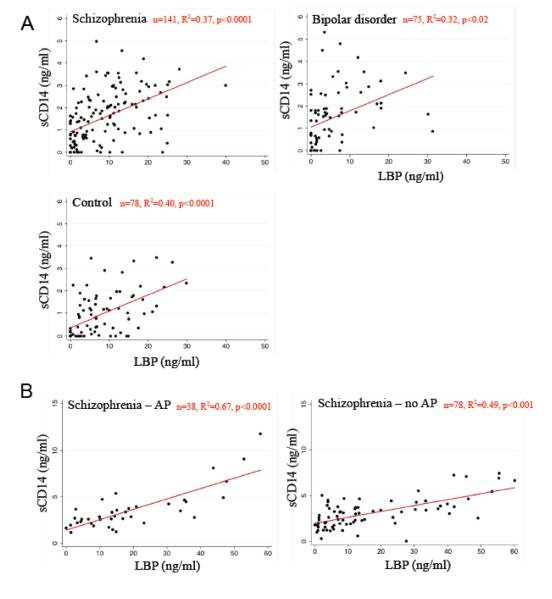
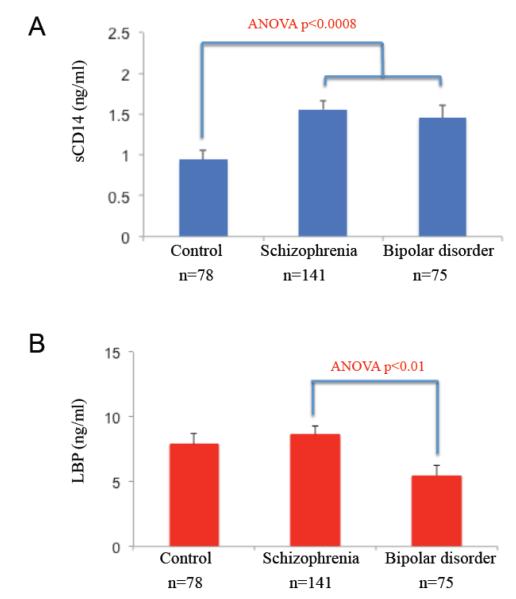
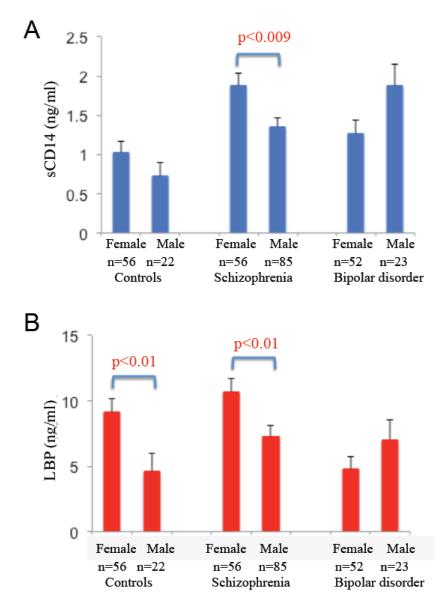
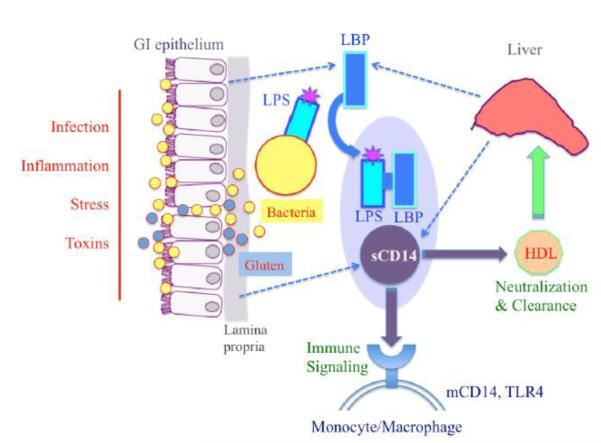
The origin of inflammation in psychiatric disorders is not well understood. The translocation of commensal microbiota across the gastrointestinal barrier can result in a persistent state of low-grade immune activation and/or inflammation. We measured serological surrogate markers of bacterial translocation (soluble CD14 (sCD14) and lipopolysaccharide binding protein (LBP)) in two psychiatric cohorts and compared these levels to C-reactive protein (CRP), body mass index (BMI), and food-related and autoimmune antibodies. The two cohorts were composed of the following: (1) n=141 schizophrenia, n=75 bipolar disorder, n=78 controls; (2) n=78 antipsychotic-naïve first-episode schizophrenia, n=38 medicated first-episode schizophrenia. sCD14 seropositivity conferred a 3.1-fold increased odds of association with schizophrenia (multivariate regressions, OR=3.09, p<0.0001) compared to controls. Case-control differences in sCD14 were not matched by LBP. Quantitative levels of LBP, but not sCD14, correlated with BMI in schizophrenia (R(2)=0.21, p<0.0001). sCD14 and LBP also exhibited some congruency in schizophrenia with both significantly correlated with CRP (R(2)=0.26-0.27, p<0.0001) and elevated in females compared to males (p<0.01). Antipsychotic treatment generally did not impact sCD14 or LBP levels except for significant correlations, especially sCD14, with gluten antibodies in antipsychotic-naïve schizophrenia (R(2)=0.27, p<0.0001). In bipolar disorder, sCD14 levels were significantly correlated with anti-tissue transglutaminase IgG (R(2)=0.37, p<0.001). In conclusion, these bacterial translocation markers produced discordant and complex patterns of activity, a finding that may reflect an imbalanced, activated innate immune state. Whereas both markers may upregulate following systemic exposure to Gram-negative bacteria, non-lipopolysaccharide-based monocyte activation, autoimmunity and metabolic dysfunction may also contribute to the observed marker profiles.
Keywords: BMI; C-reactive protein; CRP; Diet; GI; Gut; LBP; LPS; Macrophage; Mental illness; Metabolic syndrome; Microbiome; Psychosis; body mass index; gastrointestinal; lipopolysaccharide; lipopolysaccharide binding protein; sCD14; soluble CD14; tTG; tissue transglutaminase.
Copyright © 2013 Elsevier B.V. All rights reserved.
Figures
References
-
- Berg AH, Scherer PE. Adipose tissue, inflammation, and cardiovascular disease. Circ Res. 2005;96(9):939–949. - PubMed
-
- Beumer W, Drexhage RC, De Wit H, Versnel MA, Drexhage HA, Cohen D. Increased level of serum cytokines, chemokines and adipokines in patients with schizophrenia is associated with disease and metabolic syndrome. Psychoneuroendocrinology. 2012a;37(12):1901–1911. - PubMed
-
- Beumer W, Gibney SM, Drexhage RC, Pont-Lezica L, Doorduin J, Klein HC, Steiner J, Connor TJ, Harkin A, Versnel MA, Drexhage HA. The immune theory of psychiatric diseases: a key role for activated microglia and circulating monocytes. J Leukoc Biol. 2012b;92(5):959–975. - PubMed
-
- Brenchley JM, Price DA, Schacker TW, Asher TE, Silvestri G, Rao S, Kazzaz Z, Bornstein E, Lambotte O, Altmann D, Blazar BR, Rodriguez B, Teixeira-Johnson L, Landay A, Martin JN, Hecht FM, Picker LJ, Lederman MM, Deeks SG, Douek DC. Microbial translocation is a cause of systemic immune activation in chronic HIV infection. Nat Med. 2006;12(12):1365–1371. - PubMed
Publication types
MeSH terms
Substances
Grants and funding
LinkOut - more resources
Full Text Sources
Other Literature Sources
Medical
Research Materials
Miscellaneous
