


Mesenchymal stem cell secretome and regenerative therapy after cancer
- PMID: 23747841
- PMCID: PMC3825748
- DOI: 10.1016/j.biochi.2013.05.010
Mesenchymal stem cell secretome and regenerative therapy after cancer
Abstract
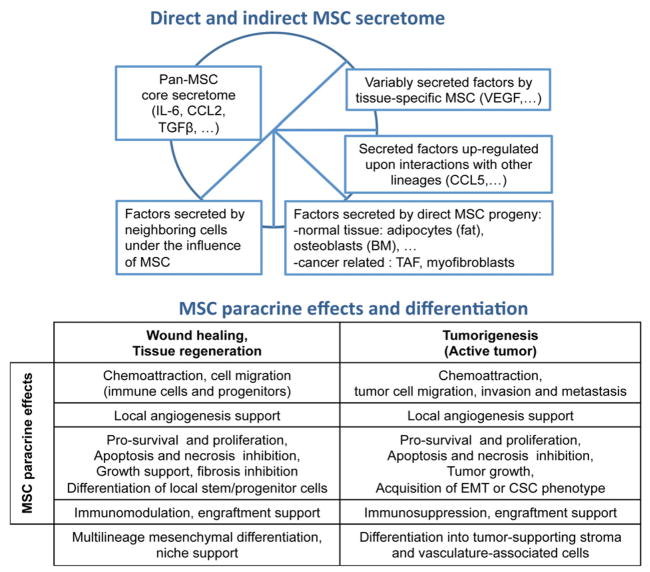
Cancer treatment generally relies on tumor ablative techniques that can lead to major functional or disfiguring defects. These post-therapy impairments require the development of safe regenerative therapy strategies during cancer remission. Many current tissue repair approaches exploit paracrine (immunomodulatory, pro-angiogenic, anti-apoptotic and pro-survival effects) or restoring (functional or structural tissue repair) properties of mesenchymal stem/stromal cells (MSC). Yet, a major concern in the application of regenerative therapies during cancer remission remains the possible triggering of cancer recurrence. Tumor relapse implies the persistence of rare subsets of tumor-initiating cancer cells which can escape anti-cancer therapies and lie dormant in specific niches awaiting reactivation via unknown stimuli. Many of the components required for successful regenerative therapy (revascularization, immunosuppression, cellular homing, tissue growth promotion) are also critical for tumor progression and metastasis. While bi-directional crosstalk between tumorigenic cells (especially aggressive cancer cell lines) and MSC (including tumor stroma-resident populations) has been demonstrated in a variety of cancers, the effects of local or systemic MSC delivery for regenerative purposes on persisting cancer cells during remission remain controversial. Both pro- and anti-tumorigenic effects of MSC have been reported in the literature. Our own data using breast cancer clinical isolates have suggested that dormant-like tumor-initiating cells do not respond to MSC signals, unlike actively dividing cancer cells which benefited from the presence of supportive MSC. The secretome of MSC isolated from various tissues may partially diverge, but it includes a core of cytokines (i.e. CCL2, CCL5, IL-6, TGFβ, VEGF), which have been implicated in tumor growth and/or metastasis. This article reviews published models for studying interactions between MSC and cancer cells with a focus on the impact of MSC secretome on cancer cell activity, and discusses the implications for regenerative therapy after cancer.
Keywords: ASC; BA; BM; CCL; CSC; CXCL; Cancer recurrence; C–X–C motif chemokine; ECM; EGF; EMT; FSP1; HDGF; HGF; HSC; Hepatocyte growth factor; IL-6; INFγ; IPSC; MCP1; MMP; MSC; Mesenchymal stem/stromal cells; OA; PDGF; Regenerative therapy after cancer; SA; SDF1; TAF; TGFβ; TNFα; Tumor-initiating cells; UC; VEGF; adipose-derived stem/stromal cells; bone marrow; breast adipose; cancer stem cells; chemokine C–C motif ligand; epidermal growth factor; epithelial–mesenchymal transition; extra-cellular matrix; fibroblast-specific protein-1; hematopoietic stem cells; hepatoma-derived growth factor; induced pluripotent stem cell; interferon-gamma; interleukin-6; matrix metalloproteinases; mesenchymal stromal/stem cells; monocyte chemoattractant protein-1; omental adipose; platelet-derived growth factor; stromal cell-derived factor-1; subcutaneous adipose; transforming growth factor-beta; tumor necrosis factor-alpha; tumor-associated fibroblasts; umbilical cord; vascular endothelial growth factor.
Copyright © 2013 Elsevier Masson SAS. All rights reserved.
Conflict of interest statement
Authors do not have any conflict of interest.
Figures
References
-
- Caplan AI. Adult mesenchymal stem cells for tissue engineering versus regenerative medicine. J Cell Physiol. 2007;213:341–347. - PubMed
-
- Dvorak HF. Tumors: wounds that do not heal. Similarities between tumor stroma generation and wound healing. N Engl J Med. 1986;315:1650–1659. - PubMed
-
- Spaeth E, Klopp A, Dembinski J, Andreeff M, Marini F. Inflammation and tumor microenvironments: defining the migratory itinerary of mesenchymal stem cells. Gene therapy. 2008;15:730–738. - PubMed
Publication types
MeSH terms
Substances
Grants and funding
- 1U01HL099775/HL/NHLBI NIH HHS/United States
- U01 HL100397/HL/NHLBI NIH HHS/United States
- N01-HB-37165/HB/NHLBI NIH HHS/United States
- R01 CA114246/CA/NCI NIH HHS/United States
- R01 HL085819/HL/NHLBI NIH HHS/United States
- U01 HL099775/HL/NHLBI NIH HHS/United States
- R03 HL096220/HL/NHLBI NIH HHS/United States
- N01 HB037165/HB/NHLBI NIH HHS/United States
- K08 HL077595/HL/NHLBI NIH HHS/United States
- R01-HL-085819/HL/NHLBI NIH HHS/United States
- R01CA 114246/CA/NCI NIH HHS/United States
- U01HL100397/HL/NHLBI NIH HHS/United States
LinkOut - more resources
Full Text Sources
Other Literature Sources
Research Materials
Miscellaneous
