


doi: 10.1038/nmeth.2518.
Epub 2013 Jun 9.
Integrated proteomic analysis of post-translational modifications by serial enrichment
Affiliations
- PMID: 23749302
- PMCID: PMC3943163
- DOI: 10.1038/nmeth.2518
Item in Clipboard
Integrated proteomic analysis of post-translational modifications by serial enrichment
Nat Methods.
2013 Jul.
Abstract
We report a mass spectrometry-based method for the integrated analysis of protein expression, phosphorylation, ubiquitination and acetylation by serial enrichments of different post-translational modifications (SEPTM) from the same biological sample. This technology enabled quantitative analysis of nearly 8,000 proteins and more than 20,000 phosphorylation, 15,000 ubiquitination and 3,000 acetylation sites per experiment, generating a holistic view of cellular signal transduction pathways as exemplified by analysis of bortezomib-treated human leukemia cells.
Figures
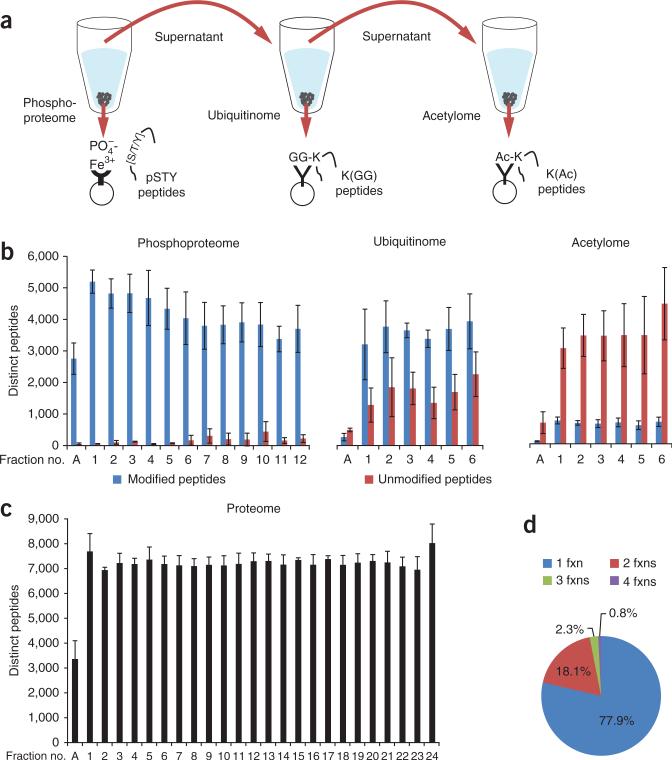
SEPTM enables deep, quantitative analysis of the PTM-ome of a biological sample. (a) Integrated proteome and PTM-ome profiling by sequential enrichment for phosphorylated peptides with IMAC, for ubiquitinated peptides with K(GG)-specific antibodies and for lysine-acetylated peptides with K(Ac)-specific antibodies. (b) Ideal and even partitioning of phosphorylated, ubiquitinated and acetylated peptides by basic RP fractionation. The specificity of each enrichment step (distinct modified peptides out of total peptides) was >93% for phosphopeptides, >71% for ubiquitinated peptides and >18% for acetylated peptides. (c) We used 5% of the starting samples for whole-proteome analysis; basic RP separation yielded even partitioning of unmodified peptides. Average numbers of PTM sites (b) and proteins (c) per replicate are shown with s.d. error bars. (d) Uniqueness and occurrence of unmodified peptides per fraction (fxn).
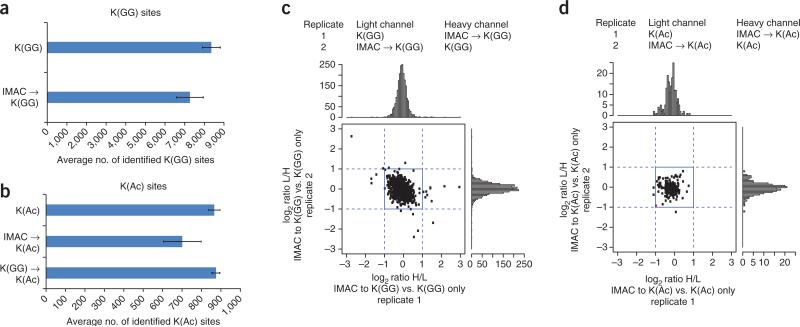
Comparison of nonserial to serial enrichments for K(GG) and K(Ac) enrichments. (a,b) Comparison of the number of identified K(GG) (a) and K(Ac) (b) sites. Label-free, tryptic HeLa peptides (2.5 mg) were either singly or doubly enriched for the indicated PTM enrichments. Each identified modification-site value is that of the last PTM enriched in the sample. s.d. error bars were calculated for three process replicates. (c,d) SILAC ratio comparisons of doubly versus singly K(GG)-enriched (c) or K(Ac)-enriched (d) samples. SILAC heavy (H)- and light (L)-labeled HeLa peptides (2.5 mg) were subjected to either one or two rounds of differential PTM enrichment (as indicated). log2 SILAC ratios of replicates 1 and 2 are visualized as scatter plots and associated histograms. We used a moderated t-test (P < 0.05) to detect any statistically significant up- or downregulated sites among 2,131 K(GG) sites (c) and 193 K(Ac)-sites (d). Only one data point had a P <0.05; this is colored red in the scatter plot. The second replicates were performed with an inverted SILAC labeling strategy.
Comment in
-
Eavesdropping on PTM cross-talk through serial enrichment.Nat Methods. 2013 Jul;10(7):620-1. doi: 10.1038/nmeth.2526. Nat Methods. 2013. PMID: 23807195 No abstract available.
References
Publication types
MeSH terms
Substances
Grants and funding
LinkOut - more resources
Full Text Sources
Other Literature Sources
Molecular Biology Databases
