


Response of millet and sorghum to a varying water supply around the primary and nodal roots
- PMID: 23749473
- PMCID: PMC3698390
- DOI: 10.1093/aob/mct099
Response of millet and sorghum to a varying water supply around the primary and nodal roots
Abstract
Background and aims: Cereals have two root systems. The primary system originates from the embryo when the seed germinates and can support the plant until it produces grain. The nodal system can emerge from stem nodes throughout the plant's life; its value for yield is unclear and depends on the environment. The aim of this study was to test the role of nodal roots of sorghum and millet in plant growth in response to variation in soil moisture. Sorghum and millet were chosen as both are adapted to dry conditions.
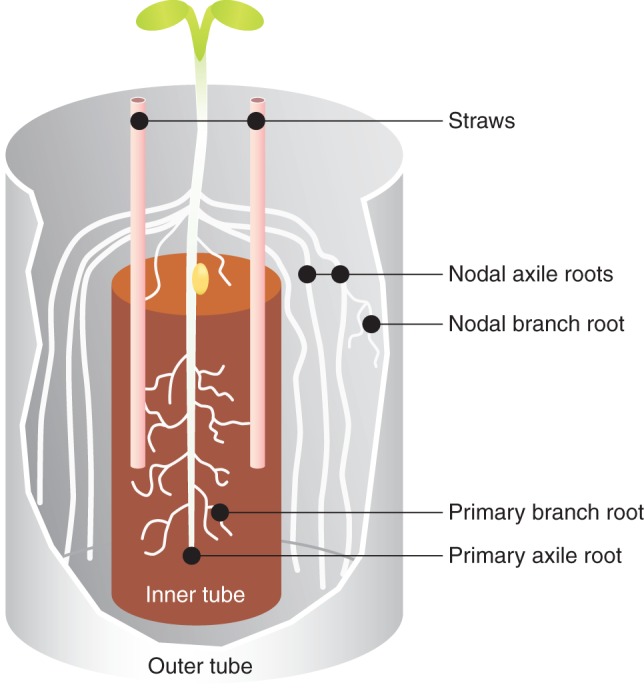
Methods: Sorghum and millet were grown in a split-pot system that allowed the primary and nodal roots to be watered separately.
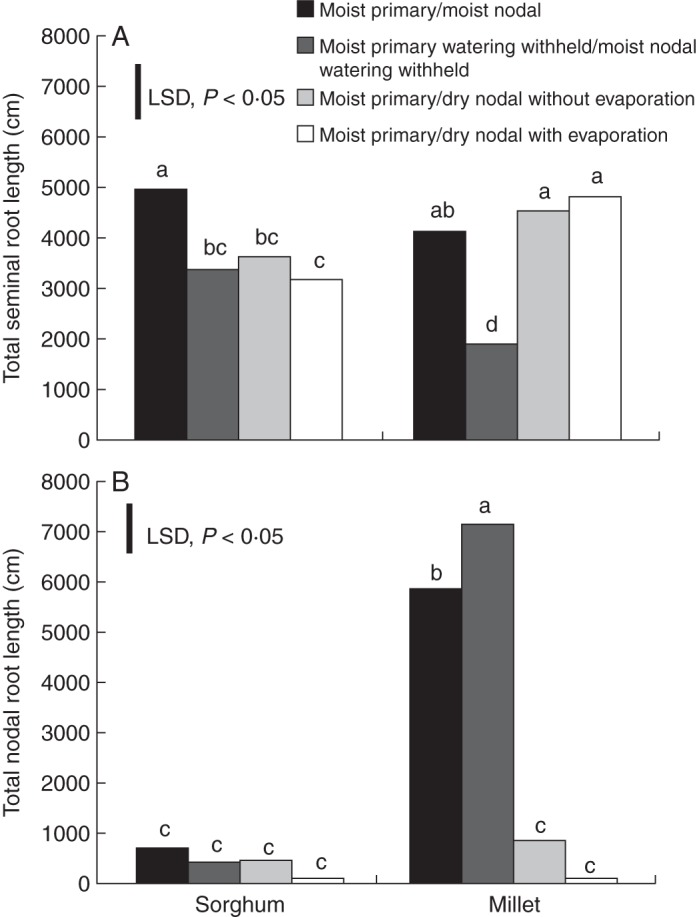
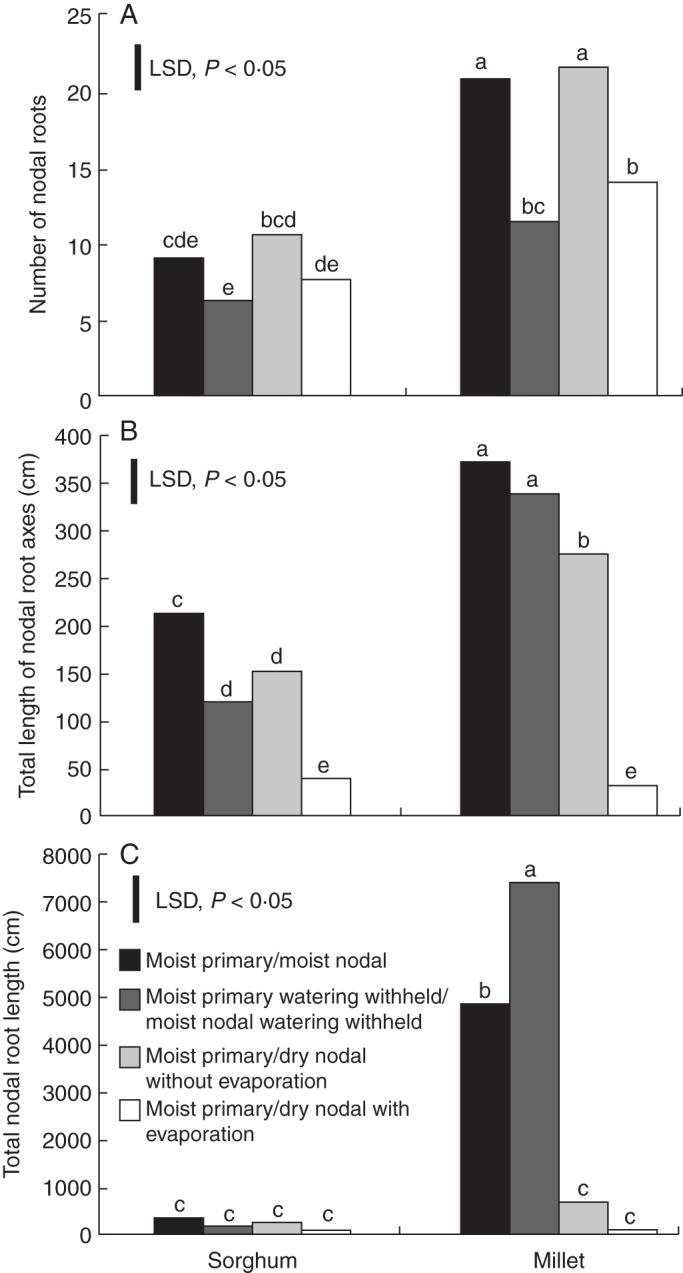
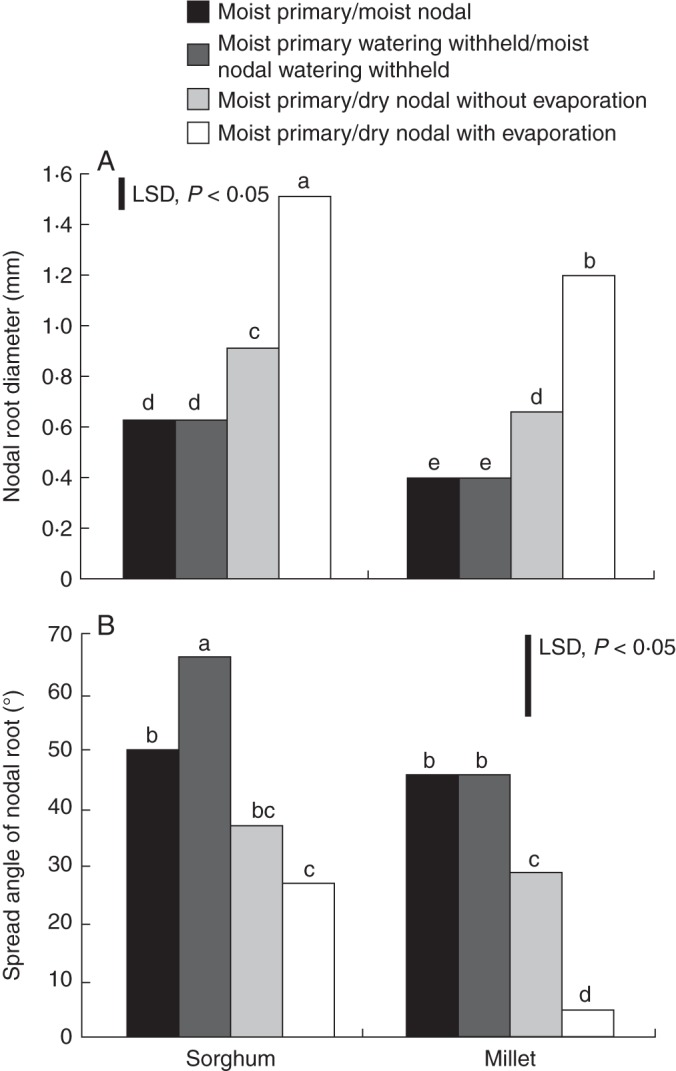
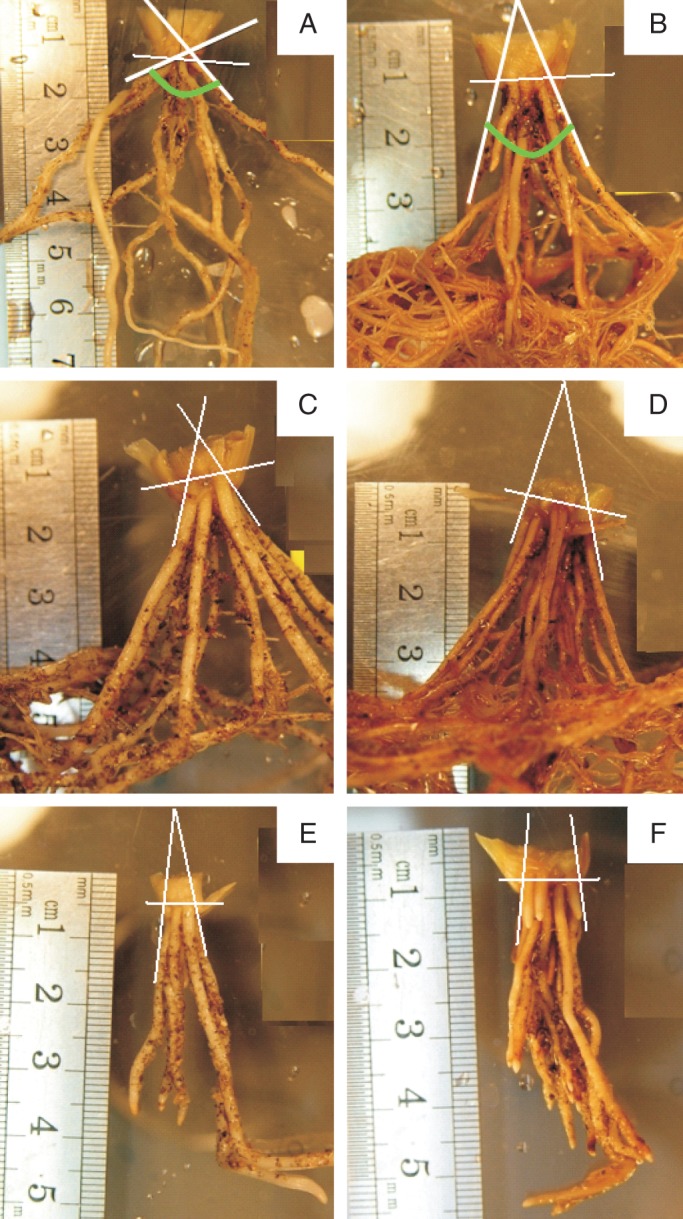
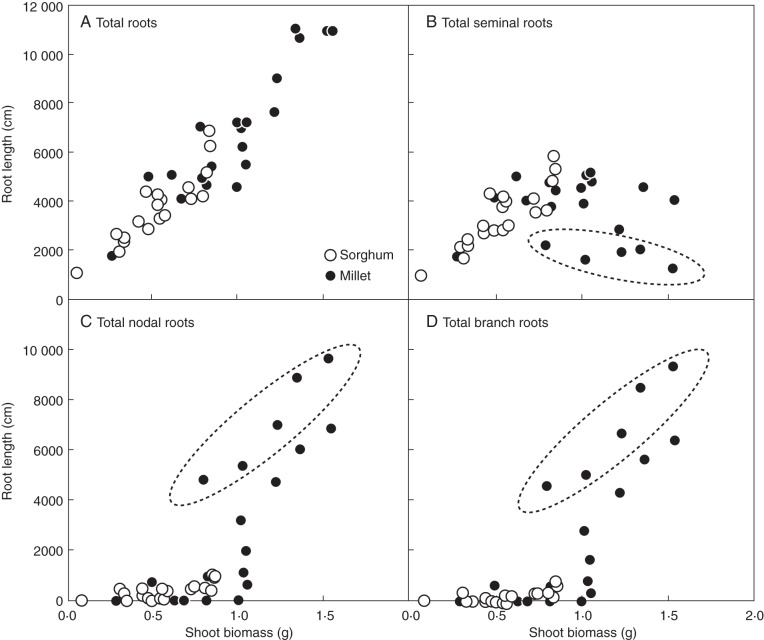
Key results: When primary and nodal roots were watered (12 % soil water content; SWC), millet nodal roots were seven times longer than those of sorghum and six times longer than millet plants in dry treatments, mainly from an 8-fold increase in branch root length. When soil was allowed to dry in both compartments, millet nodal roots responded and grew 20 % longer branch roots than in the well-watered control. Sorghum nodal roots were unchanged. When only primary roots received water, nodal roots of both species emerged and elongated into extremely dry soil (0.6-1.5 % SWC), possibly with phloem-delivered water from the primary roots in the moist inner pot. Nodal roots were thick, short, branchless and vertical, indicating a tropism that was more pronounced in millet. Total nodal root length increased in both species when the dry soil was covered with plastic, suggesting that stubble retention or leaf mulching could facilitate nodal roots reaching deeper moist layers in dry climates. Greater nodal root length in millet than in sorghum was associated with increased shoot biomass, water uptake and water use efficiency (shoot mass per water). Millet had a more plastic response than sorghum to moisture around the nodal roots due to (1) faster growth and progression through ontogeny for earlier nodal root branch length and (2) partitioning to nodal root length from primary roots, independent of shoot size.
Conclusions: Nodal and primary roots have distinct responses to soil moisture that depend on species. They can be selected independently in a breeding programme to shape root architecture. A rapid rate of plant development and enhanced responsiveness to local moisture may be traits that favour nodal roots and water use efficiency at no cost to shoot growth.
Keywords: Millet; Pennisetum glaucum; Sorghum bicolor; adventitious roots; crown roots; lateral roots; plasticity; soil moisture; sorghum; split-root system.
Figures
References
-
- Blum A, Arkin GF, Jordan WR. Sorghum root morphogenesis and growth. I. Effect of maturity genes. Crop Science. 1977;17:149–153.
-
- Boyer JS, Silk WK, Watt M. Path of water for root growth. Functional Plant Biology. 2010;37:1105–1116.
-
- Brady NC. The nature and properties of soils. 10th edn. New York: MacMillan Publishing Company; 1990.
-
- Crush JR, Nichols SN, Ouyang L. Adventitious root mass distribution in progeny of four perennial ryegrass (Lolium perenne L.) groups selected for root shape. New Zealand Journal of Agricultural Research. 2010;53:193–200.
-
- Esau K. Anatomy of seed plants. New York: John Wiley and Sons; 1977.
Publication types
MeSH terms
Substances
LinkOut - more resources
Full Text Sources
Other Literature Sources
