


Assessment of valve haemodynamics, reverse ventricular remodelling and myocardial fibrosis following transcatheter aortic valve implantation compared to surgical aortic valve replacement: a cardiovascular magnetic resonance study
- PMID: 23749779
- PMCID: PMC3747520
- DOI: 10.1136/heartjnl-2013-303927
Assessment of valve haemodynamics, reverse ventricular remodelling and myocardial fibrosis following transcatheter aortic valve implantation compared to surgical aortic valve replacement: a cardiovascular magnetic resonance study
Abstract
Objective: To compare the effects of transcatheter aortic valve implantation (TAVI) and surgical aortic valve replacement (SAVR) on aortic valve haemodynamics, ventricular reverse remodelling and myocardial fibrosis (MF) by cardiovascular magnetic resonance (CMR) imaging.
Design: A 1.5 T CMR scan was performed preoperatively and 6 months postoperatively.
Setting: University hospitals of Leeds and Leicester, UK.
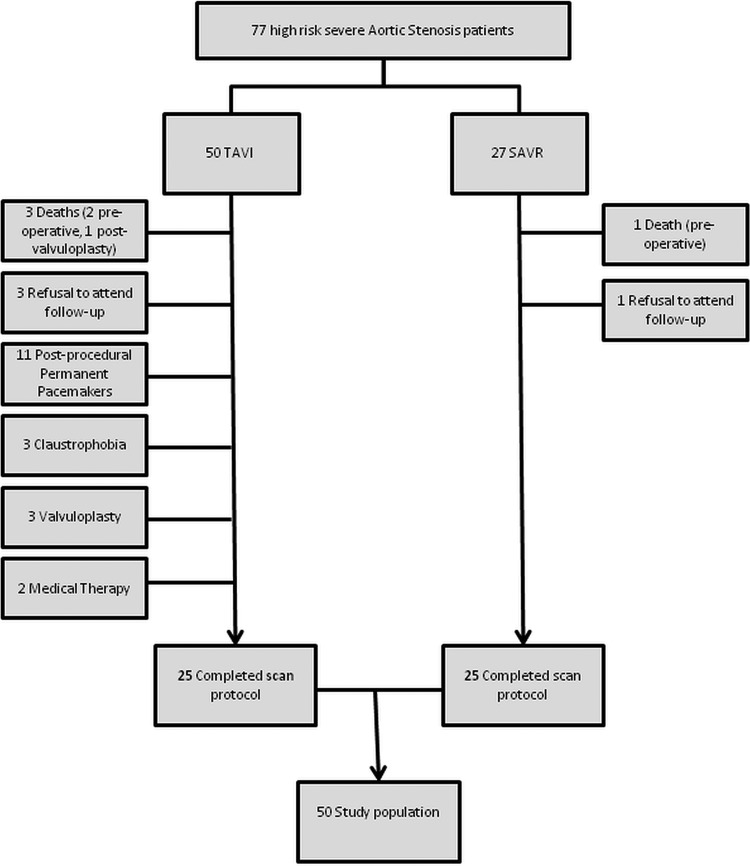
Patients: 50 (25 TAVI, 25 SAVR; age 77±8 years) high-risk severe symptomatic aortic stenosis (AS) patients.
Main outcome measures: Valve haemodynamics, ventricular volumes, ejection fraction (EF), mass and MF.
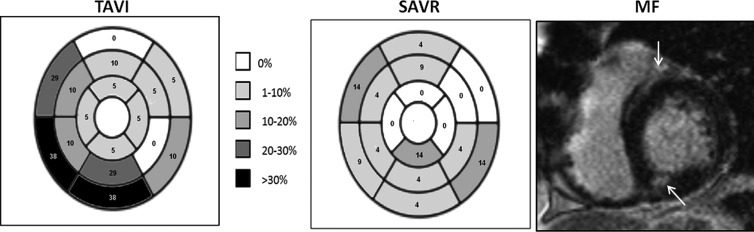
Results: Patients were matched for gender and AS severity but not for age (80±6 vs 73±7 years, p=0.001) or EuroSCORE (22±14 vs. 7±3, p<0.001). Aortic valve mean pressure gradient decreased to a greater degree post-TAVI compared to SAVR (21±8 mm Hg vs. 35±13 mm Hg, p=0.017). Aortic regurgitation reduced by 8% in both groups, only reaching statistical significance for TAVI (p=0.003). TAVI and SAVR improved (p<0.05) left ventricular (LV) end-systolic volumes (46±18 ml/m2 vs. 41±17 ml/m2; 44±22 ml/m2 vs. 32±6 ml/m2 and mass (83±20 g/m2 vs. 65±15 g/m2; 74±11 g/m2 vs. 59±8 g/m2). SAVR reduced end-diastolic volumes (92±19 ml/m2 vs. 74±12 ml/m2, p<0.001) and TAVI increased EF (52±12% vs. 56±10%, p=0.01). MF reduced post-TAVI (10.9±6% vs. 8.5±5%, p=0.03) but not post-SAVR (4.2±2% vs. 4.1±2%, p=0.98). Myocardial scar (p≤0.01) and baseline ventricular volumes (p<0.001) were the major predictors of reverse remodelling.
Conclusions: TAVI was comparable to SAVR at LV reverse remodelling and superior at reducing the valvular pressure gradient and MF. Future work should assess the prognostic importance of reverse remodelling and fibrosis post-TAVI to aid patient selection.
Figures
References
-
- Nkomo VT, Gardin JM, Skelton TN, et al. Burden of valvular heart diseases: a population-based study. Lancet 2006;368:1005–11 - PubMed
-
- Otto CM. Valvular aortic stenosis: disease severity and timing of intervention. J Am Coll Cardiol 2006;47:2141–51 - PubMed
-
- Sandstede JJ, Beer M, Hofmann S, et al. Changes in left and right ventricular cardiac function after valve replacement for aortic stenosis determined by cine MR imaging. J Magn Reson Imaging 2000;12:240–6 - PubMed
-
- Sandstede JJ, Johnson T, Harre K, et al. Cardiac systolic rotation and contraction before and after valve replacement for aortic stenosis: a myocardial tagging study using MR imaging. AJR Am J Roentgenol 2002;178:953–8 - PubMed
-
- Gaudino M. Survival after aortic valve replacement for aortic stenosis: does left ventricular mass regression have a clinical correlate? Eur Heart J 2004;26:51–7 - PubMed
Publication types
MeSH terms
Grants and funding
LinkOut - more resources
Full Text Sources
Other Literature Sources
Medical
Research Materials
