. 2013 Sep 1;208(5):780-9.
doi: 10.1093/infdis/jit251. Epub 2013 Jun 7.

Heterozygosity for the F508del mutation in the cystic fibrosis transmembrane conductance regulator anion channel attenuates influenza severity

Affiliations

Heterozygosity for the F508del mutation in the cystic fibrosis transmembrane conductance regulator anion channel attenuates influenza severity

Famke Aeffner et al. J Infect Dis. .

Abstract

Background: Seasonal and pandemic influenza are significant public health concerns. Influenza stimulates respiratory epithelial Cl(-) secretion via the cystic fibrosis transmembrane conductance regulator (CFTR). The purpose of this study was to determine the contribution of this effect to influenza pathogenesis in mice with reduced CFTR activity.

Methods: C57BL/6-congenic mice heterozygous for the F508del CFTR mutation (HET) and wild-type (WT) controls were infected intranasally with 10 000 focus-forming units of influenza A/WSN/33 (H1N1) per mouse. Body weight, arterial O2 saturation, and heart rate were monitored daily. Pulmonary edema and lung function parameters were derived from ratios of wet weight to dry weight and the forced-oscillation technique, respectively. Levels of cytokines and chemokines in bronchoalveolar lavage fluid were measured by enzyme-linked immunosorbent assay.

Results: Relative to WT mice, influenza virus-infected HET mice showed significantly delayed mortality, which was accompanied by attenuated hypoxemia, cardiopulmonary dysfunction, and pulmonary edema. However, viral replication and weight loss did not differ. The protective HET phenotype was correlated with exaggerated alveolar macrophage and interleukin 6 responses to infection and was abrogated by alveolar macrophage depletion, using clodronate liposomes.

Conclusions: Reduced CFTR expression modulates the innate immune response to influenza and alters disease pathogenesis. CFTR-mediated Cl(-) secretion is therefore an important host determinant of disease, and CFTR inhibition may be of therapeutic benefit in influenza.

Keywords: CFTR; Influenza; alveolar macrophage; cystic fibrosis; hypoxemia; lung function; pulmonary edema.


Figures
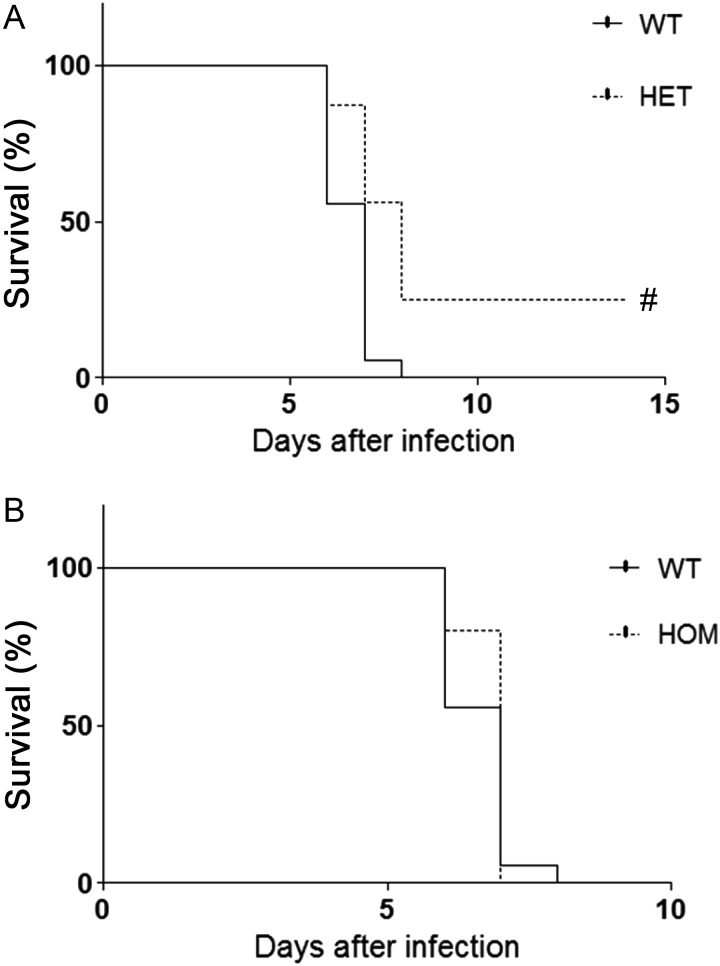
Figure 1.
Figure 1.
Heterozygosity for the F508del cystic fibrosis transmembrane conductance regulator (CFTR) mutation delays mortality following influenza virus infection. Effect of intranasal infection with H1N1 influenza A/WSN/33 (10 000 focus-forming units/mouse) on mortality in 16 F508del CFTR heterozygotes (HET; A) and 5 F508del CFTR homozygotes (HOM; B). #P < .0005, versus 18 wild-type C57BL/6 littermate controls (WT).
Figure 2.
Figure 2.
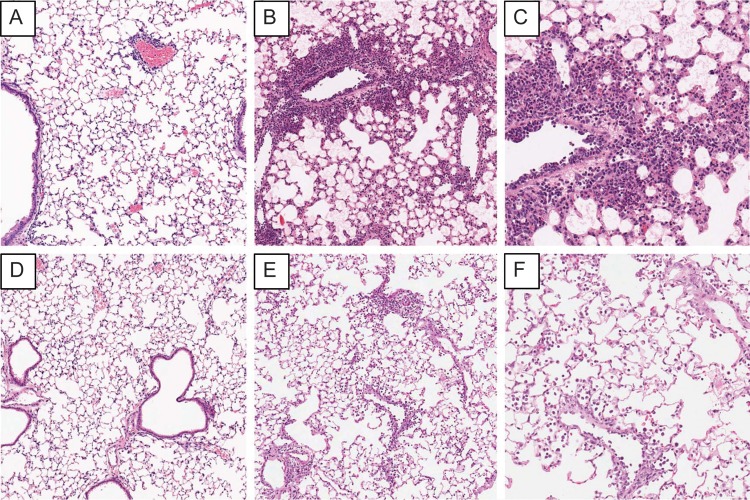
Pulmonary histopathology is attenuated in C57BL/6-congenic mice heterozygous for the F508del CFTR mutation (HET). Representative parenchymal and airway histology in hematoxylin-eosin–stained lung tissues, showing pathologic effects of influenza virus infection after 2 days (original magnification ×10; A) and 6 days (original magnification ×10 [B] ×20 [C]) in wild-type C57BL/6 littermate controls and after 2 days (original magnification ×10; D) and 6 days (original magnification ×10 [E] ×20 [F]) in HET mice.
Figure 3.
Figure 3.
Infection with influenza A virus induces an exaggerated, protective alveolar macrophage response in the lungs of C57BL/6-congenic mice heterozygous for the F508del CFTR mutation (HET). Effects of influenza virus infection after 2–6 days and treatment with clodronate liposomes for 6 days (6 CL-LIP) on bronchoalveolar lavage fluid (BALF) alveolar macrophages (AMs; n = 10–20 per group; A), BALF lymphocytes (n = 10–20 per group; B), BALF neutrophils (n = 10–20 per group; C), and mortality in untreated HET mice (n = 16; D) and CL-LIP–treated HET mice (n = 5; D). Data are presented as mean ± standard error of the mean. *P < .05, **P < .005, #P < .0005, versus uninfected wild-type C57BL/6 mice (WT) mice; ||P < .0005, versus WT mice at the same time point; P < .0005, versus non-CL-LIP–treated HET mice 6 days after infection.
Figure 4.
Figure 4.
Influenza virus–infected C57BL/6-congenic mice heterozygous for the F508del cystic fibrosis transmembrane conductance regulator (CFTR) mutation (HET) exhibit macrophage-dependent, replication-independent amelioration of cardiopulmonary dysfunction. Effects of influenza virus infection after 2–6 days and treatment with clodronate liposomes for 6 days (6 CL-LIP) on body weight (BWT; % change from day 0; n = 20 per group; A), carotid arterial oxygen saturation (SaO2; n = 20 per group; B), heart rate (beats/minute [bpm]; n = 20 per group; C), and log viral titers in lung homogenates (log focus-forming units/g; n = 8–10 per group; D). Data are presented as mean ± standard error of the mean. **P < .005, ||P < .0005, versus wild-type C57BL/6 mice at the same time point; #P < .0005, versus non-CL-LIP–treated mice of the same genotype 6 days after infection.
Figure 5.
Figure 5.
Heterozygosity for the F508del cystic fibrosis transmembrane conductance regulator (CFTR) mutation prevents influenza-induced pulmonary edema in a macrophage-dependent fashion. Effects of influenza virus infection after 2–6 days and treatment with clodronate liposomes for 6 days (6 CL-LIP) on lung water content (ratio of wet weight to dry weight; n = 6–9 per group; A) and bronchoalveolar lavage fluid (BALF) protein content (μg/mL; n = 6–10 per group; B). Data are presented as mean ± standard error of the mean. **P < .005, #P < .0005, versus uninfected wild-type C57BL/6 mice (WT) mice; P < .005, ||P < .0005, versus WT mice at the same time point; P < .0005, versus non-CL-LIP–treated C57BL/6-congenic mice heterozygous for the F508del CFTR mutation (HET) 6 days after infection.
Figure 6.
Figure 6.
Detrimental effects of influenza virus infection on airway resistance and lung compliance are attenuated in C57BL/6-congenic mice heterozygous for the F508del CFTR mutation. Effects of influenza virus infection after 2–6 days and treatment with clodronate liposomes for 6 days (6 CL-LIP) on static lung compliance (CST; mL/cm H2O, × 10; A), dynamic lung compliance (CDYN; mL/cmH2O, × 10; B), baseline total lung resistance (RBASAL; cmH2O.s/mL; C), and maximal lung resistance following nebulization of 50 mg/mL methacholine (RMAX; cm H2O.s/mL; D). There were 7–10 values per time point for both mouse strains. Data are presented as mean ± standard error of the mean. **P < .005, #P < .0005, versus uninfected wild-type C57BL/6 mice (WT) mice; P < .005, ||P < .0005, versus WT mice at the same time point; P < .0005, versus non-CL-LIP–treated HET mice 6 days after infection.

References

    1. Hamilton BE, Miniño AM, Martin JA, Kochanek KD, Strobino DM, Guyer B. Annual summary of vital statistics: 2005. Pediatrics. 2007;119:345–60. - PubMed
    1. Girard MP, Tam JS, Assossou OM, Kieny MP. The 2009 A (H1N1) influenza virus pandemic: A review. Vaccine. 2010;28:4895–902. - PubMed
    1. Taubenberger JK, Reid AH, Fanning TG. The 1918 influenza virus: A killer comes into view. Virology. 2000;274:241–5. - PubMed
    1. Thompson CI, Barclay WS, Zambon MC, Pickles RJ. Infection of human airway epithelium by human and avian strains of influenza A virus. J Virol. 2006;80:8060–8. - PMC - PubMed
    1. Ibricevic A, Pekosz A, Walter MJ, et al. Influenza virus receptor specificity and cell tropism in mouse and human airway epithelial cells. J Virol. 2006;80:7469–80. - PMC - PubMed

Publication types

MeSH terms

Substances