


Does size matter? Scaling of CO2 emissions and US urban areas
- PMID: 23750213
- PMCID: PMC3672169
- DOI: 10.1371/journal.pone.0064727
Does size matter? Scaling of CO2 emissions and US urban areas
Abstract
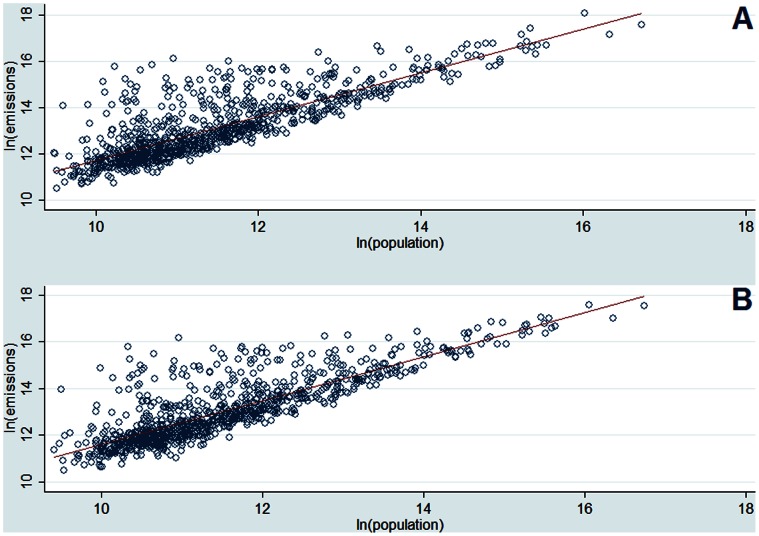
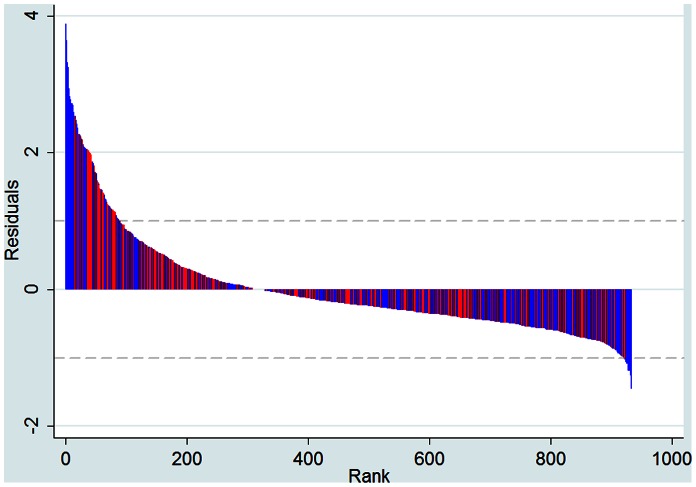
Urban areas consume more than 66% of the world's energy and generate more than 70% of global greenhouse gas emissions. With the world's population expected to reach 10 billion by 2100, nearly 90% of whom will live in urban areas, a critical question for planetary sustainability is how the size of cities affects energy use and carbon dioxide (CO2) emissions. Are larger cities more energy and emissions efficient than smaller ones? Do larger cities exhibit gains from economies of scale with regard to emissions? Here we examine the relationship between city size and CO2 emissions for U.S. metropolitan areas using a production accounting allocation of emissions. We find that for the time period of 1999-2008, CO2 emissions scale proportionally with urban population size. Contrary to theoretical expectations, larger cities are not more emissions efficient than smaller ones.
Conflict of interest statement
Figures
References
-
- Seto KC, Sanchez-Rodriguez R, Fragkias M (2010) The new geography of contemporary urbanization and the environment, Annu Rev Environ Resour. 35: 167–194.
-
- GEA (2012) Global energy assessment – toward a sustainable future, Cambridge, UK: Cambridge University Press. 1888 p.
-
- IEA (2012) World Energy Outlook 2012, Paris: International Energy Agency (IEA). 700 p.
-
- UN (2012) World Urbanization Prospects, the 2011 Revision. New York, NY: United Nations, Department of Economic and Social Affairs, Population Division. 302 p.
-
- Jones DW (1991) How urbanization affects energy use in developing countries. Energy Policy 19: 621–630.
MeSH terms
Substances
LinkOut - more resources
Full Text Sources
Other Literature Sources
