. 2013 Jun 10;18(6):6829-51.
doi: 10.3390/molecules18066829.

Exploring the C-X…π halogen bonding motif: an infrared and Raman study of the complexes of CF₃X (X = Cl, Br and I) with the aromatic model compounds benzene and toluene

Affiliations

Exploring the C-X…π halogen bonding motif: an infrared and Raman study of the complexes of CF₃X (X = Cl, Br and I) with the aromatic model compounds benzene and toluene

Nick Nagels et al. Molecules. .

Abstract

The formation of halogen bonded complexes formed between the trifluorohalomethanes CF₃Cl, CF₃Br and CF₃I and the Lewis bases benzene and toluene at temperatures below 150K was investigated using FTIR and Raman spectroscopy. Experiments using liquid krypton as solvent show that for both CF₃Br and CF₃I substantial fractions of the monomers can be involved in 1:1 complexes. In addition, weak absorptions illustrating the formation of 2:1 complexes between CF₃I and benzene are observed. Using spectra recorded at temperatures between 120 and 140 K, observed information on the relative stability was obtained for all complexes by determining the complexation enthalpies in solution. The resulting values for CF₃Br.benzene, CF₃I.benzene and (CF₃I)₂.benzene are -6.5(3), -7.6(2) and -14.5(9) kJ mol⁻¹. The values for CF₃Br.toluene and CF₃I.toluene are -6.2(5) and -7.4(5) kJ mol⁻¹. The experimental complexation enthalpies are compared with theoretical data obtained by combining results from MP2/aug-cc-pVDZ(-PP) and MP2/aug-cc-pVTZ(-PP) ab initio calculations, from statistical thermodynamical calculations and from Monte Carlo Free Energy Perturbation simulations. The data are also compared with results derived for other C-X···π halogen bonded complexes involving unsaturated Lewis bases such as ethene and ethyne.


Figures
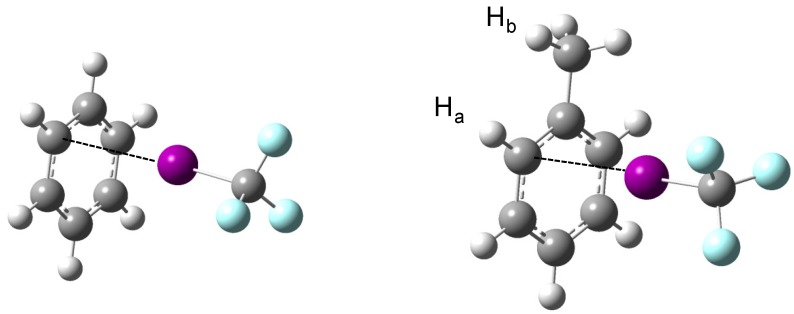
Figure 1
Figure 1
MP2/aug-cc-pVDZ(-PP) equilibrium geometries of the complexes of CF3I with benzene and toluene. Small changes observed for the complexes with CF3Br and CF3Cl are discussed in the text.
Figure 2
Figure 2
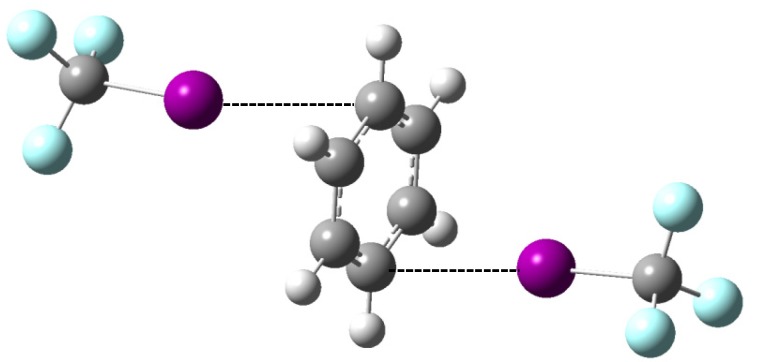
MP2/aug-cc-pVDZ(-PP) equilibrium geometry of the 2:1 complex involving two CF3I molecules and a single benzene molecule.
Figure 3
Figure 3
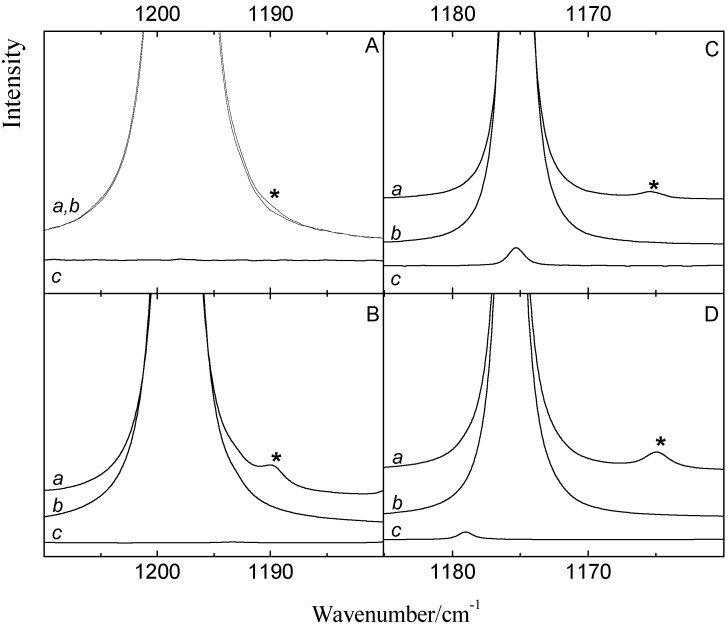
Infrared spectra of the antisymmetric ν4 stretching region of CF3X (with X = Br, I) for LKr solutions of mixtures of CF3Br (panels A and B) or CF3I (panels C and D) with benzene (panels A and C) or toluene (panel B and D) at 120 K. In each panel trace a represents the mixed solution, while traces b and c show the solution containing only CF3X (with X = Br, I) or the Lewis base, respectively. New bands appearing in the spectrum of the mixtures are marked with an asterisk (*) and are assigned to the 1:1 complex.
Figure 4
Figure 4
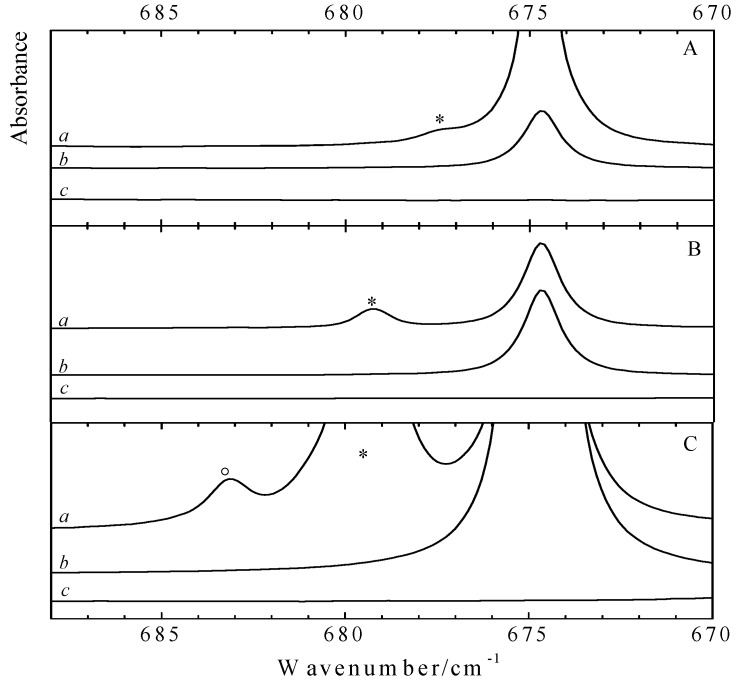
Infrared spectra of the C-H out of plane bending mode ν4 (A2u) of benzene for LKr solutions of mixtures of CF3Br (panel A) or CF3I (panels B and C) with benzene at 120K. In each panel trace a represents the mixed solution, while traces b and c show the solution containing only benzene and CF3X (with X = Br, I), respectively. New bands appearing in the spectrum of the mixtures are marked with an asterisk (*) and are assigned to the 1:1 complex. Panel C is obtained by using higher concentrations of both CF3I and benzene. In this panel, the band marked with a circle (°) is assigned to the 2:1 complex with two molecules CF3I and a single molecule benzene.
Figure 5
Figure 5
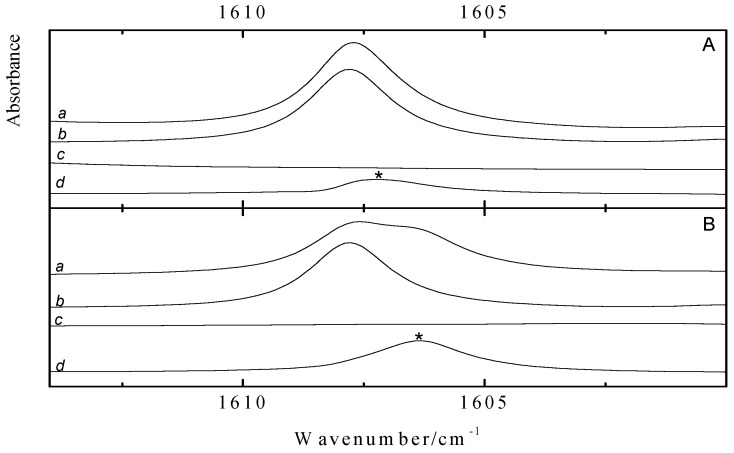
Infrared spectra of the in plane deformation ν4 (A1) of toluenefor LKr solutions of mixtures of CF3Br (panel A) or CF3I (panel B) with toluene at 120K. Additional bands are visible in the spectrum of the complex (trace d), which is obtained after subtracting the rescaled monomer traces b and c from the mixture trace a. Traces b and c show the solution containing only toluene and CF3X (with X = Br, I), respectively. New bands appearing in thespectrum of the complex are marked with an asterisk (*) and are assigned to the 1:1 complex.
Figure 6
Figure 6
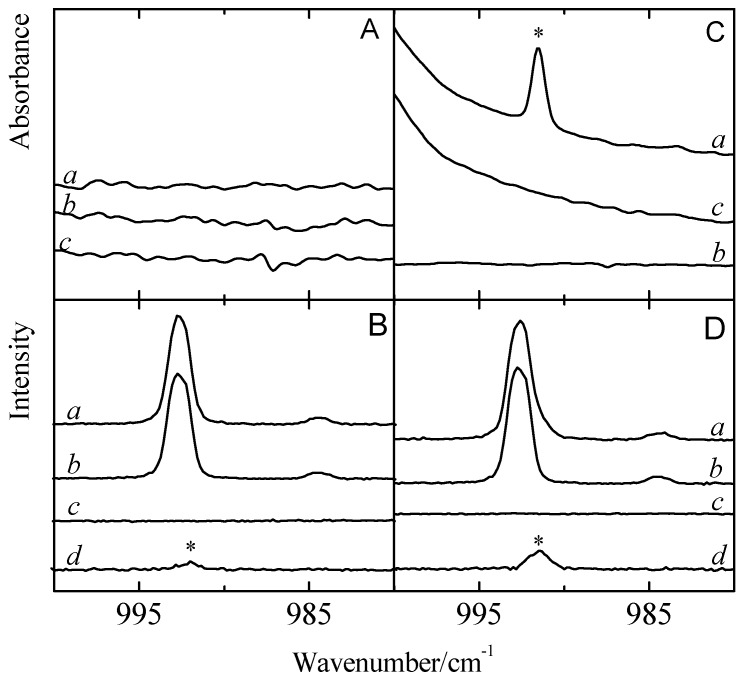
Panels A and C present the infrared spectra and panels B and D the Raman spectra of the so-called ring breathing mode ν2 of benzene for solutions with CF3Br (panels A and B) and CF3I (panels C and D). Trace a gives the spectrum of the mixed solution, while traces b and c are the spectra of the monomer benzene and CF3X (with X = Br, I), respectively. Trace d is the spectrum of the 1:1 complex, obtained by subtracting the rescaled monomer traces b and c from the mixture trace a. New bands appearing in the spectrum of the complex are marked with an asterisk (*) and are assigned to the 1:1 complex.
Figure 7
Figure 7
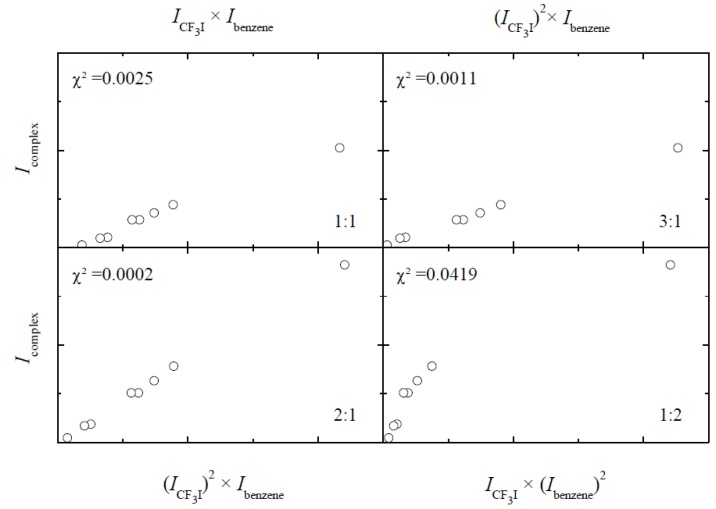
Typical results obtained for the concentrations studies supporting the assignment of the 683.2 cm−1 band observed in spectra of mixed solutions in LKr containing CF3I and benzene to a complex with 2:1 stoichiometry.
Figure 8
Figure 8
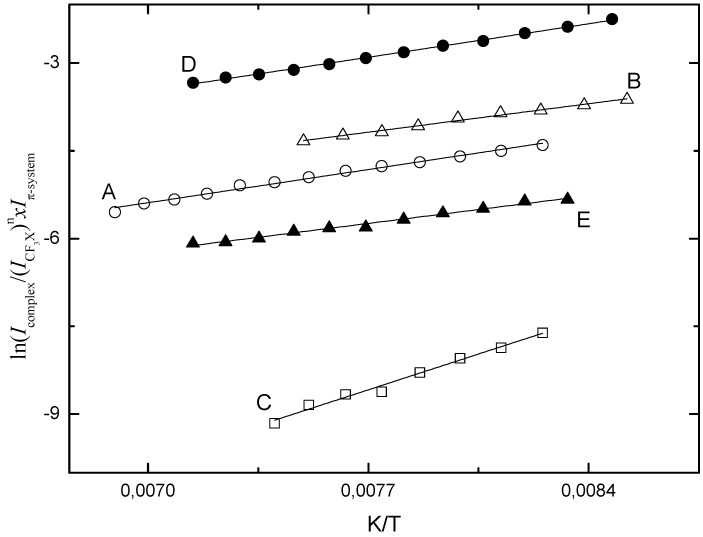
Typical Van’t Hoff plots obtained for the halogen bonded complexes observed in liquid krypton: (A) CF3I·benzene, (B) CF3Br·benzene, (C) (CF3I)2.benzene, (D) CF3I·toluene and (E) CF3Br·toluene.

References

    1. Metrangolo P., Meyer F., Pilati T., Resnati G., Terraneo G. Halogen bonding in supramolecular chemistry. Angew. Chem. Int. Ed. 2008;47:6114–6127. doi: 10.1002/anie.200800128. - DOI - PubMed
    1. Meyer F., Dubois P. Halogen bonding at work: Recent applications in synthetic chemistry and materials science. CrystEngComm. 2013;15:3058–3071. doi: 10.1039/c2ce26150b. - DOI
    1. Scholfield M.R., Zanden C.M.V., Carter M., Ho P.S. Halogen bonding: A biological perspective. Protein Sci. 2013;22:139–152. doi: 10.1002/pro.2201. - DOI - PMC - PubMed
    1. Lu Y., Wang Y., Zhu W. Nonbonding interactions of organic halogens in biological systems: implications for drug discovery and biomolecular design. Phys. Chem. Chem. Phys. 2010;12:4543–4551. doi: 10.1039/b926326h. - DOI - PubMed
    1. Wilcken R., Zimmermann M.O., Lange A., Joerger A.C., Boeckler F.M. Principles and applications of halogen bonding in medicinal chemistry and chemical biology. J. Med. Chem. 2013;56:1363–1388. doi: 10.1021/jm3012068. - DOI - PubMed

Publication types

LinkOut - more resources