. 2013 May 28:7:88.
doi: 10.3389/fnins.2013.00088. eCollection 2013.

Expression of three GnRH receptors in specific tissues in male and female sea lampreys Petromyzon marinus at three distinct life stages

Affiliations

Expression of three GnRH receptors in specific tissues in male and female sea lampreys Petromyzon marinus at three distinct life stages

Jeffrey A Hall et al. Front Neurosci. .

Abstract

Two recently cloned gonadotropin-releasing hormone (GnRH) receptors (lamprey GnRH-R-2 and lamprey GnRH-R-3) along with lamprey (l) GnRH-R-1 were shown to share similar structural features and amino acid motifs common to other vertebrate receptors. Here we report on our findings of RNA expression of these three GnRH receptors in the three major life stages (larval, parasitic, and adult phases) of the sea lamprey, Petromyzon marinus, a basal vertebrate. For each stage, we examined the expression of messenger RNA encoding the receptors in the brain, pituitary, gonad, heart, muscle, liver, eye, intestine, kidney, skin, thyroid, gill, and endostyle by RT-PCR. In adult lampreys, the spatial expression of the three receptors in the brain and pituitary was investigated by in situ hybridization. In general, the receptors were more widely expressed in adult tissues as compared to parasitic-phase tissues and least widely expressed in the larval tissues. There were noted differences in male and female lampreys in the adult and parasitic phases for all three receptors. The data showed the presence of all three receptor transcripts in brain tissues for adult and parasitic phases and all three receptor transcripts were expressed in the adult pituitaries, but not in the parasitic pituitaries. However, in the larval phase, only lGnRH-R-1 was expressed in the larval brain and pituitary. In situ hybridization revealed that lGnRH-R-2 and -3 were expressed in the pineal tissue of adult female lampreys while lGnRH-R-1 was expressed in the pineal in adult male lampreys, all restricted to the pineal pellucida. In summary, these data provide an initial comparative analysis of expression of three lamprey GnRH receptors suggesting differential regulation within males and females at three different life/reproductive stages.

Keywords: basal vertebrate; gonadotropin-releasing hormone receptors; hormone; lamprey; pituitary; receptor.


Figures
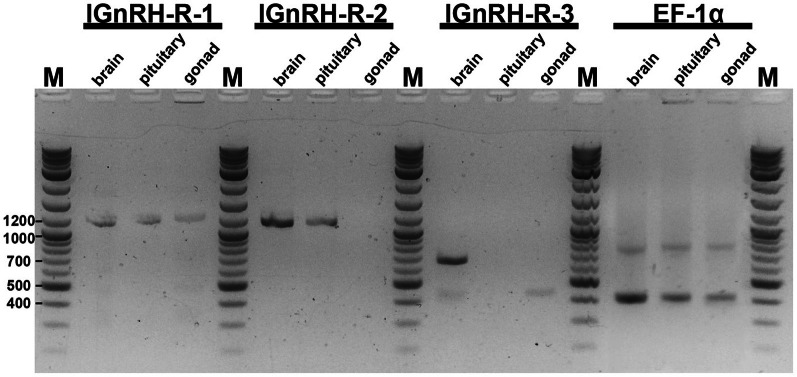
Figure 1
Figure 1
Electrophoresis of RT-PCR products on a 1.8% TAE agarose gel. The expected band size for each of the receptor RNA is as follows: lGnRH-R-1 at 1229 bp; lGnRH-R-2 at 1153 bp; and lGnRH-R-3 at 655 bp. EF-1α band size is 390 bp. In this figure, adult male brain, pituitary, and gonad tissues are shown. M = 2-Log ladder NEB (Beverly, MA); size (bps) of marker bands are indicated on the side.
Figure 2
Figure 2
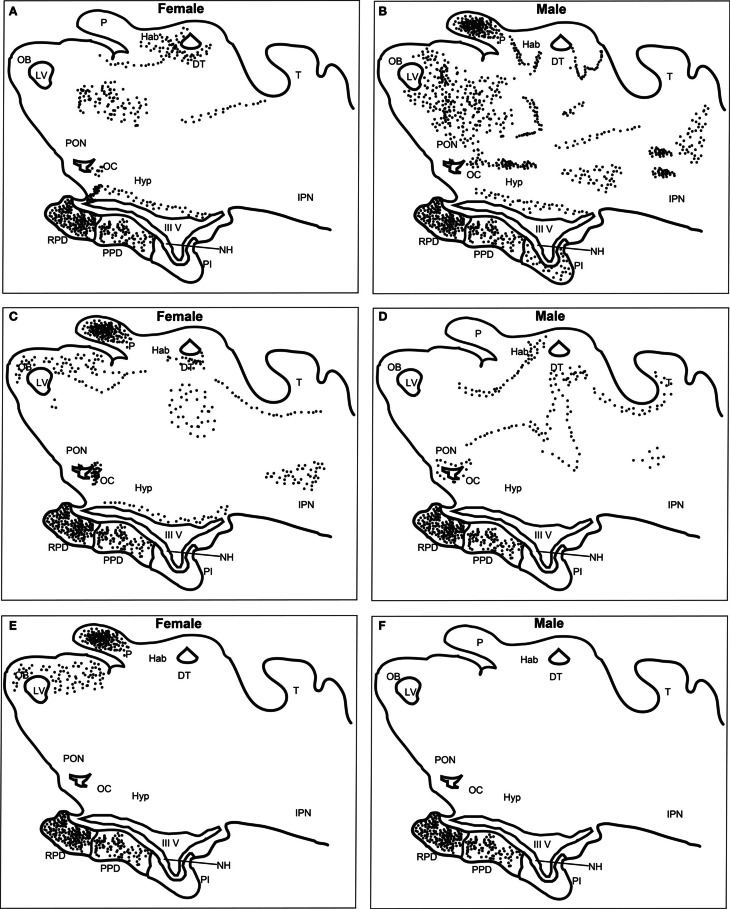
Distribution of lGnRH-R-1, -2, and -3 RNA expression in adult female and male brains using in situ hybridization (DIG-labeled). lGnRH-R-1 RNA expression shown in female (A) and male (B), lGnRH-R-2 in female (C) and male (D), and lGnRH-R-3 in female (E) and male (F). Black dots are used to indicate the receptor message expression using the DIG system. Key for labeled features; DT, Dorsal Thalamus; Hab, Habenula; Hyp, Hypothalamus; IPN, Interpeduncular Nucleus; IIIV, Third Ventricle; LV, Left Ventricle; NH, Neurohypophysis; OB, Olfactory Bulb; OC, Optic Chiasm; P, Pineal; PON, Preoptic Nucleus; PI, Pars Intermedia; PPD, Proximal Pars Distalis; RPD, Rostral Pars Distalis; and T, Optic Tectum.
Figure 3
Figure 3
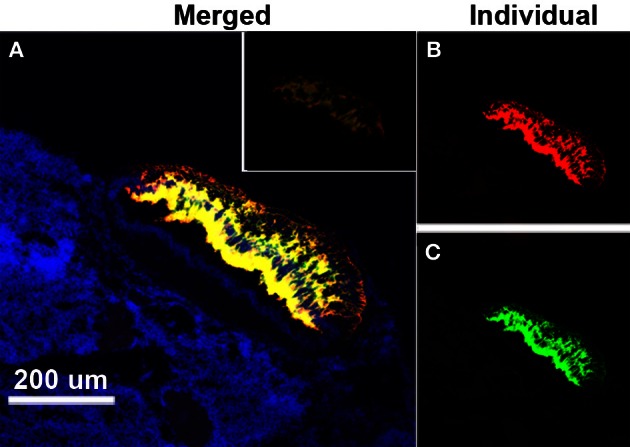
Expression of lGnRH-R-2 and R-3 RNA in the pineal of a female lamprey using in situ hybridization. (A) The merged channel (displayed as yellow) shows the composite of “anti-sense” expression of lGnRH-R-2 (Cy3-red channel) and lGnRH-R-3 (FITC-green channel) while DAPI (blue) is used to show the surrounding cell structure. The inset shows the control “sense” hybridization. The smaller panels have the lGnRH-R-2 (B) and lGnRH-R-3 (C) signals displayed individually.

References

    1. Bolduc T. G., Sower S. A. (1992). Changes in brain gonadotropin-releasing hormone, plasma estradiol 17- beta, and progesterone during the final reproductive cycle of the female sea lamprey, Petromyzon marinus. J. Exp. Zool. 264, 55–63 10.1002/jez.1402640109 - DOI - PubMed
    1. Chen C. C., Fernald R. D. (2008). GnRH and GnRH receptors: distribution, function and evolution. J. Fish Biol. 73, 1099–1120 10.1111/j.1095-8649.2008.01936.x - DOI
    1. Daukss D., Gazda K., Kosugi T., Osugi T., Tsutsui K., Sower S. A. (2012). Effects of lamprey PQRFamide peptides on brain gonadotropin-releasing hormone concentrations and pituitary gonadotropin-beta mRNA expression. Gen. Comp. Endocrinol. 177, 215–219 10.1016/j.ygcen.2012.04.024 - DOI - PubMed
    1. Fahien C. M., Sower S. A. (1990). Relationship between brain gonadotropin-releasing hormone and final reproductive period of the adult male sea lamprey, Petromyzon marinus. Gen. Comp. Endocrinol. 80, 427–437 10.1016/0016-6480(90)90192-O - DOI - PubMed
    1. Falcon J., Migaud H., Munoz-Cueto J. A., Carrillo M. (2010). Current knowledge on the melatonin system in teleost fish. Gen. Comp. Endocrinol. 165, 469–482 10.1016/j.ygcen.2009.04.026 - DOI - PubMed

LinkOut - more resources