. 2013 Jun 6;7(6):e2260.
doi: 10.1371/journal.pntd.0002260. Print 2013.

Atmospheric moisture variability and transmission of hemorrhagic fever with renal syndrome in Changsha City, Mainland China, 1991-2010

Affiliations

Atmospheric moisture variability and transmission of hemorrhagic fever with renal syndrome in Changsha City, Mainland China, 1991-2010

Hong Xiao et al. PLoS Negl Trop Dis. .

Abstract

Background: The transmission of hemorrhagic fever with renal syndrome (HFRS) is influenced by environmental determinants. This study aimed to explore the association between atmospheric moisture variability and the transmission of hemorrhagic fever with renal syndrome (HFRS) for the period of 1991-2010 in Changsha, China.

Methods and findings: Wavelet analyses were performed by using monthly reported time series data of HFRS cases to detect and quantify the periodicity of HFRS. A generalized linear model with a Poisson distribution and a log link model were used to quantify the relationship between climate and HFRS cases, highlighting the importance of moisture conditions. There was a continuous annual oscillation mode and multi-annual cycle around 3-4 years from 1994 to 1999. There was a significant association of HFRS incidence with moisture conditions and the Multivariate El Niño-Southern Oscillation Index (MEI). Particularly, atmospheric moisture has a significant effect on the propagation of HFRS; annual incidence of HFRS was positively correlated with annual precipitation and annual mean absolute humidity.

Conclusions: The final model had good accuracy in forecasting the occurrence of HFRS and moisture condition can be used in disease surveillance and risk management to provide early warning of potential epidemics of this disease.


Conflict of interest statement

The authors have declared that no competing interests exist.

Figures
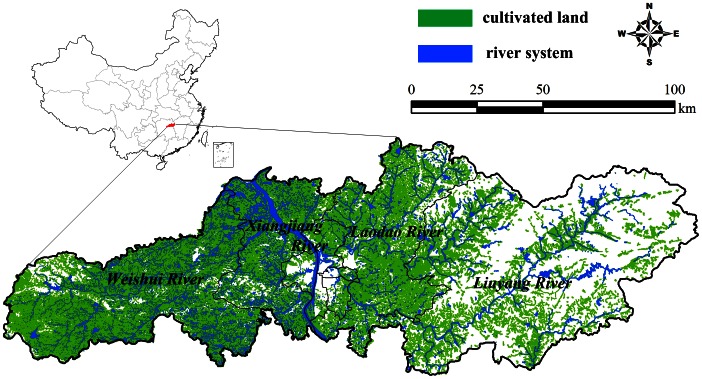
Figure 1
Figure 1. Geographic location of Changsha, China.
Figure 2
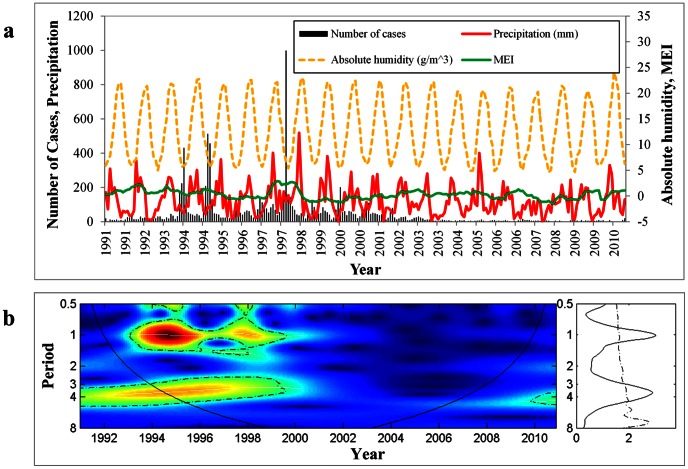
Figure 2. Wavelet power spectrum of HFRS incidence in Changsha.
(A) Temporal variation in climatic variables and the number of hemorrhagic fever with renal syndrome (HFRS) cases in Changsha, 1991–2010. (B) The wavelet power spectrum of monthly number of HFRS cases by date of symptoms onset reported through the surveillance system in Changsha during the period 1991–2010 (square root transformed). The left panel illustrates the wavelet power spectrum for the different series (x-axia: time in year; y-axis: period in year). The power is coded from low values, in dark blue, to high values, in dark red. Statistically significant areas (threshold of 5% confidence interval) in wavelet power spectrum (left panels) are highlighted with dashed line; the cone of influence (region not influenced by edge effects) is also indicated. Finally, the right panels show the mean spectrm (solid line) with its significant threshold value of 5% (dashed line).
Figure 3
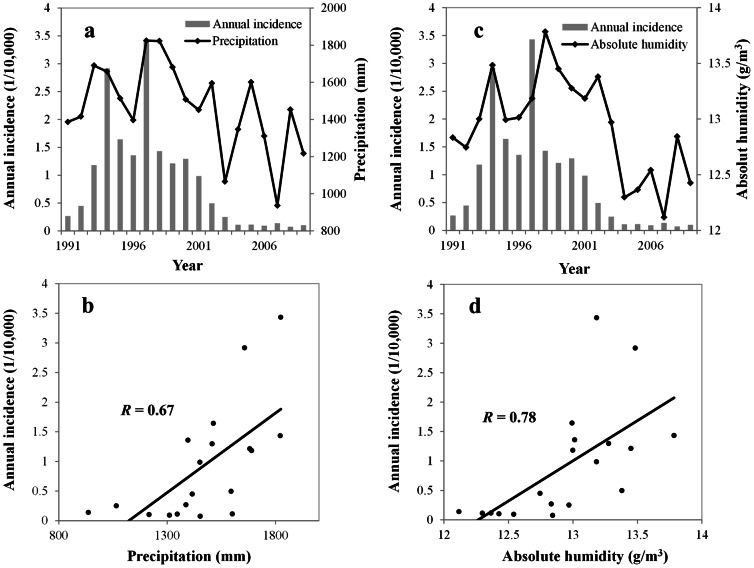
Figure 3. Annual HFRS cases and annual moisture condition, 1991–2010.
(A) Temporal dynamics of annual precipitation and HFRS cases. (B) Scatterplot of annual precipitation and HFRS cases. (C) Temporal dynamics of annual mean AH and HFRS cases. (D) Scatterplot of annual mean AH and HFRS cases. The thick solid straight lines are linear regressions of annual HFRS cases and moisture condition.
Figure 4
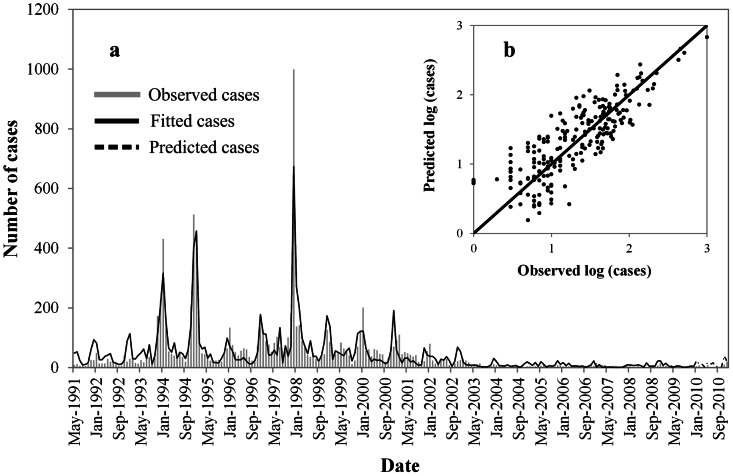
Figure 4. Observed versus predicted HFRS cases in Changsha.
(A) Temporal dynamics, and (B) scatterplot.

References

    1. Huang X, Yin H, Yan L, Wang X, Wang S (2012) Epidemiologic characteristics of haemorrhagic fever with renal syndrome in Mainland China from 2006 to 2010. West Pac Surveill Response J 3: 1–7. - PMC - PubMed
    1. Yan L, Fang LQ, Huang HG, Zhang LQ, Feng D, et al. (2007) Landscape elements and Hantaan virus–related hemorrhagic fever with renal syndrome, People's Republic of China. Emerg Infect Dis 13: 1301–1306. - PMC - PubMed
    1. Clement J, Vercauteren J, Verstraeten W, Ducoffre G, Barrios J, et al. (2009) Relating increasing hantavirus incidences to the changing climate: the mast connection. Int J Health Geogr 8: 1. - PMC - PubMed
    1. Zhang WY, Guo WD, Fang LQ, Li CP, Bi P, et al. (2010) Climate variability and hemorrhagic fever with renal syndrome transmission in Northeastern China. Environ Health Perspect 118: 915–920. - PMC - PubMed
    1. Kallio ER, Klingström J, Gustafsson E, Manni T, Vaheri A, et al. (2006) Prolonged survival of Puumala hantavirus outside the host: evidence for indirect transmission via the environment. J Gen Virol 87: 2127–2134. - PubMed

Publication types

MeSH terms

LinkOut - more resources