


Reproducibility of a long-range swept-source optical coherence tomography ocular biometry system and comparison with clinical biometers
- PMID: 23755873
- PMCID: PMC3785553
- DOI: 10.1016/j.ophtha.2013.04.007
Reproducibility of a long-range swept-source optical coherence tomography ocular biometry system and comparison with clinical biometers
Abstract
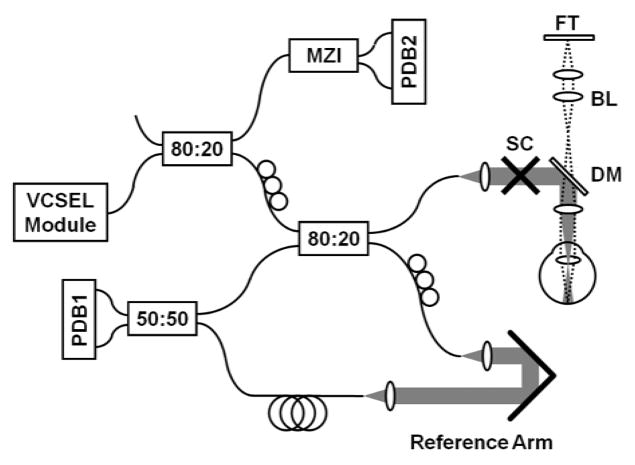
Objective: To demonstrate a novel swept source optical coherence tomography (SS-OCT) imaging device using a vertical cavity surface-emitting laser (VCSEL) capable of imaging the full eye length and to introduce a method using this device for noncontact ocular biometry. To compare the measurements of intraocular distances using this SS-OCT instrument with commercially available optical and ultrasound biometers. To evaluate the intersession reproducibility of measurements of intraocular distances using SS-OCT.
Design: Evaluation of technology.
Participants: Twenty eyes of 10 healthy subjects imaged at the New England Eye Center at Tufts Medical Center and Massachusetts Institute of Technology between May and September 2012.
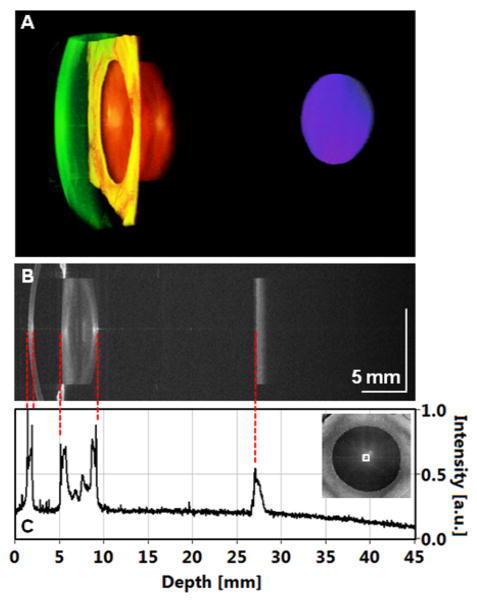
Methods: Averaged central depth profiles were extracted from volumetric SS-OCT datasets. The intraocular distances, such as central corneal thickness (CCT), aqueous depth (AD), anterior chamber depth (ACD), crystalline lens thickness (LT), vitreous depth (VD), and axial length (AL), were measured and compared with a partial coherence interferometry device (IOLMaster; Carl Zeiss Meditec, Inc., Dublin, CA) and an immersion ultrasound (IUS) A-scan biometer (Axis-II PR; Quantel Medical, Inc., Cournon d'Auvergne Cedex, France).
Main outcome measures: Reproducibility of the measurements of intraocular distances, correlation coefficients, and intraclass correlation coefficients.
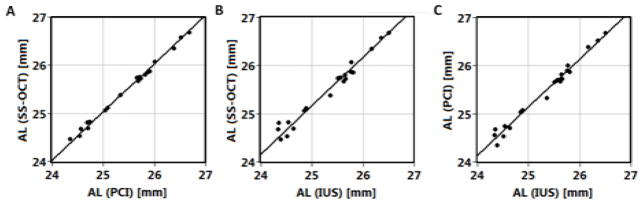
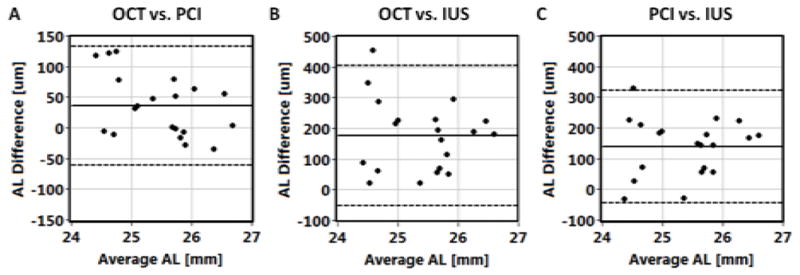
Results: The standard deviations of the repeated measurements of intraocular distances using SS-OCT were 6 μm (CCT), 16 μm (ACD), 14 μm (AD), 13 μm (LT), 14 μm (VD), and 16 μm (AL). Strong correlations among all 3 biometric instruments were found for AL (r > 0.98). The AL measurement using SS-OCT correlates better with the IOLMaster (r=0.998) than with IUS (r=0.984). The SS-OCT and IOLMaster measured higher AL values than ultrasound (175 and 139 μm, respectively). No statistically significant difference in ACD between the optical (SS-OCT or IOLMaster) and ultrasound methods was detected. High intersession reproducibility of SS-OCT measurements of all intraocular distances was observed with intraclass correlation coefficients >0.99.
Conclusions: The SS-OCT using VCSEL technology enables full eye length imaging and high-precision, noncontact ocular biometry. The measurements with the prototype SS-OCT instrument correlate well with commercial biometers. The SS-OCT biometry has the potential to provide clinically useful comprehensive biometric parameters for pre- and postoperative eye evaluation.
Copyright © 2013 American Academy of Ophthalmology. Published by Elsevier Inc. All rights reserved.
Conflict of interest statement
Jay S. Duker – Research Support – Carl Zeiss Meditec Inc., Optovue Inc., and Topcon Medical Systems Inc.; Stock – Hemera Biosciences Inc., EyeNetra, and Ophthotech Corp.
Benjamin Potsaid – Royalities – from intellectual property owned by M.I.T and licensed to Optovue Inc.; Employment – Thorlabs Inc.
Vijaysekhar Jayaraman – Stock and Employment – Praevium Inc.; Royalities – Thorlabs Inc.
Alex Cable – Stock and Employment – Thorlabs Inc.; Stock – Praevium Inc.
Figures
References
-
- Olsen T. Calculation of intraocular lens power: a review. Acta Ophthalmol Scand. 2007;85:472–85. - PubMed
-
- Jansson F. Measurements of intraocular distances by ultrasound. Acta Ophthalmol Suppl. 1963;(suppl 74):1–51. - PubMed
-
- Fujimoto JG, Desilvestri S, Ippen EP, et al. Femtosecond optical ranging in biological systems. Opt Lett. 1986;11:150–2. - PubMed
-
- Fercher AF, Mengedoht K, Werner W. Eye-length measurement by interferometry with partially coherent light. Opt Lett. 1988;13:186–8. - PubMed
Publication types
MeSH terms
Grants and funding
- R01-EY019029-04/EY/NEI NIH HHS/United States
- R01 CA075289/CA/NCI NIH HHS/United States
- R01 EY019029/EY/NEI NIH HHS/United States
- R01-EY013178-12/EY/NEI NIH HHS/United States
- R01-CA075289-16/CA/NCI NIH HHS/United States
- R01 EY011289/EY/NEI NIH HHS/United States
- R01-EY013516-09/EY/NEI NIH HHS/United States
- R01 EY013516/EY/NEI NIH HHS/United States
- R44CA101067-05/CA/NCI NIH HHS/United States
- R44 EY022864/EY/NEI NIH HHS/United States
- R01-NS057476-05/NS/NINDS NIH HHS/United States
- R44EY022864-01/EY/NEI NIH HHS/United States
- R01 NS057476/NS/NINDS NIH HHS/United States
- R44 CA101067/CA/NCI NIH HHS/United States
- R01 EY013178/EY/NEI NIH HHS/United States
- R01-EY011289-27/EY/NEI NIH HHS/United States
LinkOut - more resources
Full Text Sources
Other Literature Sources
Research Materials
