Review
. 2013 Sep;33(9):1335-46.
doi: 10.1038/jcbfm.2013.93. Epub 2013 Jun 12.

Epigenetic mechanisms in cerebral ischemia

Affiliations
Review

Epigenetic mechanisms in cerebral ischemia

Sophie Schweizer et al. J Cereb Blood Flow Metab. 2013 Sep.

Abstract

Treatment efficacy for ischemic stroke represents a major challenge. Despite fundamental advances in the understanding of stroke etiology, therapeutic options to improve functional recovery remain limited. However, growing knowledge in the field of epigenetics has dramatically changed our understanding of gene regulation in the last few decades. According to the knowledge gained from animal models, the manipulation of epigenetic players emerges as a highly promising possibility to target diverse neurologic pathologies, including ischemia. By altering transcriptional regulation, epigenetic modifiers can exert influence on all known pathways involved in the complex course of ischemic disease development. Beneficial transcriptional effects range from attenuation of cell death, suppression of inflammatory processes, and enhanced blood flow, to the stimulation of repair mechanisms and increased plasticity. Most striking are the results obtained from pharmacological inhibition of histone deacetylation in animal models of stroke. Multiple studies suggest high remedial qualities even upon late administration of histone deacetylase inhibitors (HDACi). In this review, the role of epigenetic mechanisms, including histone modifications as well as DNA methylation, is discussed in the context of known ischemic pathways of damage, protection, and regeneration.


Figures
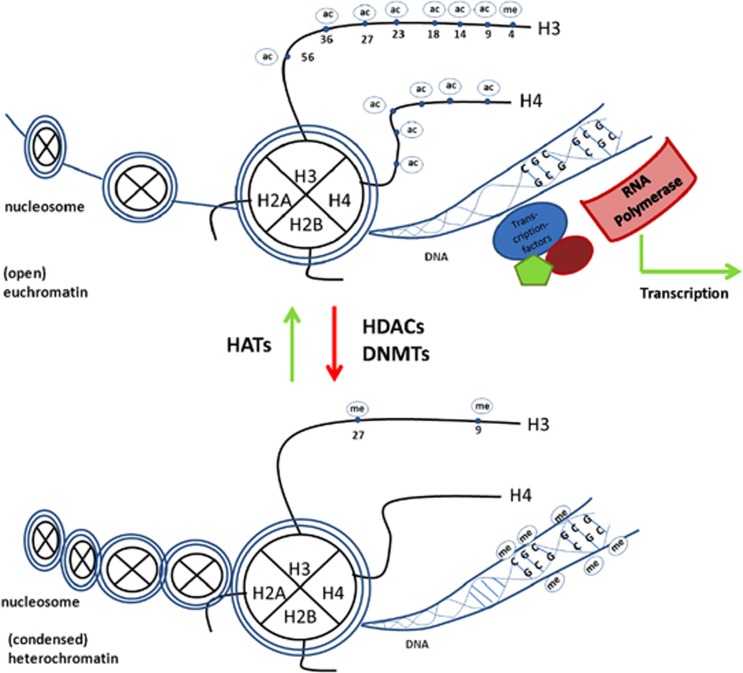
Figure 1
Figure 1
Epigenetic regulation of transcription. Transcription is possible within open (eu-) chromatic regions, where typical epigenetic marks, such as histone 3 and 4 acetylation (ac), as well as histone 3 lysine 4 trimethylation (me) appear together with the lack of DNA methylation (me). However, genes in more condensed (hetero-) chromatic regions are repressed. Characteristic epigenetic marks are DNA methylation together with histone 3 lysine 9 di-/trimethylation, as well as lysine 27 trimethylation.
Figure 2
Figure 2
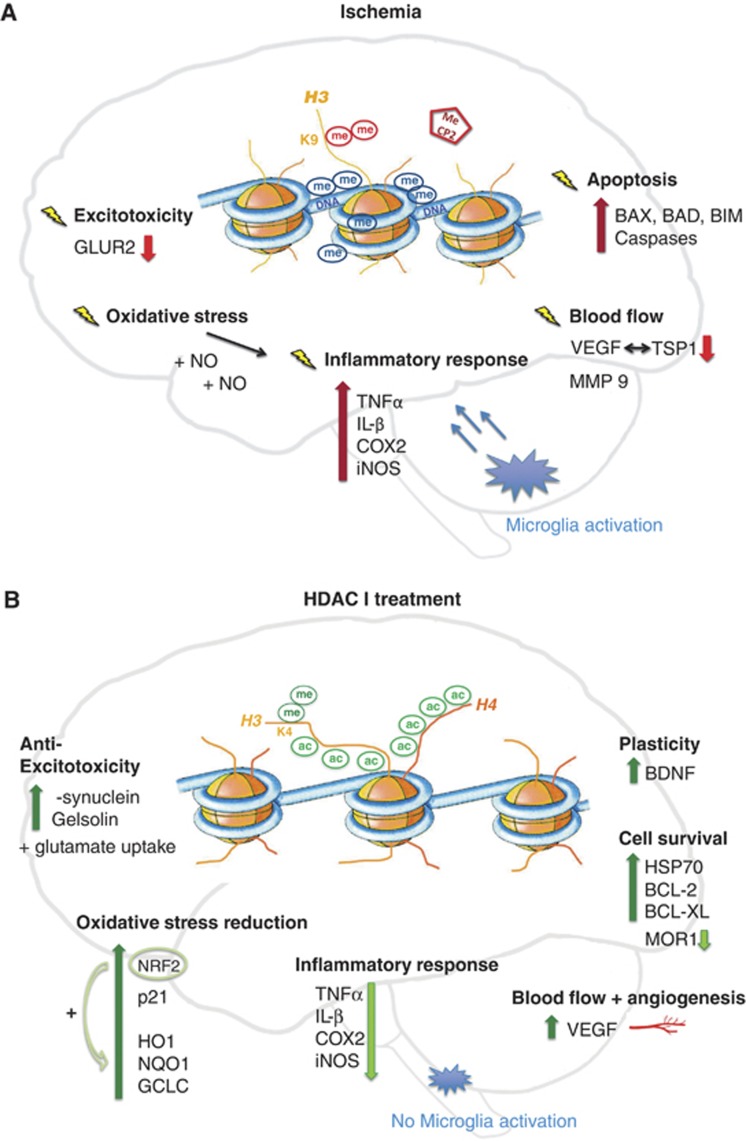
Ischemic pathways of damage (A) and protection after histone deacetylase inhibitor (HDACi) administration (B). Cerebral ischemia (A) globally leads to transcriptional repression in the cell. This effect is mirrored on the epigenetic level, where a rise in repressive DNA methylation (me) marks is observed together with vast histone 3 (H3) and histone 4 (H4) deacetylation. Additionally, H3 dimethylation at lysine 9 (H3K9me2), a further repressive sign, is enhanced. Further, transcriptional silencers, such as methyl-CpG binding protein 2 (MeCP2), are recruited to repressed gene promoters. Changes in gene regulation occur in most diverse pathways of ischemic disease development such as exitotoxicity, oxidative stress, inflammation, changes in blood flow, as well as cell death, or apoptosis. Examples for repressed genes are the glutamine receptor (GLUR2) in neurons, and thromobospondin1 (TSP1) as well as its angiogenic antagonist vascular endothelial growth factor (VEGF) in different phases of ischemic damage. However, an upregulation of pro-inflammatory and apoptotic players is visible in spite of a global repression. Examples for inducers of inflammation are tumor necrosis factor-α (TNFα), interleukin-β (IL-β), cyclooxygenase 2 (COX2) or the nitric oxide (NO) synthase (iNOS). Upregulated pro-apoptotic candidates are the BCL-2 family members BCL-2-associated X protein (BAX), BCL-2-associated death promoter (BAD) and BCL-2-like protein 11 (BIM) as well as diverse caspases. However, treatment with histone deacetylase inhibitors (HDACi) in ischemia (B) massively alters gene expression. H3 and H4 acetylation levels are maintained and no increase in DNA methylation is visible. Furthermore, activating histone methylation marks, such as H3K4 dimethylation (H3K4me2) accumulate. Many protective genes are actively expressed and modulate the response to ischemia. Upregulated gelsolin and α-synuclein levels are involved in the attenuation of excitoxicity. Protective anti-oxidative response genes are, for example, nuclear factor 2 (NRF2) together with its downstream elements heme oxygenase 1 (HO1), NADPH dehydrogenase quinone 1 (NQO1) and glutamate cysteine ligase (GCLC). An extended upregulation of the angiogenic factor VEGF modulates blood flow. Moreover cell survival pathways are boosted: important mediators are BCL-2 BCL-XL and the chaperone HSP70. Regenerative pathways are induced with the help of brain-derived neurotrophic factor (BDNF). To support pro-survival signaling, genes involved in ischemic cell death such as opioid receptor (MOR1) are repressed as well as inflammatory pathways.

References

    1. Thurman RJ, Jauch EC, Panagos PD, Reynolds MR, Mocco J.Four evolving strategies in the emergent treatment of acute ischemic stroke Emerg Med Pract 20121426–27.(quiz). - PubMed
    1. Endres M, Engelhardt B, Koistinaho J, Lindvall O, Meairs S, Mohr JP, et al. Improving outcome after stroke: overcoming the translational roadblock. Cerebrovasc Dis. 2008;25:268–278. - PubMed
    1. Mergenthaler P, Meisel A. Do stroke models model stroke. Dis Model Mech. 2012;5:718–725. - PMC - PubMed
    1. Dirnagl U, Iadecola C, Moskowitz MA. Pathobiology of ischaemic stroke: an integrated view. Trends Neurosci. 1999;22:391–397. - PubMed
    1. Mehta SL, Manhas N, Raghubir R. Molecular targets in cerebral ischemia for developing novel therapeutics. Brain Res Rev. 2007;54:34–66. - PubMed

Publication types

Substances

LinkOut - more resources