


Mitochondrial uncoupling in skeletal muscle by UCP1 augments energy expenditure and glutathione content while mitigating ROS production
- PMID: 23757405
- PMCID: PMC3742851
- DOI: 10.1152/ajpendo.00057.2013
Mitochondrial uncoupling in skeletal muscle by UCP1 augments energy expenditure and glutathione content while mitigating ROS production
Abstract
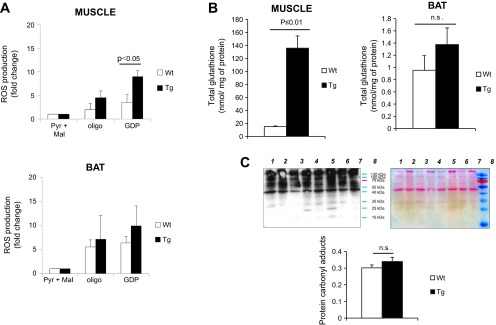
Enhancement of proton leaks in muscle tissue represents a potential target for obesity treatment. In this study, we examined the bioenergetic and physiological implications of increased proton leak in skeletal muscle. To induce muscle-specific increases in proton leak, we used mice that selectively express uncoupling protein-1 (UCP1) in skeletal muscle tissue. UCP1 expression in muscle mitochondria was ∼13% of levels in brown adipose tissue (BAT) mitochondria and caused increased GDP-sensitive proton leak. This was associated with an increase in whole body energy expenditure and a decrease in white adipose tissue content. Muscle UCP1 activity had divergent effects on mitochondrial ROS emission and glutathione levels compared with BAT. UCP1 in muscle increased total mitochondrial glutathione levels ∼7.6 fold. Intriguingly, unlike in BAT mitochondria, leak through UCP1 in muscle controlled mitochondrial ROS emission. Inhibition of UCP1 with GDP in muscle mitochondria increased ROS emission ∼2.8-fold relative to WT muscle mitochondria. GDP had no impact on ROS emission from BAT mitochondria from either genotype. Collectively, these findings indicate that selective induction of UCP1-mediated proton leak in muscle can increase whole body energy expenditure and decrease adiposity. Moreover, ectopic UCP1 expression in skeletal muscle can control mitochondrial ROS emission, while it apparently plays no such role in its endogenous tissue, brown fat.
Keywords: UCP1; glutathione; obesity; proton leak; reactive oxygen species; redox.
Figures



References
-
- Affourtit C, Crichton PG, Parker N, Brand MD. Novel uncoupling proteins. Novartis Foundation Symp 287: 70–80; discussion 80–91, 2007 - PubMed
-
- Cannon B, Shabalina IG, Kramarova TV, Petrovic N, Nedergaard J. Uncoupling proteins: a role in protection against reactive oxygen species—or not? Biochim Biophys Acta 1757: 449–458, 2006 - PubMed
-
- Clapham JC, Arch JR, Chapman H, Haynes A, Lister C, Moore GB, Piercy V, Carter SA, Lehner I, Smith SA, Beeley LJ, Godden RJ, Herrity N, Skehel M, Changani KK, Hockings PD, Reid DG, Squires SM, Hatcher J, Trail B, Latcham J, Rastan S, Harper AJ, Cadenas S, Buckingham JA, Brand MD, Abuin A. Mice overexpressing human uncoupling protein-3 in skeletal muscle are hyperphagic and lean. Nature 406: 415–418, 2000 - PubMed
-
- Clarke KJ, Porter RK. Uncoupling protein 1 dependent reactive oxygen species production by thymus mitochondria. Int J Biochem Cell Biol 45: 81–89, 2013 - PubMed
Publication types
MeSH terms
Substances
Grants and funding
LinkOut - more resources
Full Text Sources
Other Literature Sources
Molecular Biology Databases
Research Materials
