


Effect of intensive lifestyle intervention on sexual dysfunction in women with type 2 diabetes: results from an ancillary Look AHEAD study
- PMID: 23757437
- PMCID: PMC3781524
- DOI: 10.2337/dc13-0315
Effect of intensive lifestyle intervention on sexual dysfunction in women with type 2 diabetes: results from an ancillary Look AHEAD study
Abstract
Objective: Sexual dysfunction is a prevalent problem in obese women with type 2 diabetes. This study examined the effects of intensive lifestyle intervention (ILI) in these women.
Research design and methods: Look AHEAD is a 16-center, randomized, controlled trial evaluating the health effects of ILI compared with a control group (diabetes support and education [DSE]). The Look AHEAD Sexual Function Ancillary study included 375 female participants at five Look AHEAD sites. Participants completed the Female Sexual Function Inventory (FSFI) and Beck Depression Inventory (BDI), and assessments of weight and cardiovascular risk factors at baseline and 1 year were made.
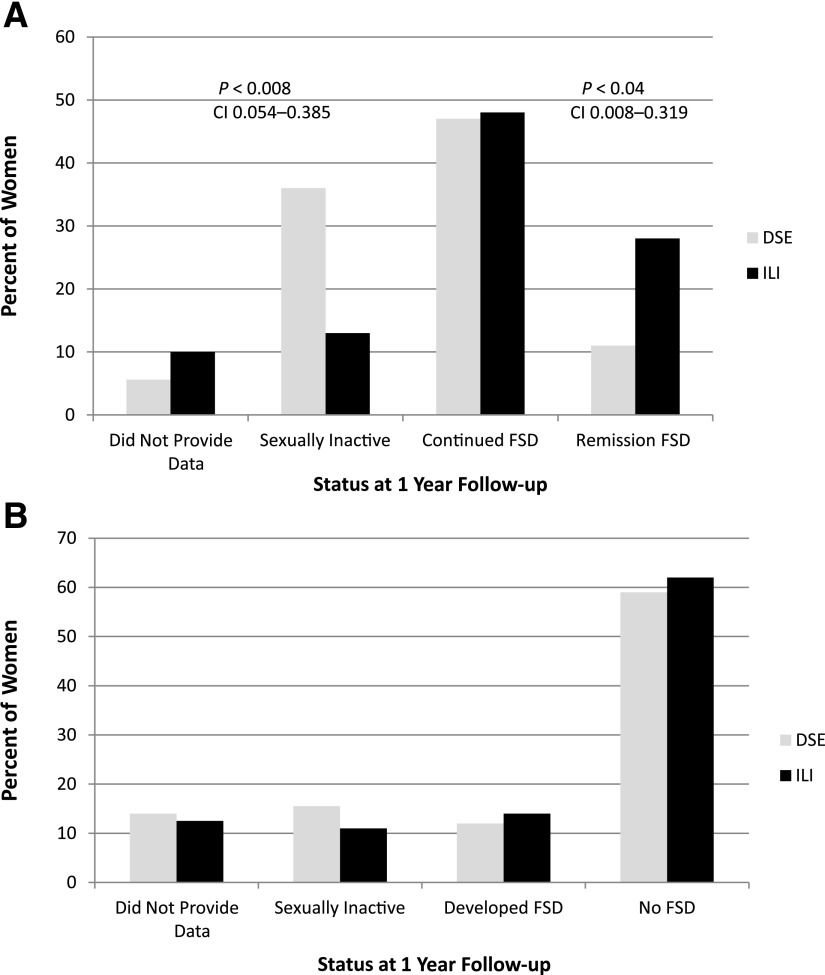
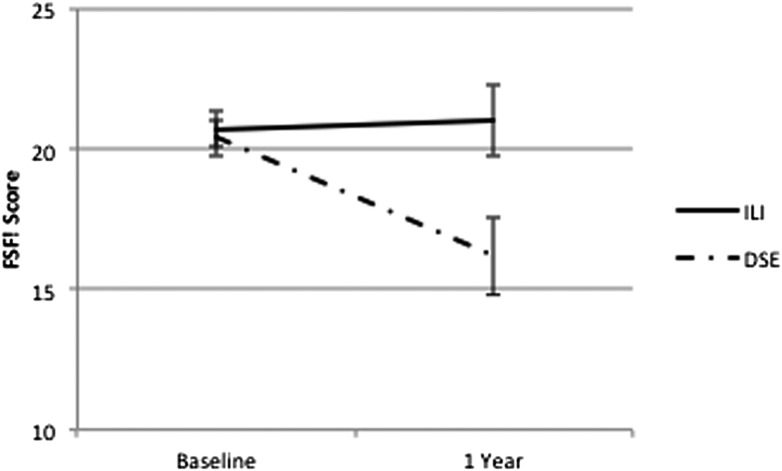
Results: At baseline, 50% of the 229 participants who reported being sexually active met criteria for female sexual dysfunction (FSD); only BDI score was related to FSD. One-year weight losses were greater in the ILI group than in the DSE group (7.6 vs. 0.45 kg; P<0.001). Among women with FSD at baseline, those in the ILI group (N=60) compared with those in the DSE group (N=53) were significantly more likely to remain sexually active (83 vs. 64%; P<0.008), reported greater improvement in total FSFI scores and in most FSFI domains (P<0.05), and were more likely to experience remission of FSD (28 vs. 11%; P<0.04) at 1 year. No significant differences between ILI and DSE were seen in women who did not have FSD at baseline.
Conclusions: Participation in ILI appeared to have beneficial effects on sexual functioning among obese women with diabetes, particularly in those who had FSD at baseline.
Trial registration: ClinicalTrials.gov NCT00017953.
Figures
Comment in
-
Comment on: Wing et al. Effect of intensive lifestyle intervention on sexual dysfunction in women with type 2 diabetes: results from an ancillary Look AHEAD Study. Diabetes care 2013;36:2937-2944.Diabetes Care. 2013 Nov;36(11):e190. doi: 10.2337/dc13-1495. Diabetes Care. 2013. PMID: 24159185 Free PMC article. No abstract available.
-
Response to Comment on: Wing et al. Effect of intensive lifestyle intervention on sexual dysfunction in women with type 2 diabetes: results from an ancillary Look AHEAD Study. Diabetes care 2013;36:2937-2944.Diabetes Care. 2013 Nov;36(11):e191. doi: 10.2337/dc13-1699. Diabetes Care. 2013. PMID: 24159186 Free PMC article. No abstract available.
References
-
- Shifren JL, Monz BU, Russo PA, Segreti A, Johannes CB. Sexual problems and distress in United States women: prevalence and correlates. Obstet Gynecol 2008;112:970–978 - PubMed
-
- Piak A, Laumann EO. Prevalence of women's sexual problems in the USA. In: Goldstein I, Meston C, Traish AM, Eds. Women's Sexual Function and Dysfunction London, Taylor & Francis, 2006, p. 23–33
-
- Bitzer J, Alder J. Diabetes and female sexual health. Womens Health (Lond Engl) 2009;5:629–636 - PubMed
-
- Esposito K, Maiorino MI, Bellastella G, Giugliano F, Romano M, Giugliano D. Determinants of female sexual dysfunction in type 2 diabetes. Int J Impot Res 2010;22:179–184 - PubMed
Publication types
MeSH terms
Associated data
Grants and funding
- DK57078/DK/NIDDK NIH HHS/United States
- U01 DK057151/DK/NIDDK NIH HHS/United States
- DK57151/DK/NIDDK NIH HHS/United States
- U01 DK057154/DK/NIDDK NIH HHS/United States
- U01 DK057171/DK/NIDDK NIH HHS/United States
- U01 DK057182/DK/NIDDK NIH HHS/United States
- U01 DK057136/DK/NIDDK NIH HHS/United States
- U01 DK057002/DK/NIDDK NIH HHS/United States
- U01 DK057177/DK/NIDDK NIH HHS/United States
- M01 RR001066/RR/NCRR NIH HHS/United States
- U01 DK057078/DK/NIDDK NIH HHS/United States
- DK57008/DK/NIDDK NIH HHS/United States
- DK57135/DK/NIDDK NIH HHS/United States
- P30 DK048520/DK/NIDDK NIH HHS/United States
- U01 DK057135/DK/NIDDK NIH HHS/United States
- P30 DK046204/DK/NIDDK NIH HHS/United States
- DK57171/DK/NIDDK NIH HHS/United States
- M01 RR002719/RR/NCRR NIH HHS/United States
- DK57131/DK/NIDDK NIH HHS/United States
- M01 RR000056/RR/NCRR NIH HHS/United States
- U01 DK057219/DK/NIDDK NIH HHS/United States
- DK57149/DK/NIDDK NIH HHS/United States
- U01 DK056992/DK/NIDDK NIH HHS/United States
- P30 DK079637/DK/NIDDK NIH HHS/United States
- M01RR01066/RR/NCRR NIH HHS/United States
- R01 DK060438/DK/NIDDK NIH HHS/United States
- DK57182/DK/NIDDK NIH HHS/United States
- DK57002/DK/NIDDK NIH HHS/United States
- M01RR01346/RR/NCRR NIH HHS/United States
- DK57178/DK/NIDDK NIH HHS/United States
- P30 DK48520/DK/NIDDK NIH HHS/United States
- U01 DK057131/DK/NIDDK NIH HHS/United States
- M01 RR000051/RR/NCRR NIH HHS/United States
- M01RR000056 44/RR/NCRR NIH HHS/United States
- ImNIH/Intramural NIH HHS/United States
- DK57136/DK/NIDDK NIH HHS/United States
- DK57154/DK/NIDDK NIH HHS/United States
- DK57219/DK/NIDDK NIH HHS/United States
- UL1 TR001082/TR/NCATS NIH HHS/United States
- DK57177/DK/NIDDK NIH HHS/United States
- U01 DK056990/DK/NIDDK NIH HHS/United States
- U01 DK057178/DK/NIDDK NIH HHS/United States
- U01 DK057008/DK/NIDDK NIH HHS/United States
- DK56990/DK/NIDDK NIH HHS/United States
- M01RR0021140/RR/NCRR NIH HHS/United States
- DK 046204/DK/NIDDK NIH HHS/United States
- U01 DK057149/DK/NIDDK NIH HHS/United States
- M01RR02719/RR/NCRR NIH HHS/United States
- M01 RR001346/RR/NCRR NIH HHS/United States
- DK56992/DK/NIDDK NIH HHS/United States
- P30 DK017047/DK/NIDDK NIH HHS/United States
- M01RR00051/RR/NCRR NIH HHS/United States
LinkOut - more resources
Full Text Sources
Other Literature Sources
Medical
Miscellaneous
