


The roles of bone morphogenetic proteins and their signaling in the osteogenesis of adipose-derived stem cells
- PMID: 23758605
- PMCID: PMC3922312
- DOI: 10.1089/ten.TEB.2013.0204
The roles of bone morphogenetic proteins and their signaling in the osteogenesis of adipose-derived stem cells
Abstract
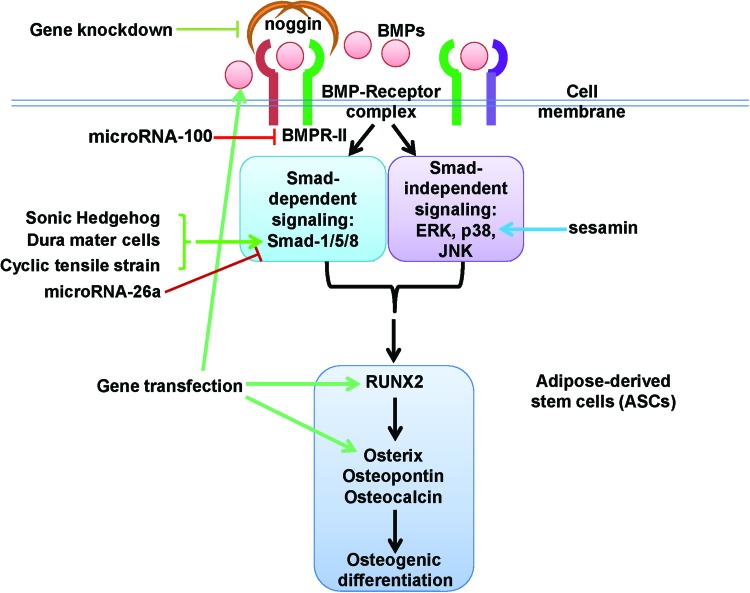
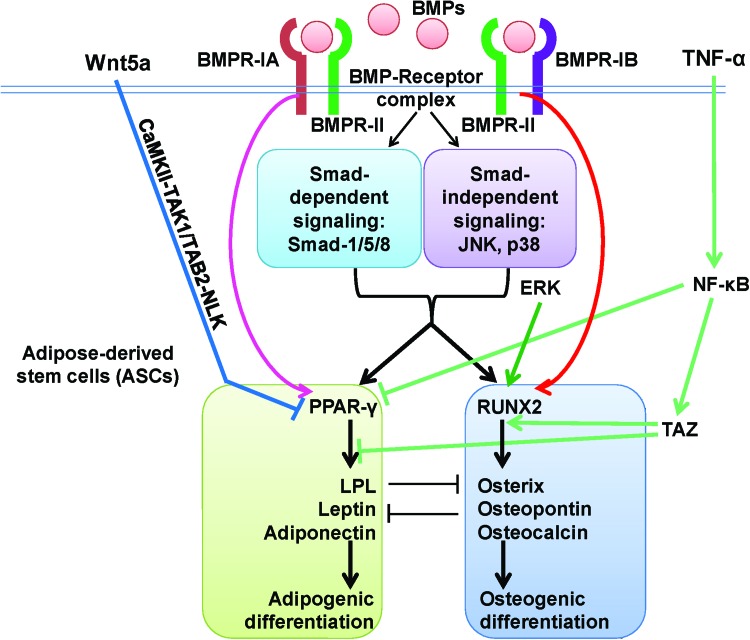
Large-size bone defects can severely compromise both aesthetics and musculoskeletal functions. Adipose-derived stem cells (ASCs)-based bone tissue engineering has recently become a promising treatment strategy for the above situation. As robust osteoinductive cytokines, bone morphogenetic proteins (BMPs) are commonly used to promote the osteogenesis of ASCs. In this process, BMP signaling plays a pivotal role. However, it remains ambiguous how the pleiotrophic BMPs are involved in the commitment of ASCs along osteogenesis instead of other lineages, such as adipogenesis. BMP receptor type-IB, extracellular signal-regulated kinase, and Wnt5a appear to be the main switches controlling the in vitro osteogenic commitment of ASCs. Tumor necrosis factor-alpha, an acute inflammatory cytokine, is reported to play an important role in mediating osteogenic commitment of ASCs in vivo. In addition, various active agents and methods have been used to enhance and accelerate the osteogenesis of ASCs through promoting BMP signaling. In this review, we summarize the current knowledge on the roles of BMPs and their signaling in the osteogenesis of ASCs in vitro and in vivo.
Figures

References
-
- Sokolsky-Papkov M., Agashi K., Olaye A., Shakesheff K., and Domb A.J.Polymer carriers for drug delivery in tissue engineering. Adv Drug Del Rev 59,187, 2007 - PubMed
-
- Levi B., Hyun J.S., Nelson E.R., Li S., Montoro D.T., Wan D.C., Jia F.J., Glotzbach J.C., James A.W., Lee M., Huang M., Quarto N., Gurtner G.C., Wu J.C., and Longaker M.T.Nonintegrating knockdown and customized scaffold design enhances human adipose-derived stem cells in skeletal repair. Stem Cells 29,2018, 2011 - PMC - PubMed
-
- Zhou Y., Ni Y., Liu Y., Zeng B., Xu Y., and Ge W.The role of simvastatin in the osteogenesis of injectable tissue-engineered bone based on human adipose-derived stromal cells and platelet-rich plasma. Biomaterials 31,5325, 2010 - PubMed
-
- Ge W., Shi L., Zhou Y., Liu Y., Ma G.E., Jiang Y., Xu Y., Zhang X., and Feng H.Inhibition of osteogenic differentiation of human adipose-derived stromal cells by retinoblastoma binding protein 2 repression of RUNX2-activated transcription. Stem Cells 29,1112, 2011 - PubMed
-
- Sheyn D., Pelled G., Zilberman Y., Talasazan F., Frank J.M., Gazit D., and Gazit Z.Nonvirally engineered porcine adipose tissue-derived stem cells: use in posterior spinal fusion. Stem Cells 26,1056, 2008 - PubMed
Publication types
MeSH terms
Substances
LinkOut - more resources
Full Text Sources
Other Literature Sources
Medical
Research Materials
