


Significant postictal hypotension: expanding the spectrum of seizure-induced autonomic dysregulation
- PMID: 23758665
- PMCID: PMC3769446
- DOI: 10.1111/epi.12251
Significant postictal hypotension: expanding the spectrum of seizure-induced autonomic dysregulation
Abstract
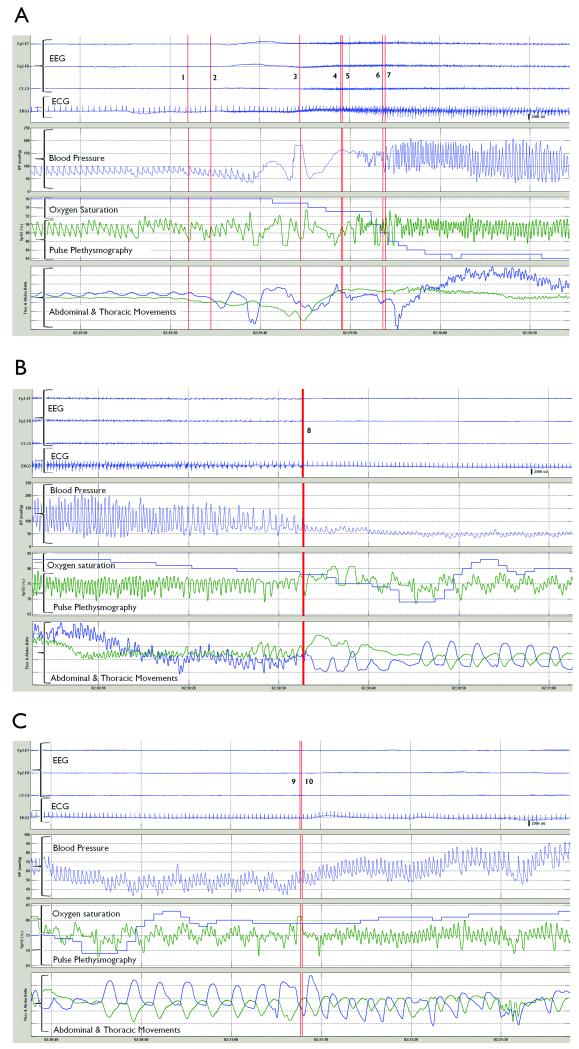
Periictal autonomic dysregulation is best studied using a "polygraphic" approach: electroencephalography ([EEG]), 3-channel electrocardiography [ECG], pulse oximetry, respiration, and continuous noninvasive blood pressure [BP]), which may help elucidate agonal pathophysiologic mechanisms leading to sudden unexpected death in epilepsy (SUDEP). A number of autonomic phenomena have been described in generalized tonic-clonic seizures (GTCS), the most common seizure type associated with SUDEP, including decreased heart rate variability, cardiac arrhythmias, and changes in skin conductance. Postictal generalized EEG suppression (PGES) has been identified as a potential risk marker of SUDEP, and PGES has been found to correlate with post-GTCS autonomic dysregulation in some patients. Herein, we describe a patient with a GTCS in whom polygraphic measurements were obtained, including continuous noninvasive blood pressure recordings. Significant postictal hypotension lasting >60 s was found, which closely correlated with PGES duration. Similar EEG changes are well described in hypotensive patients with vasovagal syncope and a similar vasodepressor phenomenon, and consequent cerebral hypoperfusion may account for the PGES observed in some patients after a GTCS. This further raises the possibility that profound, prolonged, and irrecoverable hypotension may comprise one potential SUDEP mechanism.
Keywords: Autonomic dysregulation; Postictal hypotension; Seizure polygraphy; Sudden unexpected death in epilepsy.
Wiley Periodicals, Inc. © 2013 International League Against Epilepsy.
Figures
References
-
- Ammirati F, Colivicchi F, Di Battista G, Garelli FF, Santini M. Electroencephalographic correlates of vasovagal syncope induced by head-up tilt testing. Stroke. 1998;29:2347–2351. - PubMed
-
- Brenner RP. Electroencephalography in syncope. J Clin Neurophysiol. 1997;14:197–209. - PubMed
-
- Chung E, Chen G, Alexander B, Cannesson M. Non-invasive continuous blood pressure monitoring: a review of current applications. Front Med. 2013;7:91–101. - PubMed
-
- Fortin J, Marte W, Grullenberger R, Hacker A, Habenbacher W, Heller A, Wagner C, Wach P, Skrabal F. Continuous non-invasive blood pressure monitoring using concentrically interlocking control loops. Comput Biol Med. 2006;36:941–957. - PubMed
-
- Gastaut H, Broughton RJ. Epileptic Seizures: Clinical Features and Pathophysiology Epileptic Seizures: Clinical and Electrographic Features, Diagnosis and Treatment. Charles Thomas Publisher; Springfield, Illinois, USA: 1972. pp. 28–29.
Publication types
MeSH terms
Grants and funding
LinkOut - more resources
Full Text Sources
Other Literature Sources
Medical
