


Land cover, land use and malaria in the Amazon: a systematic literature review of studies using remotely sensed data
- PMID: 23758827
- PMCID: PMC3684522
- DOI: 10.1186/1475-2875-12-192
Land cover, land use and malaria in the Amazon: a systematic literature review of studies using remotely sensed data
Abstract
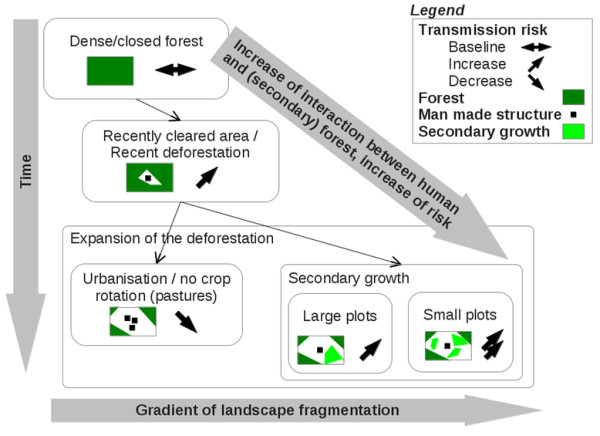
The nine countries sharing the Amazon forest accounted for 89% of all malaria cases reported in the Americas in 2008. Remote sensing can help identify the environmental determinants of malaria transmission and their temporo-spatial evolution. Seventeen studies characterizing land cover or land use features, and relating them to malaria in the Amazon subregion, were identified. These were reviewed in order to improve the understanding of the land cover/use class roles in malaria transmission. The indicators affecting the transmission risk were summarized in terms of temporal components, landscape fragmentation and anthropic pressure. This review helps to define a framework for future studies aiming to characterize and monitor malaria.
Figures
References
-
- Pan, editor. American Health Organization. 2010. (Report on the situation of malaria in the Americas, 2008. Washington, D.C: PAHO;).
-
- WHO. World Malaria Report. 2012. Geneva: World Health Organization; 2012. - PubMed
-
- Galardo AKR, Zimmerman RH, Lounibos LP, Young LJ, Galardo CD, Arruda M, D’Almeida Couto AAR. Seasonal abundance of anopheline mosquitoes and their association with rainfall and malaria along the Matapí River, Amapá, Brazil. Med Vet Entomol. 2009;23:335–349. doi: 10.1111/j.1365-2915.2009.00839.x. - DOI - PubMed
Publication types
MeSH terms
LinkOut - more resources
Full Text Sources
Other Literature Sources
Medical
Molecular Biology Databases
