Case Reports
. 2013 Jun 10:12:57.
doi: 10.1186/1476-4598-12-57.

Novel microRNA-based assay demonstrates 92% agreement with diagnosis based on clinicopathologic and management data in a cohort of patients with carcinoma of unknown primary

Affiliations
Case Reports

Novel microRNA-based assay demonstrates 92% agreement with diagnosis based on clinicopathologic and management data in a cohort of patients with carcinoma of unknown primary

George Pentheroudakis et al. Mol Cancer. .

Abstract

Background: Cancer of unknown or uncertain primary is a major diagnostic and clinical challenge, since identifying the tissue-of-origin of metastases is crucial for selecting optimal treatment. MicroRNAs are a family of non-coding, regulatory RNA molecules that are tissue-specific, with a great potential to be excellent biomarkers.

Methods: In this study we tested the performance of a microRNA-based assay in formalin-fixed paraffin-embedded samples from 84 CUP patients.

Results: The microRNA based assay agreed with the clinical diagnosis at presentation in 70% of patients; it agreed with the clinical diagnosis obtained after patient management, taking into account response and outcome data, in 89% of patients; it agreed with the final clinical diagnosis reached with supplemental immunohistochemical stains in 92% of patients, indicating a 22% improvement in agreement from diagnosis at presentation to the final clinical diagnosis. In 18 patients the assay disagreed with the presentation diagnosis and was in agreement with the final clinical diagnosis, which may have resulted in the administration of more effective chemotherapy. In three out of four discordant cases in which supplemental IHC was performed, the IHC results validated the assay's molecular diagnosis.

Conclusions: This novel microRNA-based assay shows high accuracy in identifying the final clinical diagnosis in a real life CUP patient cohort and could be a useful tool to facilitate administration of optimal therapy.


Figures
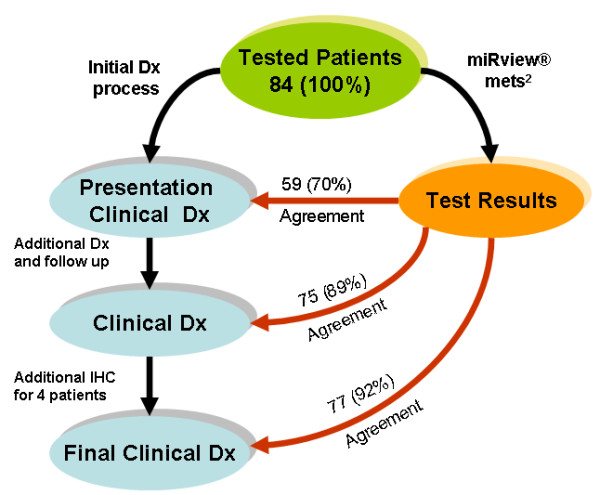
Figure 1
Figure 1
Diagnostic process and agreement to the 64 microRNA assay. At the time of referral, each patient was assigned the most likely clinical diagnosis based on all data available at presentation (“Presentation Clinical Diagnosis”). Later on based on additional data gathered during treatment and follow up, each patient was assigned one to three sites of origin (“Clinical Diagnosis”). Finally we performed more IHC tests and arrived at a final diagnosis (“Final Clinical Diagnosis”). For all patients, we independently performed the 64 microRNA assay (assay Results) and compared these to the clinical work-up. The number on each arrow depicts the number of patients (out of 84) for which there was agreement between the test results and the clinical diagnosis, and the number in parenthesis depicts this agreement in percentage. See Methods for more details.
Figure 2
Figure 2
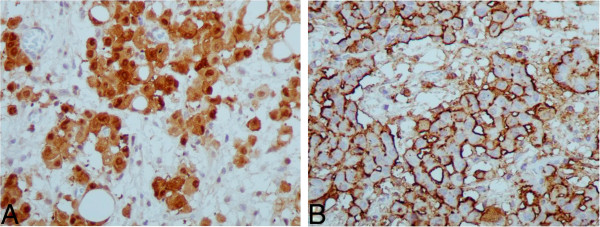
IHC results for patient # 12432 (Case report 1). Results of further IHC performed for patient #12432 following the 64 microRNA assay results: A Calretinin X400, B Mesothelin X400
Figure 3
Figure 3
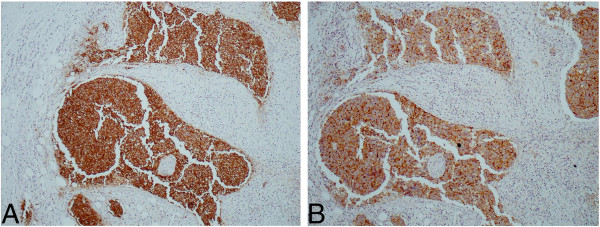
IHC results for patient # 11805 (Case report 2). Results of further IHC performed for patient #11805 following the 64 microRNA assay results: A Chromogranin X100, B Synaptophysin X100

References

    1. Brugarolas J. Renal-cell carcinoma–molecular pathways and therapies. N Engl J Med. 2007;356:185–187. doi: 10.1056/NEJMe068263. - DOI - PubMed
    1. Hudis CA. Trastuzumab–mechanism of action and use in clinical practice. N Engl J Med. 2007;357:39–51. doi: 10.1056/NEJMra043186. - DOI - PubMed
    1. Miller K, Wang M, Gralow J, Dickler M, Cobleigh M, Perez EA, Shenkier T, Cella D, Davidson NE. Paclitaxel plus bevacizumab versus paclitaxel alone for metastatic breast cancer. N Engl J Med. 2007;357:2666–2676. doi: 10.1056/NEJMoa072113. - DOI - PubMed
    1. Tsao MS, Sakurada A, Cutz JC, Zhu CQ, Kamel-Reid S, Squire J, Lorimer I, Zhang T, Liu N, Daneshmand M. et al. Erlotinib in lung cancer - molecular and clinical predictors of outcome. N Engl J Med. 2005;353:133–144. doi: 10.1056/NEJMoa050736. - DOI - PubMed
    1. Varadhachary GR, Raber MN, Matamoros A, Abbruzzese JL. Carcinoma of unknown primary with a colon-cancer profile-changing paradigm and emerging definitions. Lancet Oncol. 2008;9:596–599. doi: 10.1016/S1470-2045(08)70151-7. - DOI - PubMed

Publication types