Review
. 2013 Jun 7:6:172.
doi: 10.1186/1756-3305-6-172.

Eliminating malaria vectors

Affiliations
Review

Eliminating malaria vectors

Gerry F Killeen et al. Parasit Vectors. .

Abstract

Malaria vectors which predominantly feed indoors upon humans have been locally eliminated from several settings with insecticide treated nets (ITNs), indoor residual spraying or larval source management. Recent dramatic declines of An. gambiae in east Africa with imperfect ITN coverage suggest mosquito populations can rapidly collapse when forced below realistically achievable, non-zero thresholds of density and supporting resource availability. Here we explain why insecticide-based mosquito elimination strategies are feasible, desirable and can be extended to a wider variety of species by expanding the vector control arsenal to cover a broader spectrum of the resources they need to survive. The greatest advantage of eliminating mosquitoes, rather than merely controlling them, is that this precludes local selection for behavioural or physiological resistance traits. The greatest challenges are therefore to achieve high biological coverage of targeted resources rapidly enough to prevent local emergence of resistance and to then continually exclude, monitor for and respond to re-invasion from external populations.


Figures
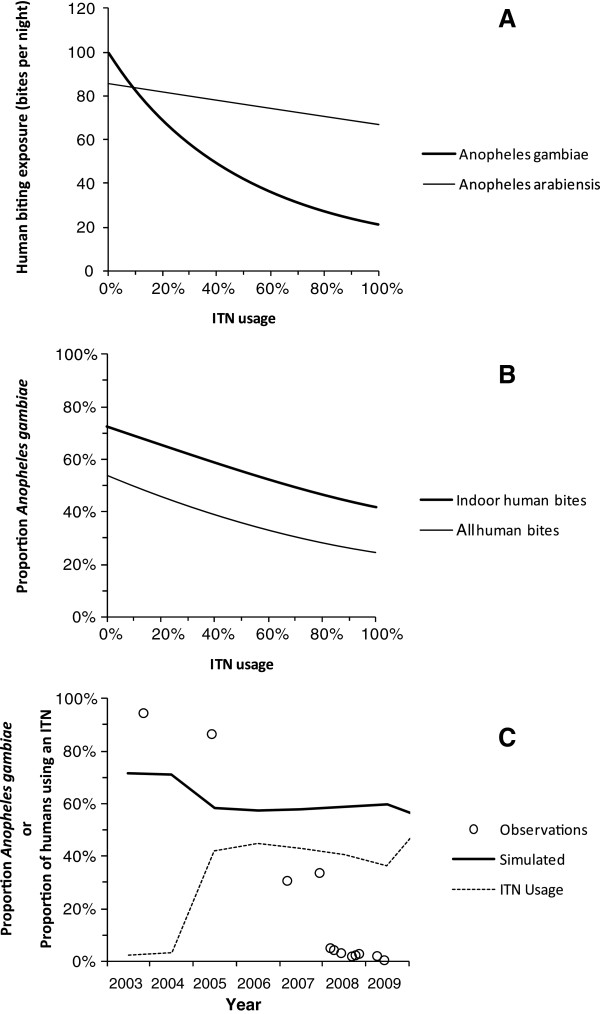
Figure 1
Figure 1
Contrasting field observations of the collapse of An. gambiae with the predictions of population dynamics models assuming no density-dependence of vector reproduction so that emergence rates are directly proportional to mean longevity. A: Simulated declining biting exposure to Anopheles gambiae s.s. and An. arabiensis as insecticide treated net usage (ITNs) increases. B: Corresponding impact of increasing ITN use upon predicted proportion of bites upon humans by An. gambiae. C: Direct comparison of observed near-disappearance of An. gambiae from Kilombero Valley in southern Tanzania [37] with simulations based upon observed ITN usage rates estimated as described previously, with only 4.7% of nets treated within the previous 6 months up to 2004 [48], following which long-lasting net retreatment kits were introduced so all nets reported as treated are considered ITNs [49]. All simulations were executed [43] assuming equal baseline emergence rates (E0 = 2 × 10⁷ mosquitoes per year) for both vector species and a ratio of cattle to humans consistent with livestock census results in Kilombero Valley (Nh = 1000, Nc =140). All ITN-induced mortality was assumed to occur before feeding so the excess proportion of mosquitoes killed after attempting to attack a protected human was assumed to be negligible (θu, post = 0). Simulated An. gambiae s.s. and An. arabiensis populations differed only in their parameter values for the proportion of human exposure to bites that occurs indoors (πi = 0.9 versus 0.4, respectively [37,50]), the attack availability rates of cattle (ac = 2.5 × 10⁻⁵ versus 1.9 × 10⁻³ attacks per host per host-seeking mosquito per night [51]) and the excess proportions of mosquitoes which are diverted (θΔ = 0.2 versus 0.6, respectively) or killed before feeding (θμ,pre = 0.8 versus 0.6, respectively) while attempting to attack a human while using an ITN [52-54].
Figure 2
Figure 2
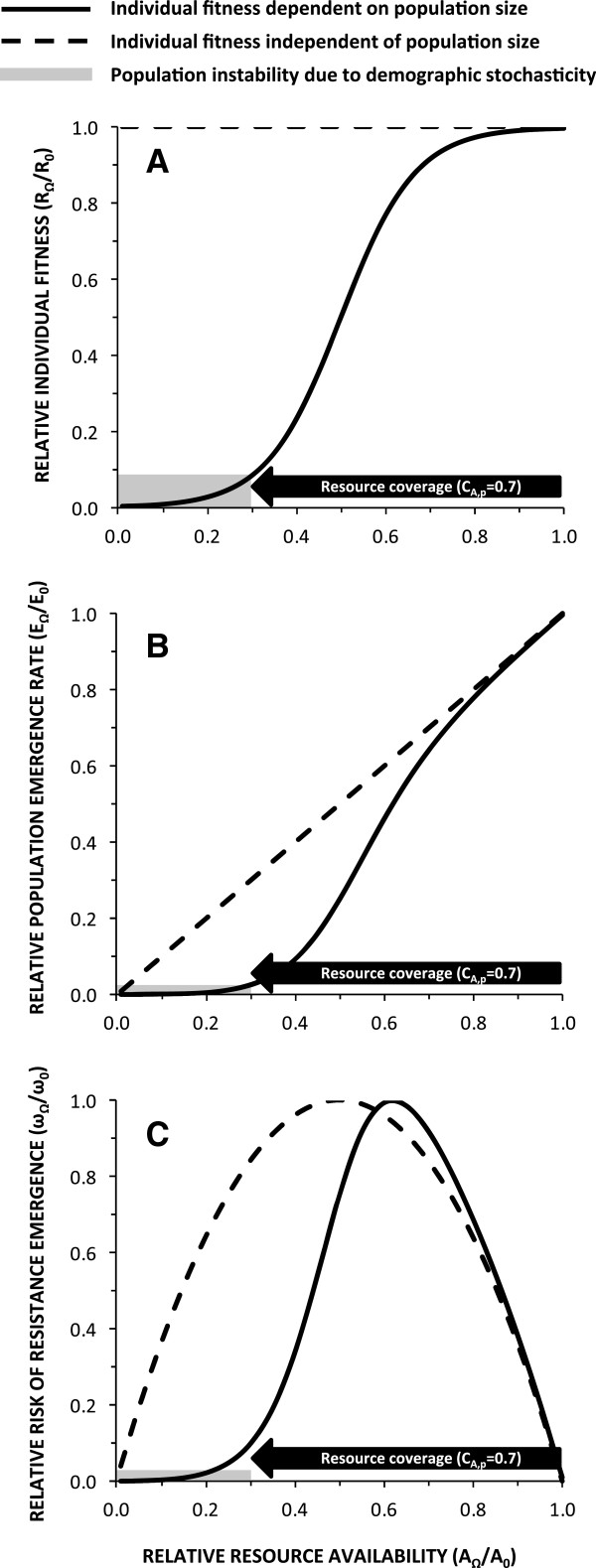
A schematic illustration of how the dependence of individual fitness (A) upon total population size or density [[63]] (B) could hypothetically cause mosquito populations to collapse without the opportunity for resistance to emerge (C) following rapid deployment of insecticidal vector control measures at high but imperfect levels of biological coverage. All outcomes plotted along the Y axis represent relative values for a given intervention scenario (Ω), with a given level of protective coverage of all available blood, sugar or aquatic resources (CA,p), compared to a baseline scenario (Ω = 0). A: Individual fitness is expressed as the reproductive number (R; the average number of female adult offspring per healthy female adult mosquito). B: Population size is expressed as the adult emergence rate (E). C: The rate at which the frequency physiological insecticide resistance traits increase to fixation or equilibrium.
Figure 3
Figure 3
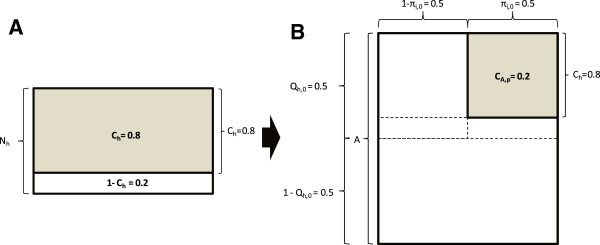
Conceptual schematic of the difference between current demographic indicators of coverage of all humans (Nh) and true biological coverage of all available mosquito blood resources (A) [26]. In all panels, the proportion considered covered by the stated indicator is represented by the shaded fraction. A: Conventional view of current ITN/IRS target of 80% crude demographic coverage of all humans while indoor (Ch = 0.8). B: Biological protective coverage (CA,p = 0.2) of all available human and animal blood (A) achieved in the same demographic coverage scenario (Ch = 0.8), where half of baseline human exposure to vectors occurred outdoors (πi,0 = 0.5) and animals previously accounted for half of all blood meals (Qh,0 = 0.5).
Figure 4
Figure 4
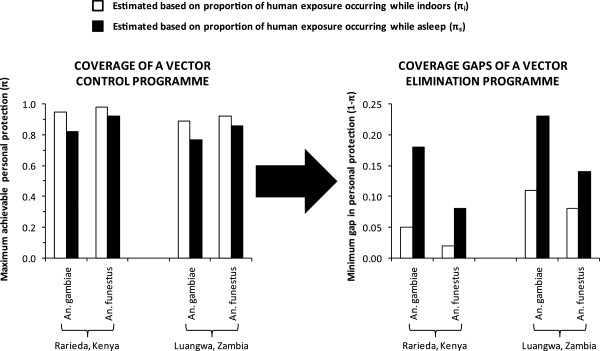
Comparative evaluation of two alternative measures of the upper limit for the level of protection an insecticide treated net (ITN) can provide from the contrasting perspectives of coverage achieved by a vector control programme versus coverage gaps in a vector elimination programme. The proportion of exposure to mosquito bites which occurs while humans are indoors (πi) overestimates protective coverage and underestimates gaps in protective coverage when compared with the proportion of exposure occurring while asleep (πs), which is considered a more accurate indicator of protective coverage by an ITN because people rarely use one unless they are both indoors and asleep [77].

References

    1. Moonen B, Cohen JM, Snow RW, Slutsker L, Drakeley C, Smith DL, Abeyasinghe RR, Rodriguez MH, Maharaj R, Tanner M, Targett G. Operational strategies to achieve and maintain malaria elimination. Lancet. 2010;376:1592–1603. - PMC - PubMed
    1. Killeen GF. A second chance to tackle African malaria vector mosquitoes that avoid houses and don’t take drugs. Am J Trop Med Hyg. 2013;88:809–816. - PMC - PubMed
    1. Eckhoff PA. Mathematical models of within-host and transmission dynamics to determine effects of malaria Interventions in a variety of transmission settings. Am J Trop Med Hyg. 2013;88:817–827. - PMC - PubMed
    1. Griffin JT, Hollingsworth TD, Okell LC, Churcher TS, White M, Hinsley W, Bousema T, Drakeley CJ, Ferguson NM, Basáñez MG, Ghani AC. Strategies towards Plasmodium falciparum malaria elimination in Africa using currently available tools. PLoS Med. 2010;7:e1000324. - PMC - PubMed
    1. Okell LC, Griffin JT, Kleinschmidt I, Hollingsworth TD, Churcher TS, White MT, Bousema T, Drakeley CJ, Ghani AC. The potential contribution of mass treatment to the control of Plasmodium falciparum malaria. PLoS One. 2011;6:e20179. - PMC - PubMed

Publication types