The repellency of lemongrass oil against stable flies, tested using video tracking
- PMID: 23759542
- PMCID: PMC3718533
- DOI: 10.1051/parasite/2013021
The repellency of lemongrass oil against stable flies, tested using video tracking
Abstract
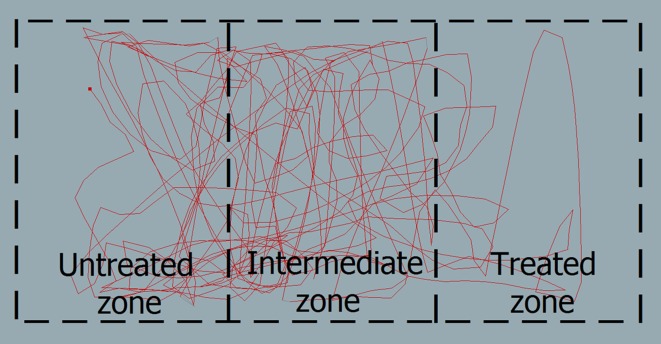
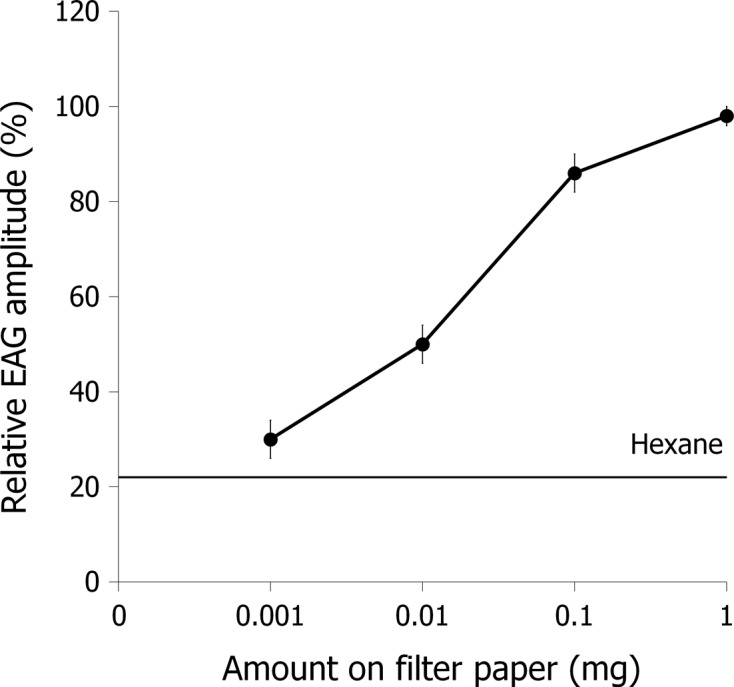
Lemongrass oil (Cymbopogon citratus) is an effective repellent against mosquitoes (Diptera: Culicidae) and house flies (Diptera: Muscidae). In this study, its effectiveness was assessed on stable flies (Diptera: Muscidae) in laboratory conditions. First, we demonstrated that lemongrass oil is an active substance for antennal olfactory receptor cells of Stomoxys calcitrans as indicated by a significant increase in the electroantennogram responses to increasing doses of lemongrass oil. Feeding-choice tests in a flight cage with stable flies having access to two blood-soaked sanitary pads, one of which was treated with lemongrass oil, showed that stable flies (n = 24) spent significantly more time in the untreated zone (median value = 218.4 s) than in the treated zone (median value = 63.7 s). No stable flies fed on the treated pad, whereas nine fed on the untreated pad. These results suggest that lemongrass oil could be used as an effective repellent against stable flies. Additional studies to confirm its spatial repellent and feeding deterrent effects are warranted.
L’huile essentielle de Cymbopogon citratus est un répulsif actif contre les moustiques (Diptera : Culicidae) et les mouches domestiques (Diptera : Muscidae). Dans cette étude, nous avons testé son efficacité contre les stomoxes (Diptera : Muscidae) en laboratoire. Nous avons tout d’abord démontré par électroantennographie (EAG) que l’huile essentielle de C. citratus était une substance active sur les récepteurs olfactifs des antennes de Stomoxys calcitrans, par la mise en évidence d’une augmentation significative des réponses EAG à des doses croissantes d’huile essentielle. Des tests de choix réalisés en cage de vol avec des stomoxes ayant à disposition deux supports imprégnés de sang, l’un ayant été traité avec de l’huile essentielle, montrent que les stomoxes (n = 24) ont passé significativement plus de temps dans la zone non traitée (valeur médiane = 218,4 s) que dans la zone traitée (valeur médiane = 63,7 s). Aucun stomoxe ne s’est nourri sur le support traité alors que neuf stomoxes se sont nourris sur le support non traité. Ces résultats suggèrent que l’huile essentielle de C. citratus pourrait être utilisée comme répulsif contre les stomoxes. Des études complémentaires sont nécessaires pour confirmer ses effets répulsifs et anti-gorgement.
© F. Baldacchino et al., published by EDP Sciences, 2013.
Figures

References
-
- Bartlett C. 1985. An olfactometer for measuring the repellent effect of chemicals on the stable fly Stomoxys calcitrans (L). Pesticide Science, 16, 479–487
-
- Chisowa EH, Hall DR, Farman DI. 1998. Volatile constituents of the essential oil of Cymbopogon citratus Stapf grown in Zambia. Flavour and Fragrance Journal, 13, 29–30
-
- Cilek JE. 2003. Attraction of colored plasticized corrugated boards to adult stable flies, Stomoxys calcitrans (Diptera: Muscidae). Florida Entomologist, 86, 420–423
-
- Cilek JE, Greene GL. 1994. Stable flies (Diptera, Muscidae) insecticide resistance in Kansas cattle feedlots. Journal of Economic Entomology, 87, 275–279
-
- Cilek JE, Hallmon CF, Johnson R. 2011. Efficacy of several commercially formulated essential oils against caged female Aedes albopictus and Culex quinquefasciatus when operationally applied via an automatic-timed insecticide application system. Journal of the American Mosquito Control Association, 27, 252–255 - PubMed
MeSH terms
Substances
LinkOut - more resources
Full Text Sources
Other Literature Sources