


Astroglial cells regulate the developmental timeline of human neurons differentiated from induced pluripotent stem cells
- PMID: 23759711
- PMCID: PMC3979966
- DOI: 10.1016/j.scr.2013.05.002
Astroglial cells regulate the developmental timeline of human neurons differentiated from induced pluripotent stem cells
Abstract
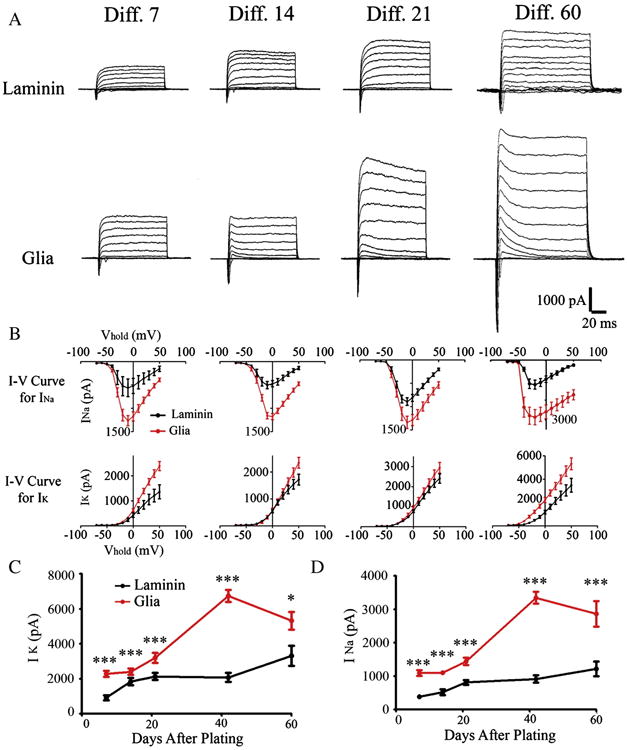
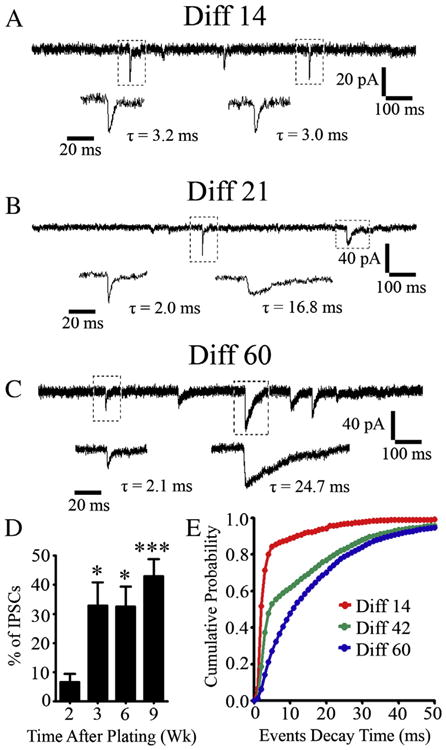
Neurons derived from human induced-pluripotent stem cells (hiPSCs) have been used to model a variety of neurological disorders. Different protocols have been used to differentiate hiPSCs into neurons, but their functional maturation process has varied greatly among different studies. Here, we demonstrate that laminin, a commonly used substrate for iPSC cultures, was inefficient to promote fully functional maturation of hiPSC-derived neurons. In contrast, astroglial substrate greatly accelerated neurodevelopmental processes of hiPSC-derived neurons. We have monitored the neural differentiation and maturation process for up to two months after plating hiPSC-derived neuroprogenitor cells (hNPCs) on laminin or astrocytes. We found that one week after plating hNPCs, there were 21-fold more newly differentiated neurons on astrocytes than on laminin. Two weeks after plating hNPCs, there were 12-fold more dendritic branches in neurons cultured on astrocytes than on laminin. Six weeks after plating hNPCs, the Na(+) and K(+) currents, as well as glutamate and GABA receptor currents, were 3-fold larger in neurons cultured on astrocytes than on laminin. And two months after plating hNPCs, the spontaneous synaptic events were 8-fold more in neurons cultured on astrocytes than on laminin. These results highlight a critical role of astrocytes in promoting neural differentiation and functional maturation of human neurons derived from hiPSCs. Moreover, our data presents a thorough developmental timeline of hiPSC-derived neurons in culture, providing important benchmarks for future studies on disease modeling and drug screening.
Copyright © 2013 Elsevier B.V. All rights reserved.
Figures






References
-
- Banker GA. Trophic interactions between astroglial cells and hippocampal neurons in culture. Science. 1980;209:809–810. - PubMed
-
- Barres BA. The mystery and magic of glia: a perspective on their roles in health and disease. Neuron. 2008;60:430–440. - PubMed
-
- Bilican B, Serio A, Barmada SJ, Nishimura AL, Sullivan GJ, Carrasco M, Phatnani HP, Puddifoot CA, Story D, Fletcher J, Park IH, Friedman BA, Daley GQ, Wyllie DJ, Hardingham GE, Wilmut I, Finkbeiner S, Maniatis T, Shaw CE, Chandran S. Mutant induced pluripotent stem cell lines recapitulate aspects of TDP-43 proteinopathies and reveal cell-specific vulnerability. Proc Natl Acad Sci U S A. 2012;109(15):5803–5808. - PMC - PubMed
Publication types
MeSH terms
Grants and funding
- DP2 OD006495/OD/NIH HHS/United States
- 1R21MH093954-01A1/MH/NIMH NIH HHS/United States
- R01 MH094753/MH/NIMH NIH HHS/United States
- R01 MH083911/MH/NIMH NIH HHS/United States
- R01MH095741/MH/NIMH NIH HHS/United States
- R21 MH093954/MH/NIMH NIH HHS/United States
- P01 NICHD033113/PHS HHS/United States
- MH083911/MH/NIMH NIH HHS/United States
- R01 NH094753-02/NH/NIH HHS/United States
- R01 MH095741/MH/NIMH NIH HHS/United States
- 1-DP2-OD006495-01/OD/NIH HHS/United States
- MH092740/MH/NIMH NIH HHS/United States
- R21 MH092740/MH/NIMH NIH HHS/United States
LinkOut - more resources
Full Text Sources
Other Literature Sources
