Review
. 2013 Jul;13(7):497-510.
doi: 10.1038/nrc3486. Epub 2013 Jun 13.

Cancer as a dysregulated epigenome allowing cellular growth advantage at the expense of the host

Affiliations
Review

Cancer as a dysregulated epigenome allowing cellular growth advantage at the expense of the host

Winston Timp et al. Nat Rev Cancer. 2013 Jul.

Abstract

Although at the genetic level cancer is caused by diverse mutations, epigenetic modifications are characteristic of all cancers, from apparently normal precursor tissue to advanced metastatic disease, and these epigenetic modifications drive tumour cell heterogeneity. We propose a unifying model of cancer in which epigenetic dysregulation allows rapid selection for tumour cell survival at the expense of the host. Mechanisms involve both genetic mutations and epigenetic modifications that disrupt the function of genes that regulate the epigenome itself. Several exciting recent discoveries also point to a genome-scale disruption of the epigenome that involves large blocks of DNA hypomethylation, mutations of epigenetic modifier genes and alterations of heterochromatin in cancer (including large organized chromatin lysine modifications (LOCKs) and lamin-associated domains (LADs)), all of which increase epigenetic and gene expression plasticity. Our model suggests a new approach to cancer diagnosis and therapy that focuses on epigenetic dysregulation and has great potential for risk detection and chemoprevention.


Conflict of interest statement

Competing interests statement

The authors declare no competing financial interests.

Figures
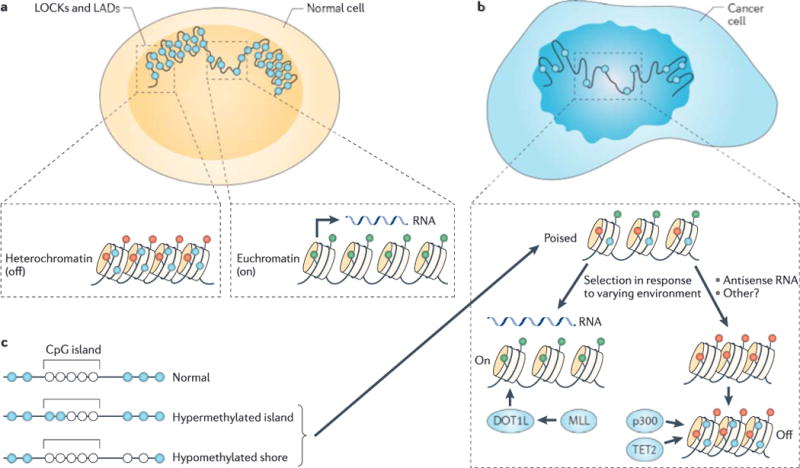
Figure 1
Figure 1. Alterations in the cancer epigenome that can cause epigenetic dysregulation
a | Large organized chromatin lysine modifications (LOCKs) and lamin-associated domains (LADs) (shown here in large scale) are associated with the nuclear membrane and are generally heterochromatic, with a high level of DNA methylation. Transcriptionally active genes have less compact nucleosomes than silent genes, and active and silent genes are distinguished by differing post-translational modifications of histones (green represents on and red represents off), as well as increased DNA methylation (shown in blue) of silent genes, b | In cancer there is a reduction of LOCKs, as well as general disorganization of the nuclear membrane and hypomethylation of large blocks of DNA corresponding approximately to the LOCKs and LADs. Chromatin is in a more stem cell-like state with the ability to differentiate into euchromatin and hypomethylated genes, or into heterochromatin and hypermethylated genes. Our argument is that epigenetic dysregulation allows for selection in response to the cellular environment for cellular growth advantage at the expense of the host. Mechanisms include mutations in epigenetic regulatory genes (for example, DOT1-like (DOT1L), mixed lineage leukaemia (MLL), EP300 (which encodes p300) and tet methylcytosine dioxygenase 2 (TET2)) and primary epigenetic modifications with positive feedback. c | Loss of boundary stability of methylation at CpG islands includes the encroaching of boundaries, leading to CpG island hypermethylation, and the shifting out of boundaries, leading to hypomethylated CpG shores. Both mean shifts in methylation and hypervariability allow for selection.
Figure 2
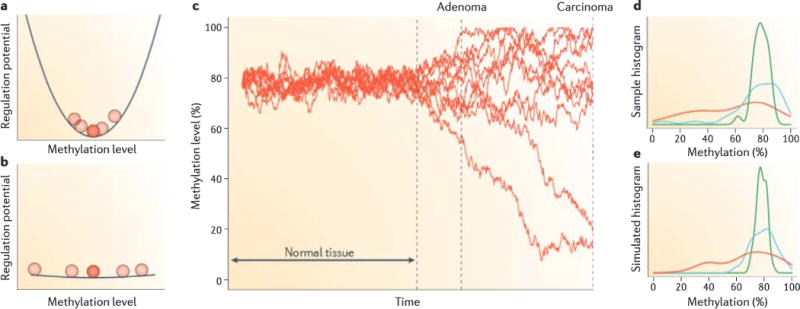
Figure 2. Modelling epigenetic dysregulation using an Ornstein-Uhlenbeck process
We used an Ornstein-Uhlenbeck process to model stochastic change in DNA methylation opposed by regulatory proteins. a | In normal tissue, the methylation level can be represented as a ball at the bottom of a valley—stochastic noise allows it to vary slightly, but regulatory forces represented by the walls of the valley keep the levels clustered around a single point, b | An early carcinogenic event flattens the landscape, leading to more variable methylation levels, c | Using the Euler-Murayama method, we can model this behaviour as = θ (μM)dt+σ dW, with M being the methylation value, μ the equilibrium point, θ the restoring force, σ the noise level (4%) and dW a Wiener process increment. Shown are ten example traces of simulated methylation levels. Regulatory forces (θ) are set high in the normal tissue and low after a carcinogenic event. As time progresses, samples of the simulation are taken, representing different stages of cancer progression: that is, normal, adenoma and carcinoma. d | Density plots of methylation data of a single CpG site from REF. (Gene Expression Omnibus number: GSE29381) showing methylation histograms for normal (green; N = 29), adenoma (blue; N = 31) and carcinoma (red; N = 10) colon samples. The plots were generated by Gaussian kernel smoothed density function in R.e | Density plots of simulations for the same CpG showing the combined results from 100 simulations using the same sampling methods as in part d. The model provides an excellent fit to the data.
Figure 3
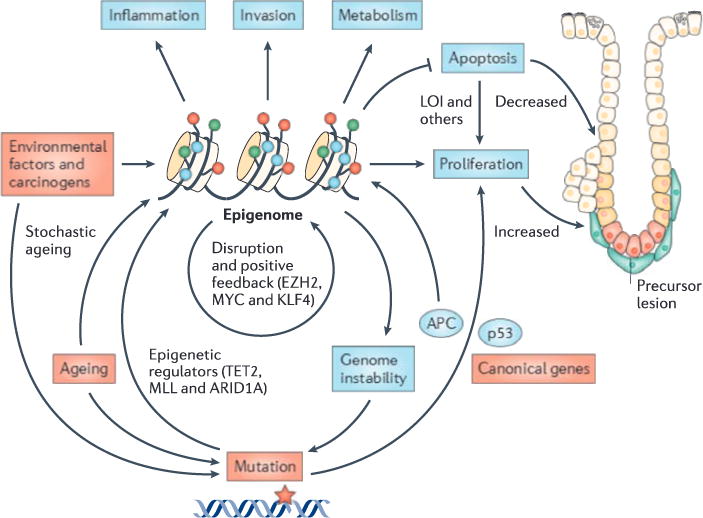
Figure 3. Collaboration of epigenetic modification and mutation in the hallmarks of cancer
The epigenome sits at the intersection of the environment, genetic mutation and tumour cell growth. Environmental factors, such as carcinogens or diet, as well as injury and inflammation, cause epigenetic reprogramming. The epigenome also accumulates damage stochastically and through ageing. The machinery for maintaining epigenetic integrity can be stably disrupted in either of two ways: by mutation or by epigenetic change itself with positive feedback. Examples of mutation include epigenetic regulator mutations (TABLE 1), whereas examples of epigenetic change include loss of imprinting (LOI) of insulin-like growth factor 2 (IGF2) in colorectal carcinogenesis, enhancer of zeste homologue 2 (EZH2) silencing in prostate cancer (TABLE 2) and overexpression of reprogramming factors. The disruption of epigenetic integrity maintenance leads to the loss of epigenetic regulation and stochastic drift from a normal set point, followed by selection for cellular growth at the expense of other cells (FIGS 1,2). Some epigenetic modifications, such as shifting methylation boundaries at CpG islands and shores, lead to metabolic change and enhanced proliferation. Others, such as hypomethylated blocks, lead to increased invasion. Still others, such as LOI, directly change the balance between apoptosis and proliferation. Canonical mutations, such as in adenomatous polyposis coli (APC) and TP53 (which encodes p53), directly affect cancer hallmarks but can also cause epigenetic dysregulation. Similarly, epigenetic disruption, such as regional hypomethylation or CpG hypermethylation, can lead to increased chromosomal rearrangements and mutations, respectively. Instability of CpG island methylation boundaries also contributes to epigenetic dysregulation, allowing for selection in response to the cellular environment for cellular growth advantage at the expense of the host. ARID1A, AT-rich interactive domain-containing protein 1A; KLF4, Krüppel-like factor 4; MLL, mixed lineage leukaemia; TET2, tet methylcytosine dioxygenase 2.

References

    1. Weinhouse S. Isozymes in cancer. Cancer Res. 1971;31:1166–1167. - PubMed
    1. Shih C, Weinberg RA. Isolation of a transforming sequence from a human bladder carcinoma cell line. Cell. 1982;29:161–169. - PubMed
    1. Feinberg AP, Vogelstein B. Hypomethylation distinguishes genes of some human cancers from their normal counterparts. Nature. 1983;301:89–92. - PubMed
    1. Knudson AG. Mutation and cancer: statistical study of retinoblastoma. Proc Natl Acad Sci USA. 1971;68:820–823. - PMC - PubMed
    1. Greger V, Passarge E, Hopping W, Messmer E, Horsthemke B. Epigenetic changes may contribute to the formation and spontaneous regression of retinoblastoma. Hum Genet. 1989;83:155–158. - PubMed

Publication types

MeSH terms

Substances