. 2013 Jul 4;499(7456):50-4.
doi: 10.1038/nature12318. Epub 2013 Jun 12.

53BP1 is a reader of the DNA-damage-induced H2A Lys 15 ubiquitin mark

Affiliations

53BP1 is a reader of the DNA-damage-induced H2A Lys 15 ubiquitin mark

Amélie Fradet-Turcotte et al. Nature. .

Expression of concern in

Abstract

53BP1 (also called TP53BP1) is a chromatin-associated factor that promotes immunoglobulin class switching and DNA double-strand-break (DSB) repair by non-homologous end joining. To accomplish its function in DNA repair, 53BP1 accumulates at DSB sites downstream of the RNF168 ubiquitin ligase. How ubiquitin recruits 53BP1 to break sites remains unknown as its relocalization involves recognition of histone H4 Lys 20 (H4K20) methylation by its Tudor domain. Here we elucidate how vertebrate 53BP1 is recruited to the chromatin that flanks DSB sites. We show that 53BP1 recognizes mononucleosomes containing dimethylated H4K20 (H4K20me2) and H2A ubiquitinated on Lys 15 (H2AK15ub), the latter being a product of RNF168 action on chromatin. 53BP1 binds to nucleosomes minimally as a dimer using its previously characterized methyl-lysine-binding Tudor domain and a carboxy-terminal extension, termed the ubiquitination-dependent recruitment (UDR) motif, which interacts with the epitope formed by H2AK15ub and its surrounding residues on the H2A tail. 53BP1 is therefore a bivalent histone modification reader that recognizes a histone 'code' produced by DSB signalling.


Conflict of interest statement

The authors declare no competing financial interests.

Figures
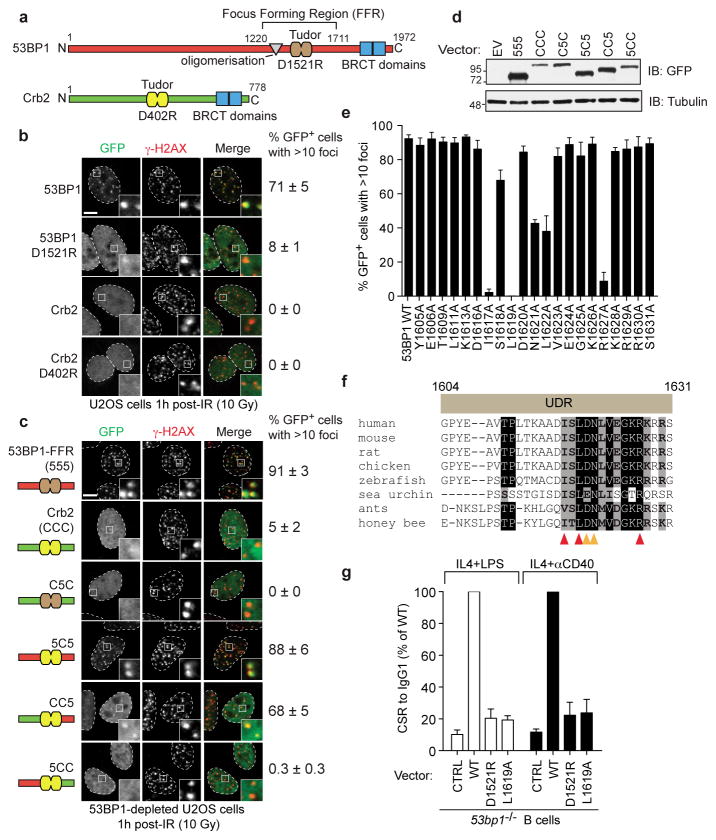
Figure 1
Figure 1. Identification of the 53BP1 UDR
a, Schematic representation of 53BP1 and Crb2. b, U2OS cells transfected with GFP-53BP1 and GFP-Crb2 expression vectors were irradiated (10 Gy) and processed for GFP imaging and γ-H2AX immunofluorescence (mean ± s.e.m., N≥3). c, 53BP1-depleted U2OS cells transfected with the indicated GFP-53BP1/Crb2-derived expression vectors were irradiated (10 Gy) and processed as described in a (mean ± s.e.m., N≥3). d, Analysis of GFP fusion protein expression by immunoblotting. e, 53BP1-depleted U2OS cells transfected with vectors expressing the indicated GFP-53BP1 mutants (residues 1220-1631) were irradiated (10 Gy) and processed as in a (mean ± s.e.m., N≥3). f, Alignment of the UDR region in 53BP1 orthologs. Arrowheads highlight key UDR residues. g, Relative levels of class switching to IgG1 in 53bp1−/− murine B cells transduced with the indicated retroviruses (mean ± s.d., N≥2).
Figure 2
Figure 2. 53BP1 binds to ubiquitylated nucleosomes
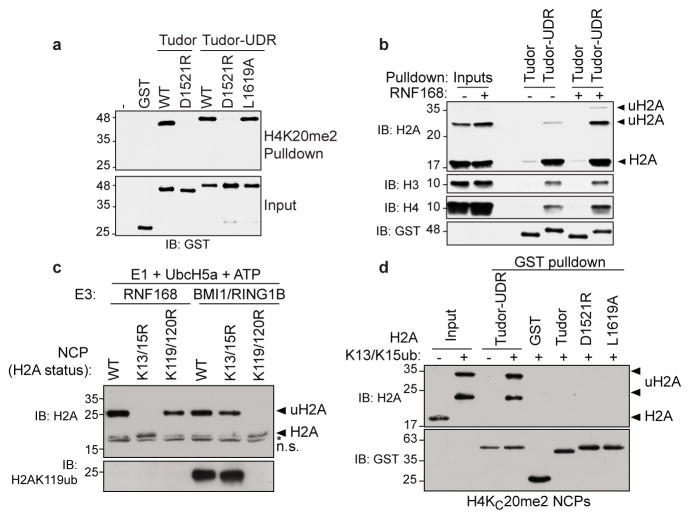
a, Streptavidin pulldowns of the indicated GST fusion proteins with a biotinylated H4K20me2 peptide. b, Chromatin from HEK293 cells expressing Flag-RNF168 (+) or not (−) were subjected to pulldown assays with the indicated GST fusion proteins. c, Ubiquitylation of the indicated NCPs by RNF168 and BMI1-RING1B. n.s. non-specific band. d, Pulldown assays of NCPs containing H4KC20me2 with the indicated GST fusion proteins. NCPs were ubiquitylated with RNF168 as the E3 (+); a reaction without E1 (−) was used as negative control.
Figure 3
Figure 3. 53BP1 is a bivalent reader of the H4K20me2 and H2AK15ub histone marks
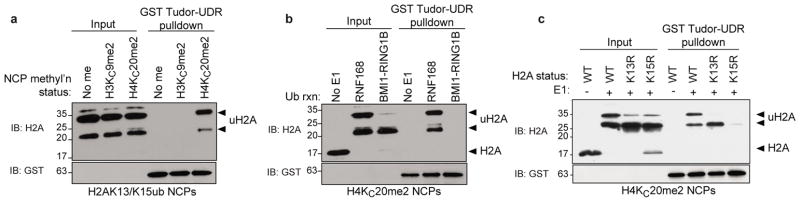
a, Pulldown assays of RNF168-ubiquitylated NCPs containing unmethylated histone H4 and H3 (No me), H4KC20me2 or H3KC9me2 with GST-Tudor-UDR. b, Pulldown assays of NCPs ubiquitylated with the indicated E3s by GST-Tudor-UDR. A reaction without E1 (No E1) acts as negative control. c, GST-Tudor-UDR pulldown assays of the indicated NCPs ubiquitylated with RNF168 (+); a reaction lacking E1 (−) was used as negative control.
Figure 4
Figure 4. Determinants of H2AK15ub recognition
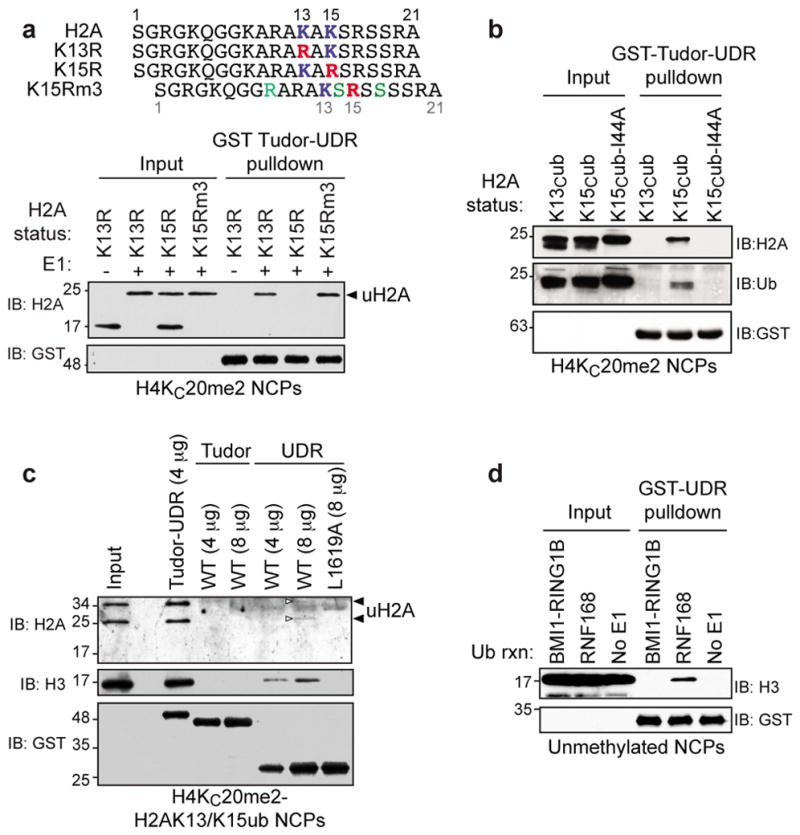
a, Upper panel: Sequence of the H2A N-termini of various mutants. Mutations are highlighted in color. Lower panel: GST-Tudor-UDR pulldown assays of RNF168-ubiquitylated NCPs (+) assembled with H4KC20me2 and the indicated H2A mutants. A reaction without E1 (−) was used as control. b, GST-Tudor-UDR pulldown assays of NPCs with the indicated H2A ubiquitylations. c, Pulldown assays of RNF168-ubiquitylated H4KC20me2-NCPs with the indicated fusion proteins. A white arrowhead highlights faint uH2A bands. d, GST-UDR pulldown assays of unmethylated NCPs that were either ubiquitylated with the indicated E3 or not (no E1).

References

    1. Lukas J, Lukas C, Bartek J. More than just a focus: The chromatin response to DNA damage and its role in genome integrity maintenance. Nature cell biology. 2011;13:1161–1169. doi: 10.1038/ncb2344. - DOI - PubMed
    1. Jackson SP, Durocher D. Regulation of DNA damage responses by ubiquitin and SUMO. Molecular cell. 2013;49:795–807. doi: 10.1016/j.molcel.2013.01.017. - DOI - PubMed
    1. Nakamura K, et al. Genetic dissection of vertebrate 53BP1: a major role in non-homologous end joining of DNA double strand breaks. DNA Repair (Amst) 2006;5:741–749. - PubMed
    1. Bunting SF, et al. 53BP1 inhibits homologous recombination in Brca1-deficient cells by blocking resection of DNA breaks. Cell. 2010;141:243–254. doi: 10.1016/j.cell.2010.03.012. S0092-8674(10)00285-0 [pii] - DOI - PMC - PubMed
    1. Ward IM, et al. 53BP1 is required for class switch recombination. J Cell Biol. 2004;165:459–464. - PMC - PubMed

Publication types

MeSH terms