. 2013 Aug;41(15):7438-52.
doi: 10.1093/nar/gkt527. Epub 2013 Jun 12.

Binding of RNA by APOBEC3G controls deamination-independent restriction of retroviruses

Affiliations

Binding of RNA by APOBEC3G controls deamination-independent restriction of retroviruses

Kasandra Bélanger et al. Nucleic Acids Res. 2013 Aug.

Abstract

APOBEC3G (A3G) is a host-encoded protein that potently restricts the infectivity of a broad range of retroviruses. This can occur by mechanisms dependent on catalytic activity, resulting in the mutagenic deamination of nascent viral cDNA, and/or by other means that are independent of its catalytic activity. It is not yet known to what extent deamination-independent processes contribute to the overall restriction, how they exactly work or how they are regulated. Here, we show that alanine substitution of either tryptophan 94 (W94A) or 127 (W127A) in the non-catalytic N-terminal domain of A3G severely impedes RNA binding and alleviates deamination-independent restriction while still maintaining DNA mutator activity. Substitution of both tryptophans (W94A/W127A) produces a more severe phenotype in which RNA binding and RNA-dependent protein oligomerization are completely abrogated. We further demonstrate that RNA binding is specifically required for crippling late reverse transcript accumulation, preventing proviral DNA integration and, consequently, restricting viral particle release. We did not find that deaminase activity made a significant contribution to the restriction of any of these processes. In summary, this work reveals that there is a direct correlation between A3G's capacity to bind RNA and its ability to inhibit retroviral infectivity in a deamination-independent manner.


Figures
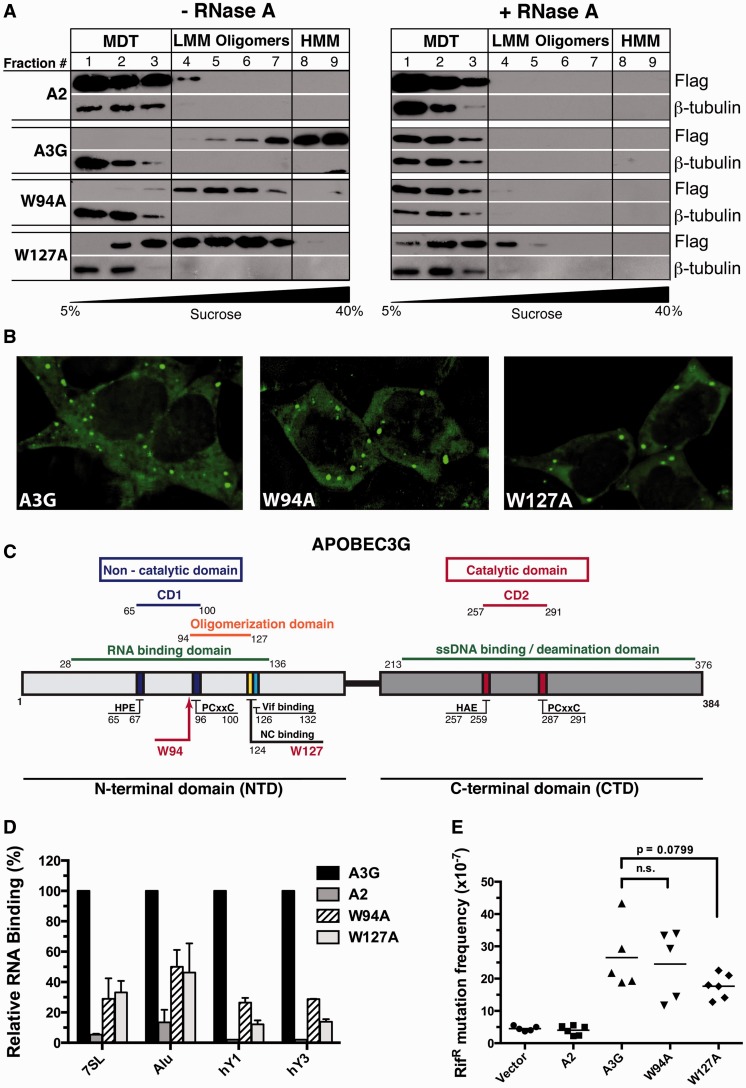
Figure 1.
Figure 1.
Effects of the W94A and W127A mutations on HMM complex assembly, subcellular distribution, RNA-binding and DNA deaminase activity. (A) Lysates of transfected 293T cells, treated (right panels) or untreated (left panels) with RNase, were resolved by velocity sedimentation over a non-denaturing 5–40% sucrose gradient and analyzed by western blot using anti-FLAG and anti-β-tubulin antibodies. (B) Fluorescent imaging of the subcellular localization of 293T cells expressing eGFP-A3G, eGFP-W94A and eGFP-W127A. (C) Schematic representation of the location of important residues and binding domains in the A3G protein sequence. (D) Binding of FLAG-tagged A2, A3G, W94A and W127A to 7SL, Alu, hY1 and hY3 RNAs were determined by qPCR. Relative binding to A3G is depicted. Results represent the mean ± SD of triplicate values from three independent transfection experiments. (E) Evaluation of the intrinsic DNA cytidine deaminase activity using a bacterial mutator assay. Each point represents the mutation frequency (RifR mutants per 107 viable cells) of an independent bacterial culture; median values are indicated.
Figure 2.
Figure 2.
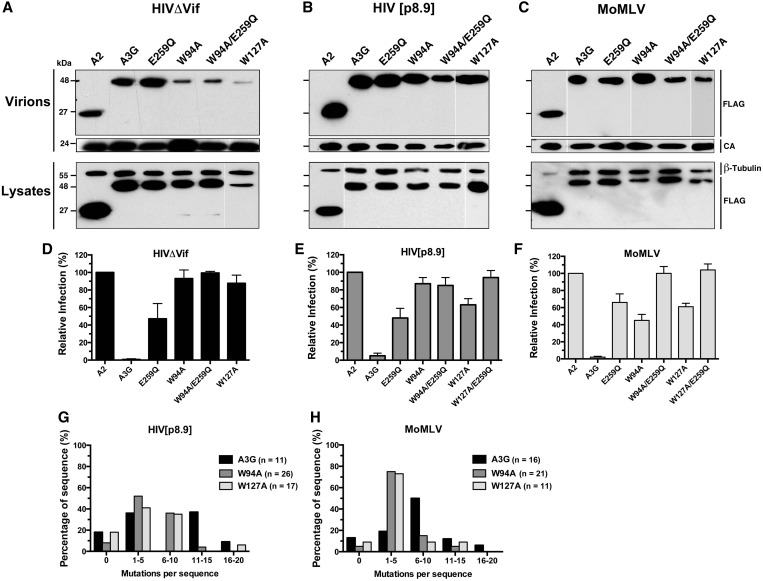
Virus-dependent packaging of W94A and W127A, and retroviral restriction analysis. (A–C) Viral particles were purified from cell supernatants, lysed and assayed for the presence of FLAG-tagged APOBEC proteins by western blot analysis (top panels). Lysates of virus-producing cells are shown in the bottom panels. (D–F) Restriction analysis of virus infectivity as measured by eGFP expression in target cells infected with HIVΔVif (D), HIV[p8.9] (E) or MoMLV (F). Results represent the mean ± SD of triplicate values from at least three independent transfection experiments. (G and H) Analysis of mutations in proviral DNA. Histograms depict the proportion of total sequences containing the indicated number of mutations. The total number of clones sequenced is indicated in the chart legend. Sequences were compiled from one experiment for A3G and W127A and from two independent experiments for W94A.
Figure 3.
Figure 3.
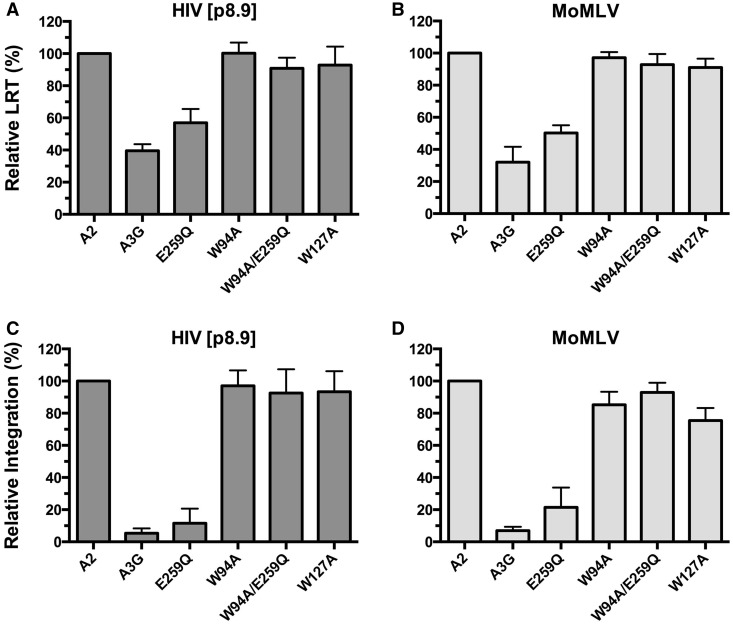
Effects of W94A and W127A on proviral DNA synthesis and integration. (A and B) Analysis of LRT accumulation. (C and D) Analysis of proviral DNA integration. DNA from infected 293T cells was collected at 12 h post-infection for LRT analysis and at 24 h for integration analysis. Infections were performed on 293T cells with HIV[p8.9] (A and C), or on NIH 3T3 cells with MoMLV (B and D). The results reflect the mean RQ ± SD of three independent experiments each performed in quadruplicate. Data were normalized to A2 values.
Figure 4.
Figure 4.
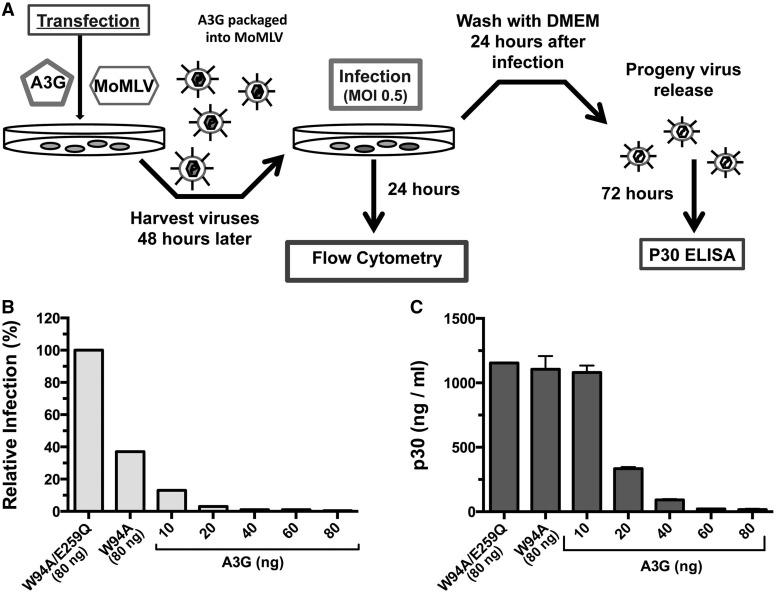
Effect of deamination on MoMLV particle release. (A) Diagram of the experimental method. (B) Relative infection of NIH 3T3 cells by MoMLV measured after 24 h. Viral particles were produced in presence of a 1:10 A3G (80 ng)-to-MoMLV (800 ng) proviral plasmid ratio for W94A and W94A/E259Q, and increasing amounts of wild-type A3G as indicated. (C) p30 levels in cell supernatants were measured by enzyme-linked immunosorbent assay 72 h after infection. Data represent the mean ± SD of three independent protein measurements.
Figure 5.
Figure 5.
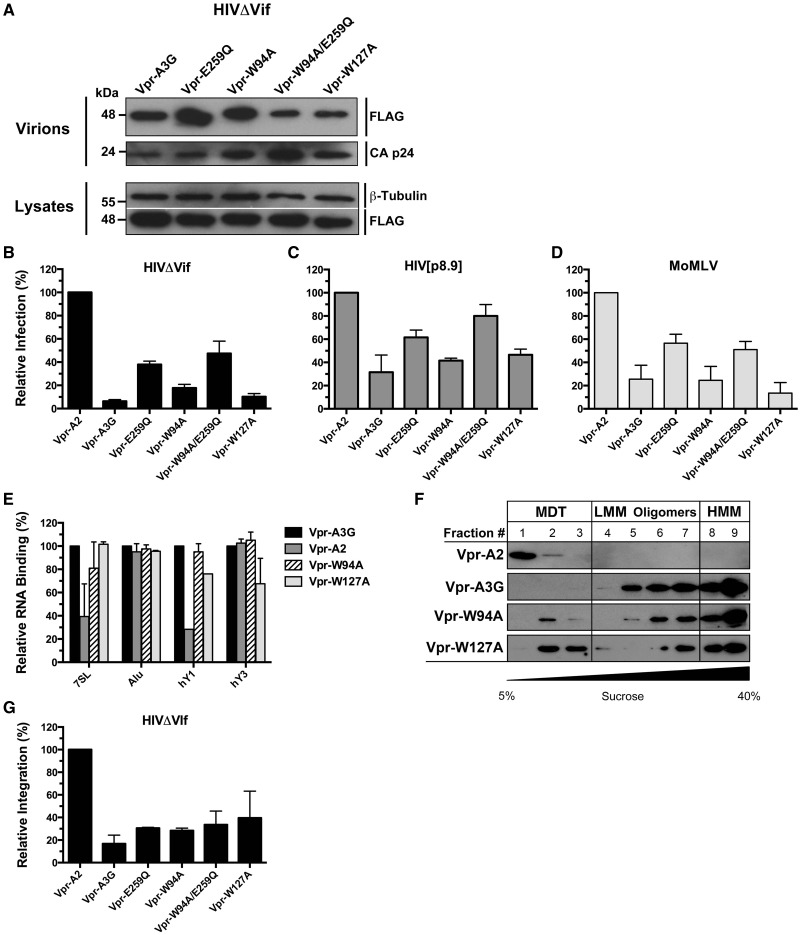
Vpr14–88 polypeptide (Vpr) fusions restore virion packaging, RNA-binding, HMM complex assembly and antiretroviral properties of W94A and W127A. (A) Packaging of all Vpr-A3G fusion proteins into HIVΔVif virions. (B–D) Antiretroviral activities of Vpr-A3G fusion proteins on HIVΔVif (B), HIV[p8.9] (C) and MoMLV (D). (E) Evaluation of the RNA-binding properties of Vpr fusion proteins. Data represent the mean ± SD of triplicate values from three independent experiments. (F) Lysates of 293T cells transfected with Vpr expression vectors analyzed by velocity sedimentation over non-denaturing sucrose gradients. (G) Effect of Vpr fusion proteins on HIVΔVif proviral integration. The results reflect the mean RQ ± SD of three independent experiments each performed in quadruplicate. Data were normalized to Vpr-A2 values.
Figure 6.
Figure 6.
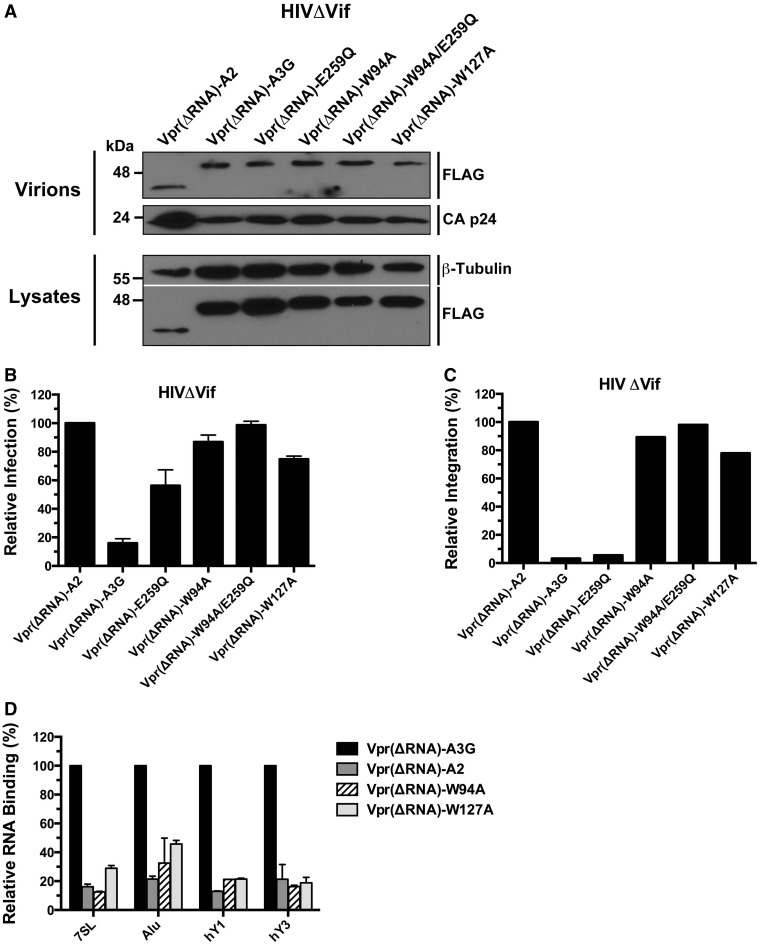
Fusion to the RNA-binding defective Vpr14–86 polyprotein [Vpr(ΔRNA)] does not restore the restriction potential of the W94A and W127A mutants. (A) Analysis of the packaging of all Vpr(ΔRNA)-A3G fusion proteins into HIVΔVif virions. (B) Antiretroviral activities of Vpr(ΔRNA)-A3G fusion proteins on HIVΔVif. (C) Evaluation of the RNA-binding properties of VprΔRNA) fusion proteins. Data represent the mean ± SD of triplicate values from three independent experiments. (D) Effect of Vpr(ΔRNA) fusion proteins on HIVΔVif proviral integration. The results reflect the mean RQ of one experiment performed in quadruplicate. Data were normalized to Vpr-A2 values.
Figure 7.
Figure 7.
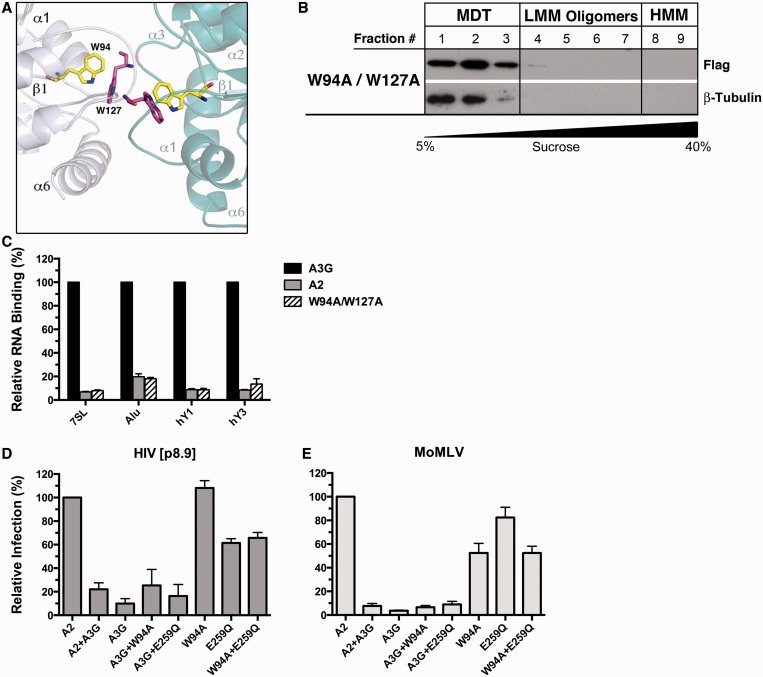
Retroviral restriction by A3G requires RNA but not a protein co-factor. (A) Cropped field from the homology model of the head-to-head NTD dimer of A3G (see Supplementary Figure S4 for the complete model and details). The W94 and W127 interaction domain at the interface of the monomers is shown, W94 (yellow); W127 (pink). (B) Lysates of 293T cells transfected with the W94A/W127A mutant resolved by non-denaturing velocity sedimentation. (C) Evaluation of the RNA-binding properties of the W94A/W127A mutant. (D and E) Viruses for the complementation assays were produced by co-transfecting a total of 80 ng of APOBEC expression plasmids (40 ng each) for MoMLV restrictions assays, or 150 ng for HIV[p8.9] (75 ng each). Data represent the mean ± SD of triplicate values from three independent experiments.

References

    1. Albin JS, Harris RS. Interactions of host APOBEC3 restriction factors with HIV-1 in vivo: implications for therapeutics. Expert Rev. Mol. Med. 2010;12:e4. - PMC - PubMed
    1. Jern P, Russell RA, Pathak VK, Coffin JM. Likely role of APOBEC3G-mediated G-to-A mutations in HIV-1 evolution and drug resistance. PLoS Pathog. 2009;5:e1000367. - PMC - PubMed
    1. Suspene R, Rusniok C, Vartanian JP, Wain-Hobson S. Twin gradients in APOBEC3 edited HIV-1 DNA reflect the dynamics of lentiviral replication. Nucleic Acids Res. 2006;34:4677–4684. - PMC - PubMed
    1. Yu Q, Konig R, Pillai S, Chiles K, Kearney M, Palmer S, Richman D, Coffin JM, Landau NR. Single-strand specificity of APOBEC3G accounts for minus-strand deamination of the HIV genome. Nat. Struct. Mol. Biol. 2004;11:435–442. - PubMed
    1. Armitage AE, Deforche K, Chang CH, Wee E, Kramer B, Welch JJ, Gerstoft J, Fugger L, McMichael A, Rambaut A, et al. APOBEC3G-induced hypermutation of human immunodeficiency virus type-1 is typically a discrete “all or nothing” phenomenon. PLoS Genet. 2012;8:e1002550. - PMC - PubMed

Publication types

MeSH terms