


Breast cancer mortality trends in England and the assessment of the effectiveness of mammography screening: population-based study
- PMID: 23761583
- PMCID: PMC3705415
- DOI: 10.1177/0141076813486779
Breast cancer mortality trends in England and the assessment of the effectiveness of mammography screening: population-based study
Abstract
Objective: To investigate whether mortality statistics show an effect of mammographic screening on population-based breast cancer mortality in England.
Design: Joinpoint regression analyses, and other analyses, of population-based mortality data.
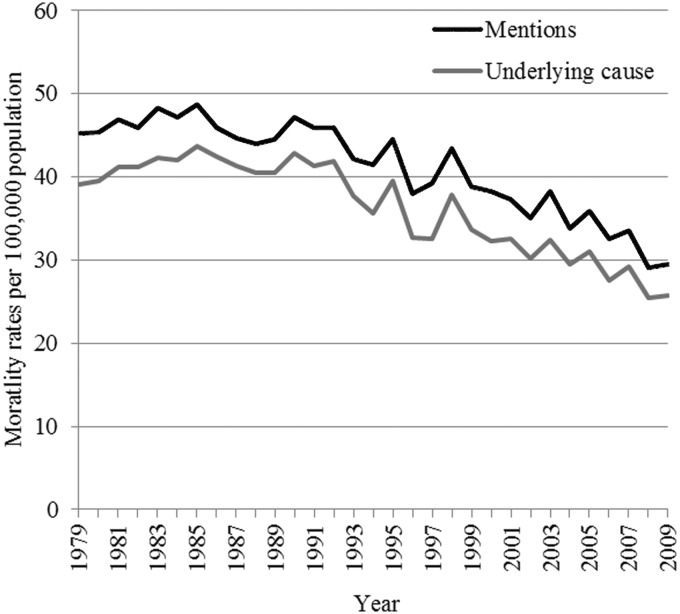
Setting: Analysis of mortality rates in the Oxford region, UK (1979-2009) because, unlike the rest of England, all causes of death mentioned on each death certificate for its residents (not just the underlying cause) are available prior to commencement of the English National Breast Screening Programme (NHSBSP). In addition, analysis of English national breast cancer mortality rates (1971-2009).
Participants: Women who died from breast cancer in the Oxford region (1979--2009) and England (1971--2009) MAIN OUTCOME MEASURES: Age-specific mortality rates, and age-standardized mortality rates. Joinpoint regression analysis was used to estimate years ('joinpoints') in which trends changed, and annual percentage change between joinpoints, with confidence intervals.
Results: In the Oxford region, trends for breast cancer mortality based on underlying cause and on mentions were very similar. For all ages combined, mortality rates peaked for both underlying cause and mentions in 1985 and then started to decline, prior to the introduction of the NHSBSP in 1988. Between 1979 and 2009, for mortality measured as underlying cause, rates declined by -2.1% (95% CI -2.7 to -1.4) per year for women aged 40-49 years (unscreened), and by the same percentage per year (-2.1% [-2.4 to -1.7]) for women aged 50-64 years (screened). In England, the first estimated changes in trend occurred prior to the introduction of screening, or before screening was likely to have had an effect (between 1982 and 1989). Thereafter, the downward trend was greatest in women aged under 40 years: -2.0% per year (-2.8 to -1.2) in 1988-2001 and -5.0% per year (-6.7 to -3.3) in 2001-2009. There was no evidence that declines in mortality rates were consistently greater in women in age groups and cohorts that had been screened at all, or screened several times, than in other (unscreened) women, in the same time periods. Conclusions Mortality statistics do not show an effect of mammographic screening on population-based breast cancer mortality in England.
Figures
Comment in
-
Complex statistical techniques cannot overcome weak methodology in the evaluation of breast cancer mortality trends.J R Soc Med. 2013 Sep;106(9):346. doi: 10.1177/0141076813501807. J R Soc Med. 2013. PMID: 23995822 Free PMC article. No abstract available.
-
Breast cancer mortality trends in England and mammography screening (1971-2009): authors' response.J R Soc Med. 2014 Feb;107(2):54-5. doi: 10.1177/0141076813515380. J R Soc Med. 2014. PMID: 24500228 Free PMC article. No abstract available.
References
-
- International Agency for Research on Cancer. Cancer Fact Sheet: Breast Cancer Incidence, Mortality and Prevalence Worldwide in 2008, Summary. See http://globocan.iarc.fr/factsheets/cancers/breast.asp (last checked 12 April 2013)
-
- Cancer Research UK. Cancer Stats Breast Cancer – UK. May 2009. See http://publications.cancerresearchuk.org/downloads/Product/CS_CS_BREAST.pdf (last checked 12 April 2013)
-
- Bock K, Borisch B, Cawson J, et al. Effect of population-based screening on breast cancer mortality. Lancet 2011;378: 1775–6 - PubMed
-
- Jørgensen KJ, Keen JD, Gøtzsche PC. Is mammographic screening justifiable considering its substantial overdiagnosis rate and minor effect on mortality? Radiology 2011;260: 621–7 - PubMed
Publication types
MeSH terms
LinkOut - more resources
Full Text Sources
Other Literature Sources
Medical
