. 2013 Jul 2;81(1):52-9.
doi: 10.1212/WNL.0b013e318297eee0. Epub 2013 Jun 12.

Prospective study of restless legs syndrome and mortality among men

Affiliations

Prospective study of restless legs syndrome and mortality among men

Yanping Li et al. Neurology. .

Abstract

Objective: To prospectively examine whether men with restless legs syndrome (RLS) had an increased risk of mortality.

Method: This was a prospective cohort study of 18,425 US men free of diabetes, arthritis, and renal failure in the Health Professionals Follow-up Study (HPFS). In 2002, RLS was assessed using a set of standardized questions. Deaths were identified from state vital statistics records, the National Death Index, family reports, and the postal system.

Results: During 8 years of follow-up (2002-2010), we documented 2,765 deaths. In an age-adjusted model, RLS was associated with a 39% increased risk of mortality (hazard ratio [HR] = 1.39; 95% confidence interval [CI] 1.19-1.62; p < 0.0001). The association between RLS and mortality was slightly attenuated after further adjustment for body mass index, lifestyle factors, chronic conditions, sleep duration, and other sleep-related disorders (adjusted HR = 1.30; 95% CI 1.11-1.52; p = 0.003). When we further excluded those with major chronic conditions (e.g., cancer, high blood pressure, cardiovascular disease, and other comorbidities), the adjusted HR was 1.92 (95% CI 1.03-3.56; p = 0.04). The interactions between RLS and other risk factors (older age, overweight, short sleep duration, smoking, low physical activity, and unhealthy diet) in relation to total mortality risk were not significant (p for interaction >0.2 for all).

Conclusion: We observed that men with RLS had a higher overall mortality and this association was independent of known risk factors. The increased mortality in RLS was more frequently associated with respiratory disease, endocrine disease, nutritional/metabolic disease, and immunologic disorders. Future research exploring the pathophysiologic relationship between these disorders and RLS is warranted.


Figures
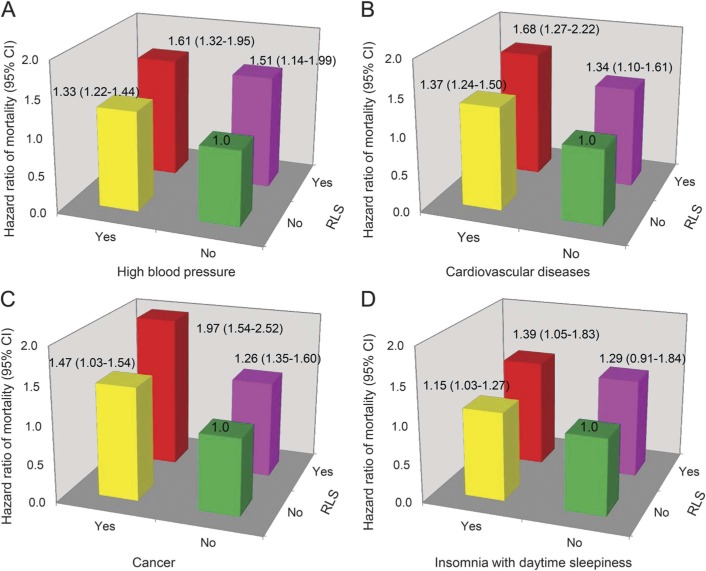
Figure 1
Figure 1. Joint effect of restless legs syndrome with high blood pressure, cardiovascular disease, cancer, and insomnia with daytime sleepiness on risk of mortality
Up to 8 years of follow-up (2002–2010) for joint effect on mortality between restless legs syndrome (RLS) and high blood pressure (A), cardiovascular disease (B), and cancer (C), and up to 6 years of follow-up of mortality (2004–2010) for joint effect between RLS and insomnia with daytime sleepiness (D). Multivariable adjusted hazard ratio estimated from Cox proportional hazards models and adjusted for age (months), ethnicity (Caucasian, yes/no), smoking status (never smoker, former smoker, or current smoker), alcohol drinking (g/day: 0, 0.1–9.9, 10.0–19.9, 20.0–29.9, and ≥30), body mass index (continuous), physical activity (quintiles), multiple vitamin supplement (yes/no), regular use of aspirin (yes/no), iron-specific supplement (yes/no), Alternate Healthy Eating Index (quintile), sleep duration (hours: ≤5, 6, 7, 8, ≥9), frequent snoring (yes/no), presence of insomnia with daytime sleepiness (yes/no or missing), use of antidepressant drugs (yes/no), presence of cancer, elevated total cholesterol, Parkinson disease, high blood pressure, and cardiovascular disease (all yes/no), except the joint variable. All were treated as time-varying covariates except ethnicity, sleep duration, snoring, and presence of insomnia with daytime sleepiness; p for interaction >0.2 for all. CI = confidence interval.
Figure 2
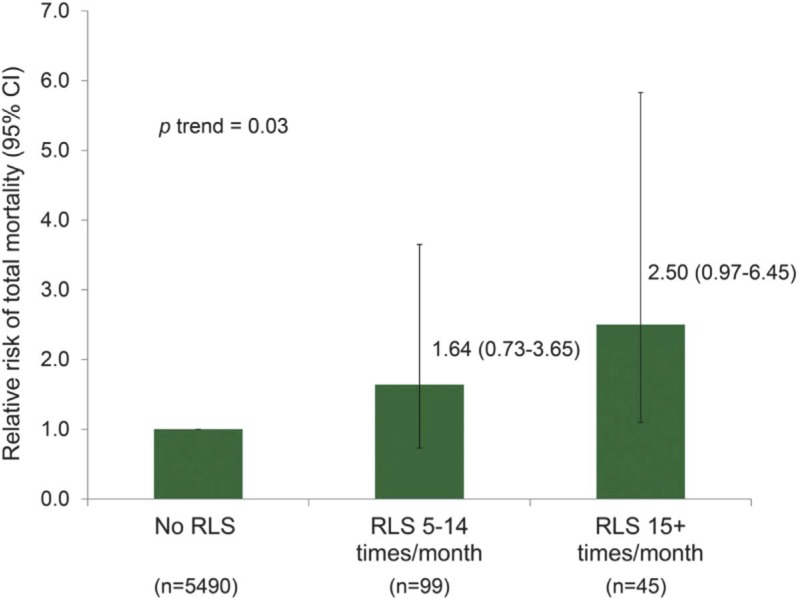
Figure 2. Association between restless legs syndrome severity and mortality among relatively healthy men
Relatively healthy men in the present study means men who were free of cancer, Parkinson disease, high blood pressure, cardiovascular disease, diabetes, arthritis, obesity, snoring every night, cancer, emphysema or chronic bronchitis, chronic obstructive pulmonary disease, pernicious anemia, ulcerative colitis or Crohn disease, pneumonia, asthma, and renal failure. Estimated from Cox proportional hazards models and adjusted for age (months), ethnicity (Caucasian, yes/no), smoking status (never smoker, former smoker, or current smoker), alcohol drinking (g/day: women 0, 0.1–4.9, 5.0–9.9, 10.0–14.9, and ≥15; men 0, 0.1–9.9, 10.0–19.9, 20.0–29.9, and ≥30), body mass index (continuous), physical activity (quintiles), multiple vitamin supplement (yes/no), regular use of aspirin (yes/no), iron-specific supplement (yes/no), Alternate Healthy Eating Index, sleep duration (hours: <7, 7, >7), frequent snoring (yes/no), presence of insomnia with daytime sleepiness (yes/no or missing), use of antidepressant drugs (yes/no), and presence of elevated total cholesterol (yes/no). CI = confidence interval; RLS = restless legs syndrome.

References

    1. Hening WA, Allen RP, Chaudhuri KR, et al. Clinical significance of RLS. Mov Disord 2007;22:S395–S400 - PubMed
    1. Ekbom K. Restless legs syndrome. Neurology 1960;10:868–873 - PubMed
    1. Restless Legs Syndrome Foundation. Available at: http://www.rls.org/Document.Doc?id=2127. Accessed January 27, 2012
    1. Ohayon MM, O'Hara R, Vitiello MV. Epidemiology of restless legs syndrome: a synthesis of the literature. Sleep Med Rev 2011;16:283–295 - PMC - PubMed
    1. Gao X, Schwarzschild MA, O'Reilly EJ, Wang H, Ascherio A. Restless legs syndrome and erectile dysfunction. Sleep 2010;33:75–79 - PMC - PubMed

Publication types