


The serotonin 5-HT3 receptor: a novel neurodevelopmental target
- PMID: 23761731
- PMCID: PMC3669892
- DOI: 10.3389/fncel.2013.00076
The serotonin 5-HT3 receptor: a novel neurodevelopmental target
Abstract
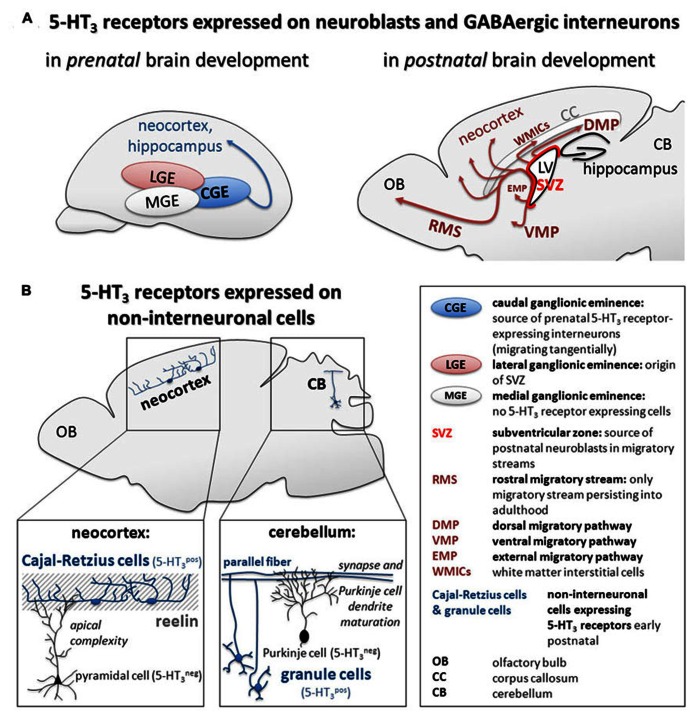
Serotonin (5-hydroxytryptamine, 5-HT), next to being an important neurotransmitter, recently gained attention as a key-regulator of pre- and postnatal development in the mammalian central nervous system (CNS). Several receptors for 5-HT are expressed in the developing brain including a ligand-gated ion channel, the 5-HT3 receptor. Over the past years, evidence has been accumulating that 5-HT3 receptors are involved in the regulation of neurodevelopment by serotonin. Here, we review the spatial and temporal expression patterns of 5-HT3 receptors in the pre- and early postnatal rodent brain and its functional implications. First, 5-HT3 receptors are expressed on GABAergic interneurons in neocortex and limbic structures derived from the caudal ganglionic eminence. Mature inhibitory GABAergic interneurons fine-tune neuronal excitability and thus are crucial for the physiological function of the brain. Second, 5-HT3 receptors are expressed on specific glutamatergic neurons, Cajal-Retzius cells in the cortex and granule cells in the cerebellum, where they regulate morphology, positioning, and connectivity of the local microcircuitry. Taken together, the 5-HT3 receptor emerges as a potential key-regulator of network formation and function in the CNS, which could have a major impact on our understanding of neurodevelopmental disorders in which 5-HT plays a role.
Keywords: 5-HT3 receptor; development; interneurons; neuroblasts; serotonin.
Figures
References
-
- Abrous D. N., Koehl M., Moal M. L. (2005). Adult neurogenesis: from precursors to network and physiology. Physiol. Rev. 85 523–569 - PubMed
-
- Anderson G. M., Freedman D. X., Cohen D. J., Volkmar F. R., Hoder E. L., McPhedran P., et al. (1987). Whole blood serotonin in autistic and normal subjects. J. Child Psychol. Psychiatry 28 885–900 - PubMed
-
- Ansorge M. S., Zhou M., Lira A., Hen R., Gingrich J. A. (2004). Early-life blockade of the 5-HT transporter alters emotional behavior in adult mice. Science 306 879–881 - PubMed
LinkOut - more resources
Full Text Sources
Other Literature Sources
Miscellaneous
