. 2013 Jun 3:4:273.
doi: 10.3389/fpsyg.2013.00273. eCollection 2013.

Choosing actions

Affiliations

Choosing actions

David A Rosenbaum et al. Front Psychol. .

Abstract

Actions that are chosen have properties that distinguish them from actions that are not. Of the nearly infinite possible actions that can achieve any given task, many of the unchosen actions are irrelevant, incorrect, or inappropriate. Others are relevant, correct, or appropriate but are disfavored for other reasons. Our research focuses on the question of what distinguishes actions that are chosen from actions that are possible but are not. We review studies that use simple preference methods to identify factors that contribute to action choices, especially for object-manipulation tasks. We can determine which factors are especially important through simple behavioral experiments.

Keywords: action selection; behavioral psychology; choosing actions; degrees-of-freedom problem; motor control.


Figures
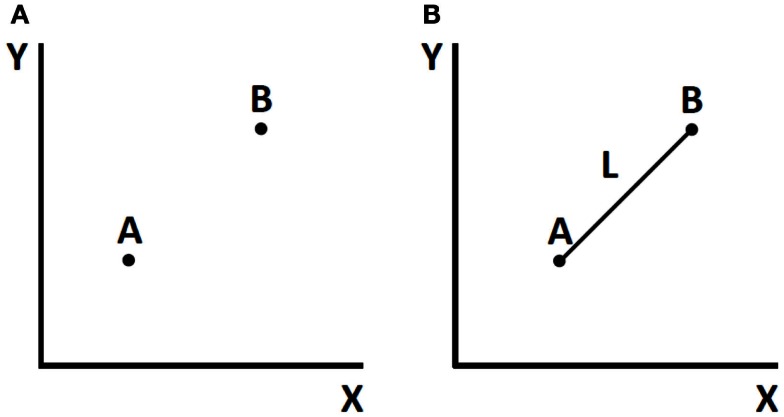
Figure 1
Figure 1
Effects of coupling on degrees of freedom. (A) Two independent points (four degrees of freedom). (B) Two points joined by a line of immutable length (three degrees of freedom).
Figure 2
Figure 2
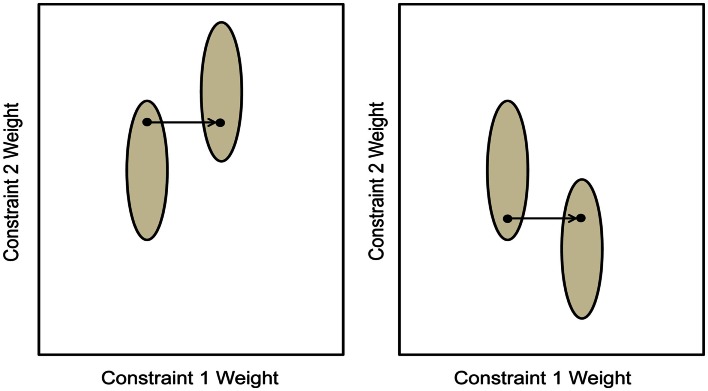
Actions selected from those that satisfy elementary task demands (enclosed in ellipses) defined by their locations in the two-dimensional space of weights (0–1) for constraint 1 and constraint 2. A different first point is chosen in the left case and second.
Figure 3
Figure 3
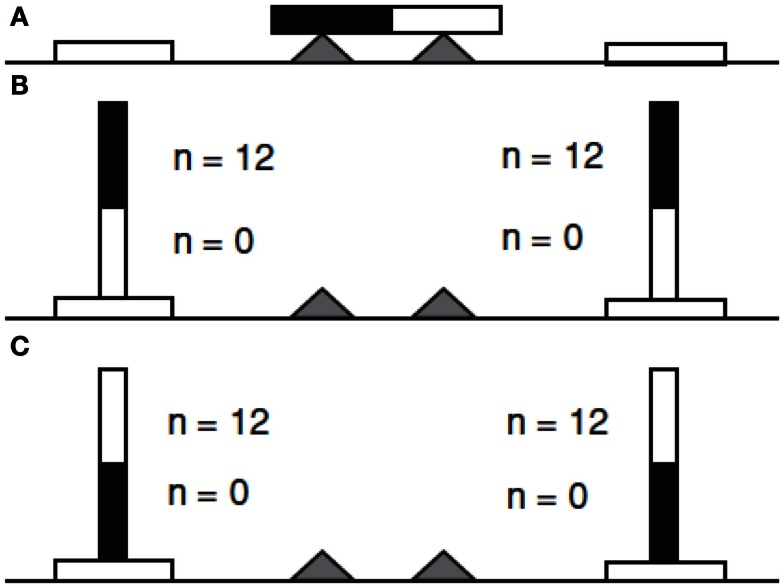
Dowel task transport (Rosenbaum et al., 1990) demonstrating the end-state comfort effect. In (A), the black and white dowel rests on a cradle with a target on either side of the cradle. In (B) the dowel’s black end was to be placed in the left or right target. In (C), the dowel’s white end was to be placed in the left or right target. The numbers near the black and white ends of the dowel represent the number of participants who grasped the dowel with the thumb directed toward that colored end of the dowel. (Image from Rosenbaum et al., .)
Figure 4
Figure 4
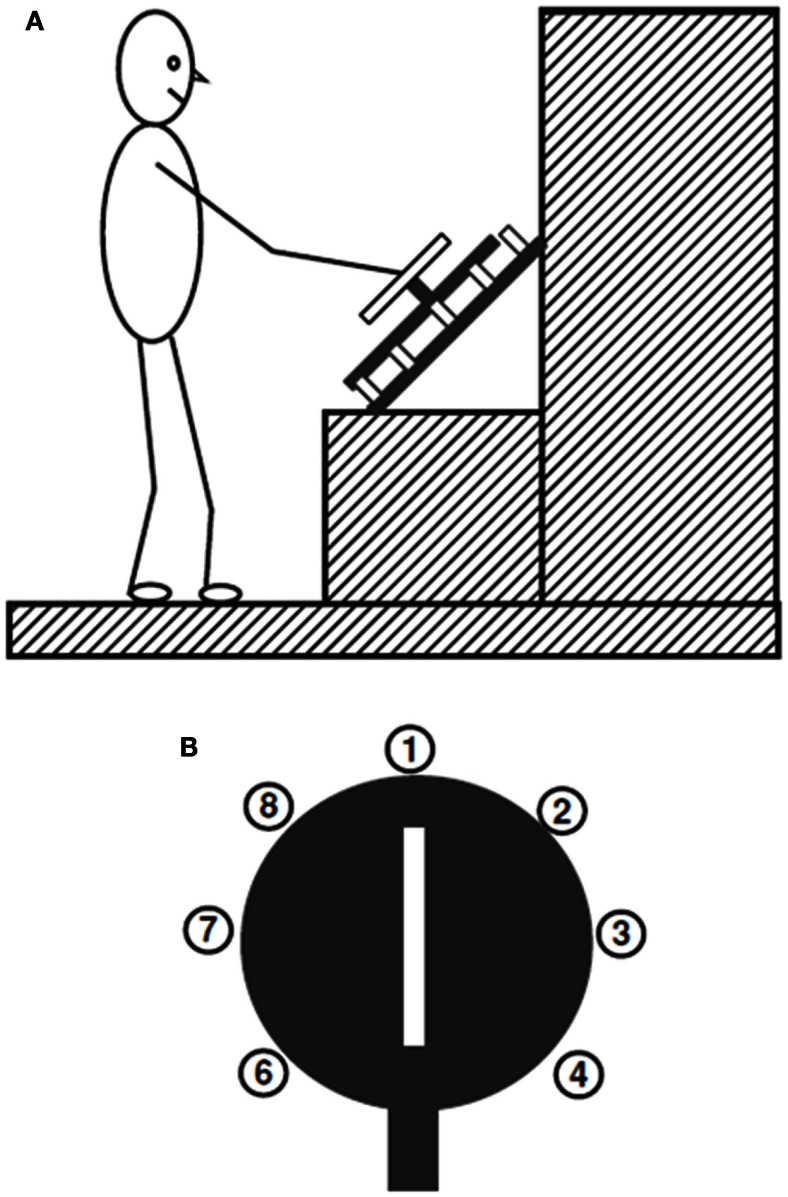
Rotation task studied by Rosenbaum et al. (1993). In (A), a participant stands in front of the wheel, which is oriented at a 45° angle, after reaching out and grasping the handle. In (B), the numbered end locations for the tab (bottom) are depicted for all possible targets, except for 5, which is hidden by the tab. (Image fromRosenbaum et al., .)
Figure 5
Figure 5
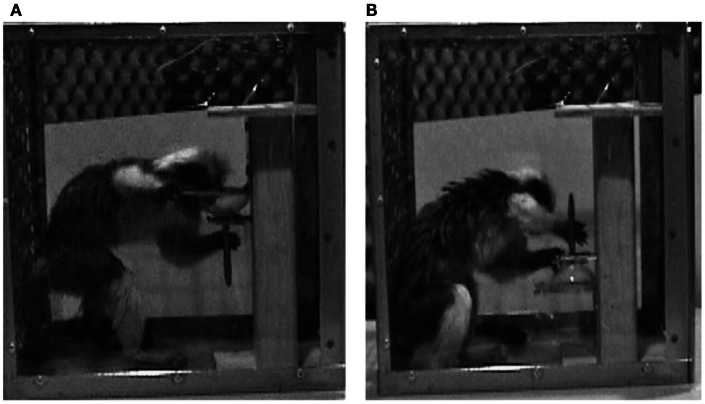
A cotton-top tamarin performing the cub extraction task of Weiss et al. (2007). In (A), the monkey grasps an upright cup’s stem using a canonical thumb-up posture. In (B), the same monkey grasps the inverted cup’s stem using a non-canonical thumb-down posture. (Image from Weiss et al., .)
Figure 6
Figure 6
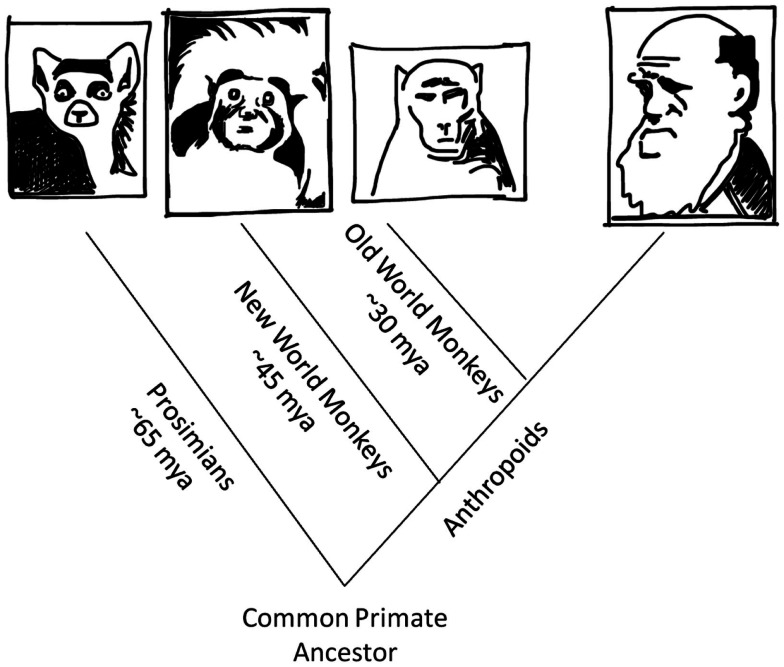
Evolutionary tree stemming for a common primate ancestor to prosimians (e.g., the ring-tailed lemur shown here), which departed from the anthropoid line approximately 65 million years ago; to New World monkeys (e.g., the cotton-top tamarin shown here), which departed from the anthropoid line approximately 45 million years ago; to Old World monkeys (e.g., the macaque shown here), which departed from the anthropoid line approximately 30 million years ago; and to Homo sapiens (e.g., Charles Darwin shown here).
Figure 7
Figure 7
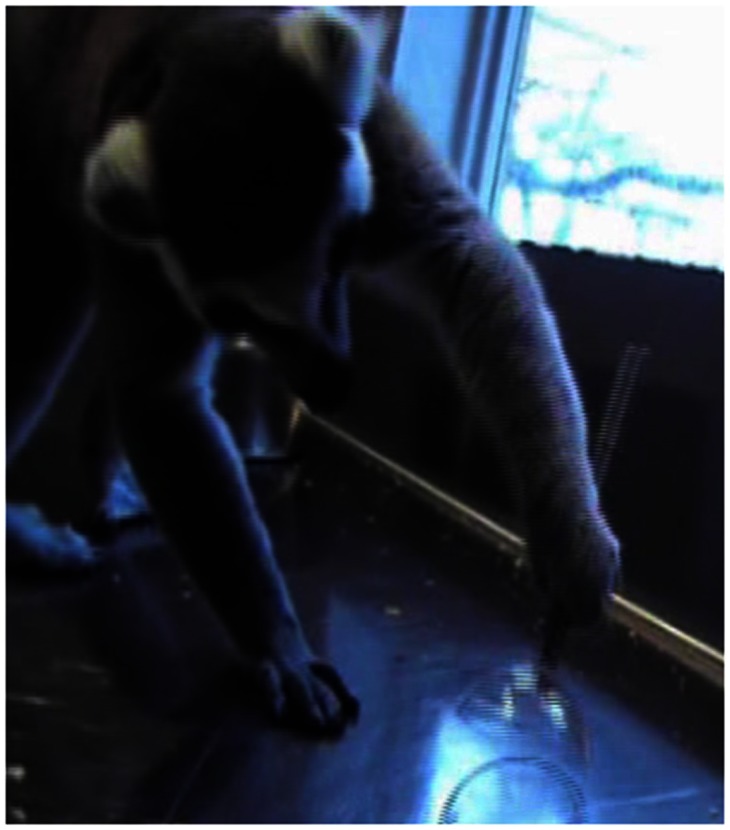
A ring-tailed lemur grasping an inverted cup’s stem using a thumb-down posture. The lemur then inverted the cup to remove a raisin from it. (Image fromChapman et al., .)
Figure 8
Figure 8
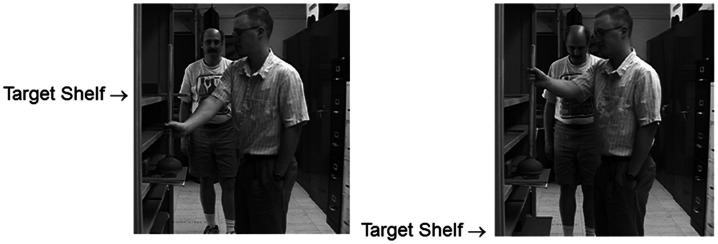
Two of the conditions studied by Cohen and Rosenbaum (2004) in their demonstration of the grasp height effect. The plunger occupies the same starting position in both conditions shown here (and in all five target-height conditions tested). Each participant was instructed to keep his or her left hand in his or her left pocket and to begin each trial with the right-hand hanging by the participant’s side. Left panel: the highest target shelf tested. Right panel: the lowest target shelf tested. The experimenter is the first author of the present article. The participant gave permission to have his face shown.
Figure 9
Figure 9
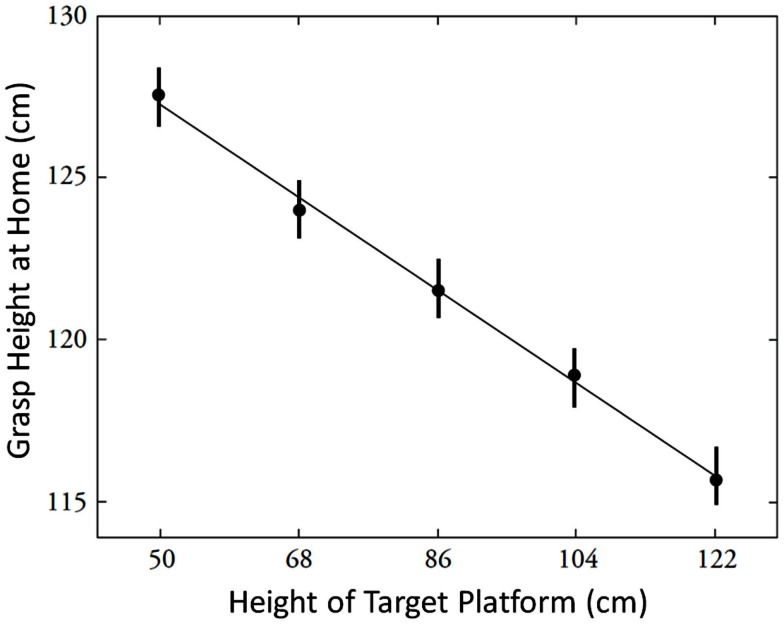
The grasp height effect. FromCohen and Rosenbaum (2004).
Figure 10
Figure 10
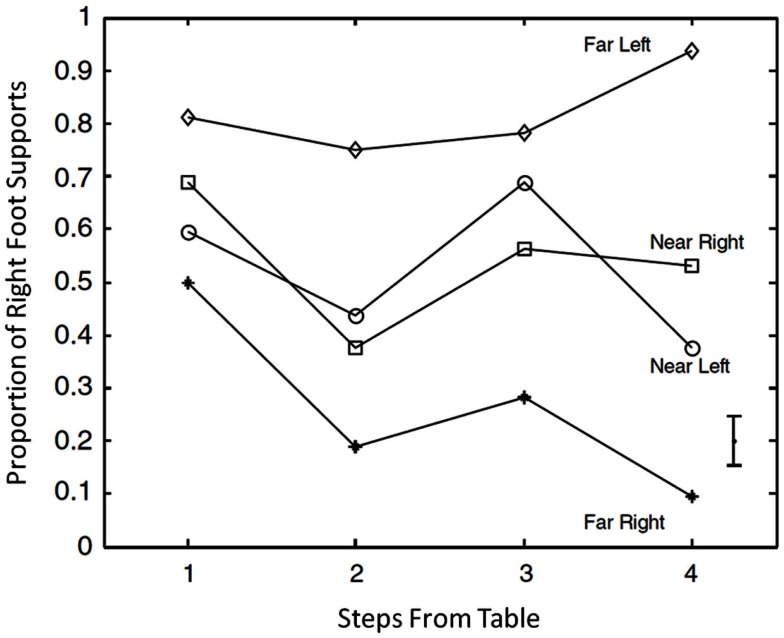
Mean observed proportion of trials in which participants stood on the right foot when they grasped a plunger to move it far to the left, near to the left, near to the right, or far from the right, plotted as a function of the distance from the table at the start of each trial. Fromvan der Wel and Rosenbaum (2007).
Figure 11
Figure 11
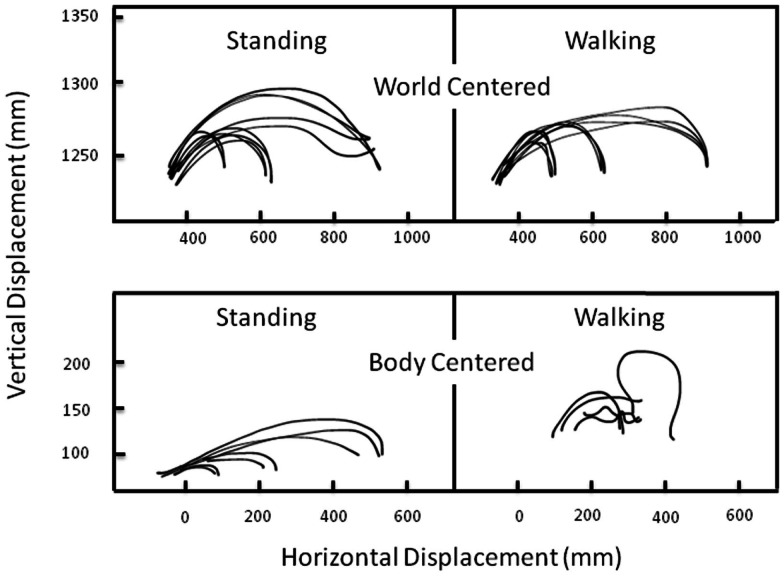
Vertical displacement of a hand-held cup as a function of horizontal displacement of the same cup when standing (left column) or walking (right column) and when the data are plotted in extrinsic spatial coordinates (top row) or intrinsic joint coordinates (bottom row). Adapted fromMarteniuk and Bertram (2001).
Figure 12
Figure 12
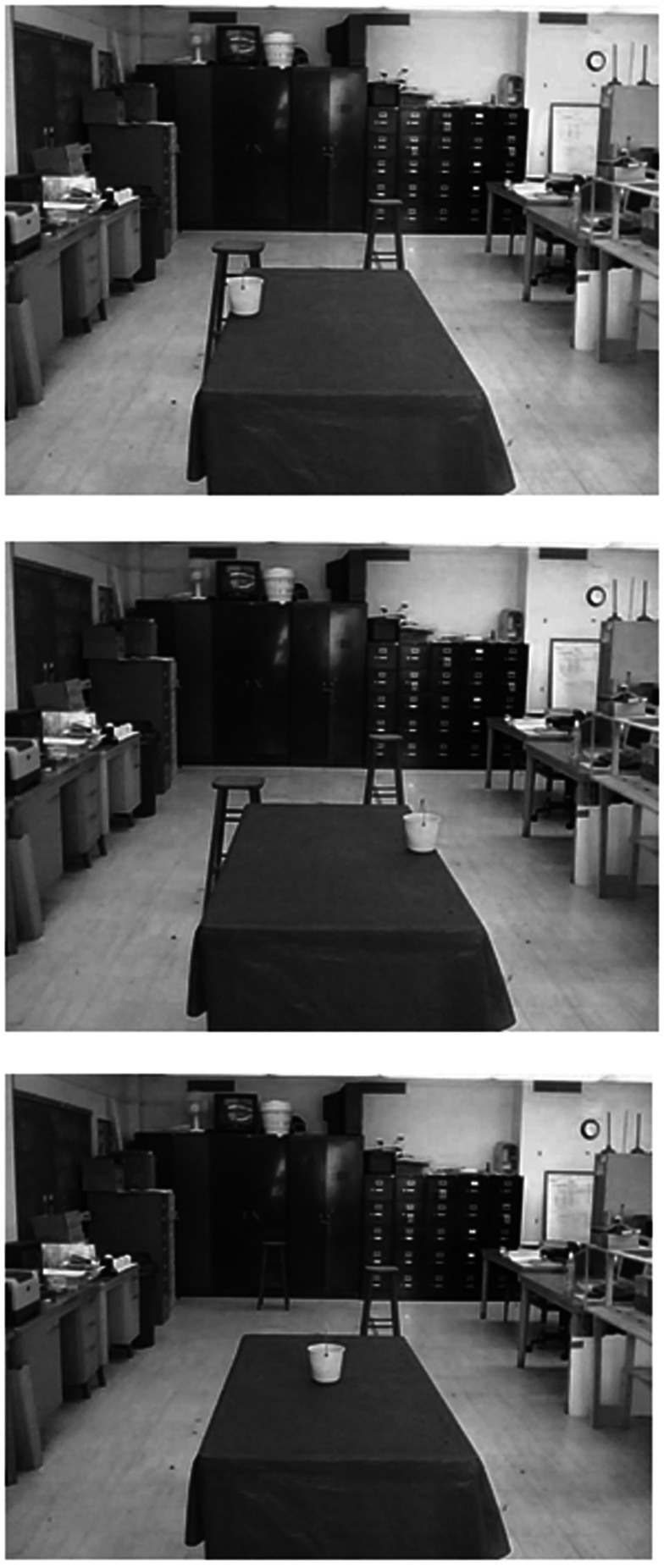
Three arrangements used by Rosenbaum et al. (2011) to study walking and reaching. In all cases, the participant stood at the site where these photographs were taken. Top panel: bucket near the left edge of the table and the left target stool is nearby. Middle panel: bucket near the right edge of the table and the left target stool is again nearby. Bottom panel: bucket in the middle of the table and the right target stool is nearby. Adapted fromRosenbaum (2012).
Figure 13
Figure 13
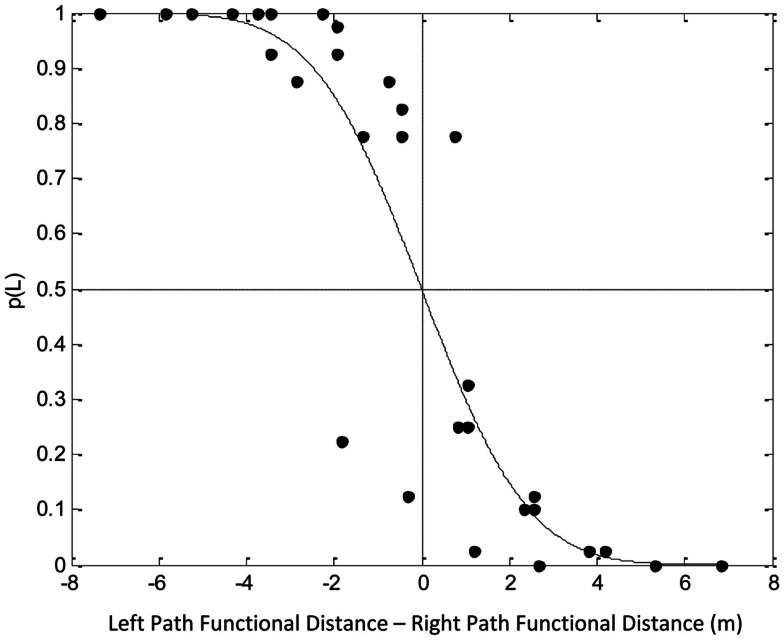
Probability, p(L), of choosing to walk along the left side of the table (Rosenbaum, 2012). Left path functional distance was defined as walking distance + 10.3 × right-hand reaching distance. Right path functional distance was defined as walking distance + 12.3 × left-hand reaching distance, all in meters (m). Adapted fromRosenbaum (2012).

References

    1. Abbs J. H. (1986). “Invariance and variability in speech production: a distinction between linguistic intent and its neuromotor implementation,” in Invariance and Variability in Speech Processes, eds Perkell J. S., Klatt D. H. (Hillsdale, NJ: Erlbaum; ), 202–219
    1. Alexander R. M. (1984). Walking and running. Am. Sci. 72, 348–354
    1. Bernstein N. (1967). The Coordination and Regulation of Movements. London: Pergamon
    1. Cai Q., Aggarwal J. K. (1999). Tracking human motion in structured environments using a distributed-camera system. IEEE Trans. Pattern Anal. Mach. Intell. 21, 1241–124710.1109/34.809119 - DOI
    1. Chapman K. M., Weiss D. J., Rosenbaum D. A. (2010). The evolutionary roots of motor planning: the end-state comfort effect in lemurs. J. Comp. Psychol. 124, 229–23210.1037/a0018025 - DOI - PubMed

LinkOut - more resources