. 2013 Jun 4:4:177.
doi: 10.3389/fpls.2013.00177. eCollection 2013.

Regulation of assimilate import into sink organs: update on molecular drivers of sink strength

Affiliations

Regulation of assimilate import into sink organs: update on molecular drivers of sink strength

Saadia Bihmidine et al. Front Plant Sci. .

Abstract

Recent developments have altered our view of molecular mechanisms that determine sink strength, defined here as the capacity of non-photosynthetic structures to compete for import of photoassimilates. We review new findings from diverse systems, including stems, seeds, flowers, and fruits. An important advance has been the identification of new transporters and facilitators with major roles in the accumulation and equilibration of sugars at a cellular level. Exactly where each exerts its effect varies among systems. Sugarcane and sweet sorghum stems, for example, both accumulate high levels of sucrose, but may do so via different paths. The distinction is central to strategies for targeted manipulation of sink strength using transporter genes, and shows the importance of system-specific analyses. Another major advance has been the identification of deep hypoxia as a feature of normal grain development. This means that molecular drivers of sink strength in endosperm operate in very low oxygen levels, and under metabolic conditions quite different than previously assumed. Successful enhancement of sink strength has nonetheless been achieved in grains by up-regulating genes for starch biosynthesis. Additionally, our understanding of sink strength is enhanced by awareness of the dual roles played by invertases (INVs), not only in sucrose metabolism, but also in production of the hexose sugar signals that regulate cell cycle and cell division programs. These contributions of INV to cell expansion and division prove to be vital for establishment of young sinks ranging from flowers to fruit. Since INV genes are themselves sugar-responsive "feast genes," they can mediate a feed-forward enhancement of sink strength when assimilates are abundant. Greater overall productivity and yield have thus been attained in key instances, indicating that even broader enhancements may be achievable as we discover the detailed molecular mechanisms that drive sink strength in diverse systems.

Keywords: carbohydrate partitioning; kernel; maize; sink strength; sorghum; stem; sucrose; sugarcane.


Figures
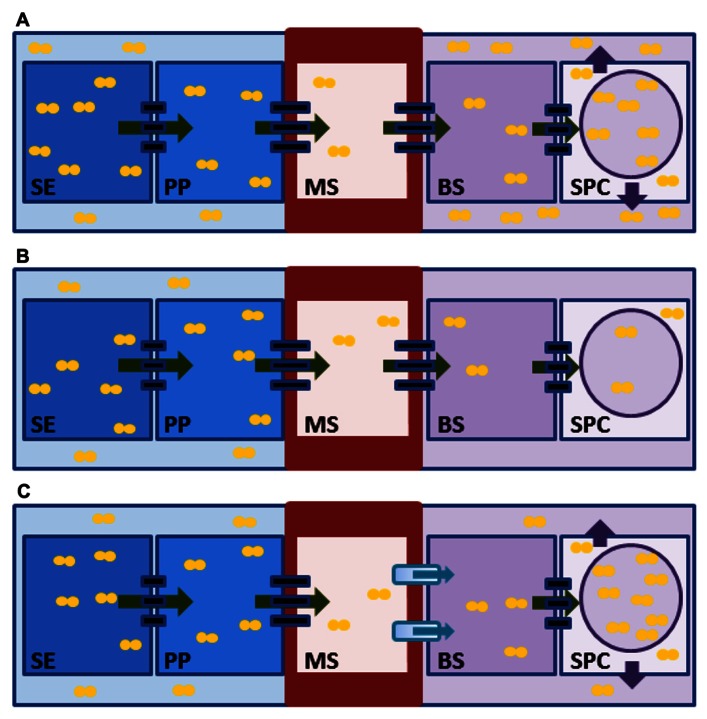
FIGURE 1
FIGURE 1
Models for sucrose movement in sugarcane and sweet sorghum stems. (A) In mature sugarcane stems, sucrose (orange circles) moves symplastically cell-to-cell (green arrows) through plasmodesmata (black rectangles) from the phloem sieve element (SE) to the stem parenchyma cell (SPC). In the SPC, some of the sucrose is stored in the vacuole (purple circle), and some is released to the apoplast (purple arrows) to increase the sink strength and sucrose storage capacity of the tissue. Sucrose in the SPC apoplast is prevented from diffusing back into the phloem apoplast by the suberized and lignified cell wall (thick red outline) of the mestome sheath cells (MS). (B) In immature sorghum stems, sucrose follows a symplastic path from the SE to the SPC cells. This tissue is actively growing and not storing much sucrose. (C) In ripening sorghum stems, sucrose movement from the SE to the SPC includes an apoplastic step. The suberized and lignified cell wall of the MS cell necessitates that the sucrose efflux must occur from either the MS or the bundle sheath cell (BS, not shown). Import could occur in either the BS or in the SPC (not shown). For simplicity, sucrose efflux and import are shown at the MS–BS interface by the shaded blue rectangle and blue arrow. The majority of the stored sucrose is intracellular. PP, phloem parenchyma cell.
FIGURE 2
FIGURE 2
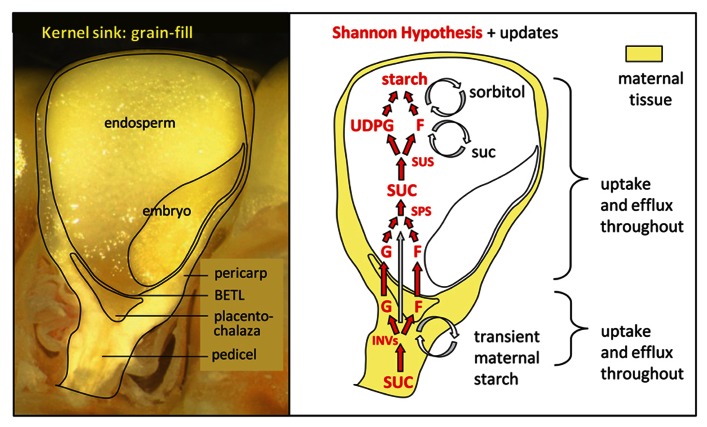
Maize kernel sink strength during grain fill. The left panel shows a fresh, longitudinal view of a maize kernel during active starch deposition in the upper endosperm and lower pericarp (12 days after pollination). The path of assimilate entry into endosperm or embryo includes mandatory movement through the cell wall space (apoplast), because these tissues are physically isolated from the maternal structures around them by a lack of plasmodesmatal (symplastic) continuity. The right panel diagrams major contributors to sink strength relative to sites of their spatial distribution in kernels at this stage. The original Shannon hypothesis is shown in red, with updates in black. Maternal tissues are shown in yellow to emphasize the role of apoplastic transfer. Sucrose (SUC) is first cleaved by vacuolar and cell wall invertases (INV) operating in the pedicel, the placenta-chalaza, and especially by cell wall INV in the basal endosperm transfer layer (BETL). Updates to the first portion of this classical path include continual influx and efflux from maternal cells (via transporters and effluxers), and a prominent role for transient starch reserves in maternal tissues (especially the lower pericarp). Assimilates next enter the endosperm across the BETL primarily as hexoses, glucose (G) and fructose (F), but also as SUC. SUC is also resynthesized in basal portions of the endosperm by sucrose phosphate synthase (SPS), and transported to upper regions of the endosperm. Recent evidence shows extremely low oxygen levels in endosperm, which can affect several aspects of kernel sink strength. These include a limitation to metabolism of stored assimilates, advantages of sucrose resynthesis and cleavage by sucrose synthase [SUS (typically cleaving sucrose in vivo)], and cycling of sorbitol as a mechanism of redox balance under deep hypoxia. UDPG, uridine-di-phosphoglucose.
FIGURE 3
FIGURE 3
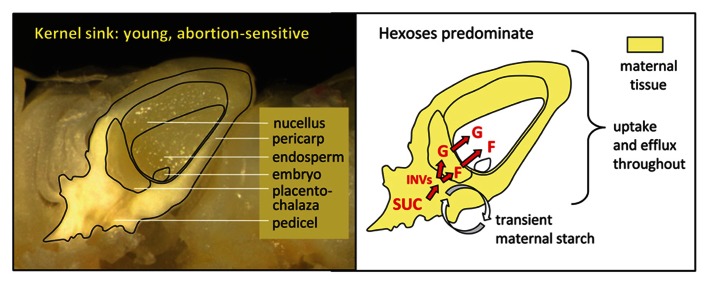
Maize kernel sink strength in young, abortion-sensitive ovaries. The left panel shows a fresh, longitudinal view of a maize kernel at eight days after pollination, when maternal tissues predominate in this sink structure. Note the importance of the nucellus and expanding pericarp (fruit wall). The right panel diagrams major contributors to sink strength relative to their spatial distribution. Maternal tissues are shown in yellow to emphasize their dominant role in sink strength, and control over abortion and kernel set at this stage. Like the more mature kernels, sucrose (SUC) in young ovaries is first cleaved by vacuolar and cell wall invertases (INVs) in the pedicel and the placenta-chalaza, and to some extent the newly forming basal endosperm transfer layer. Updates have indicated that collective effects of these INVs are most pronounced in very young kernels, where the hexoses have signaling roles in the cell cycle, cell division, and cell number that markedly enhance ultimate sink strength. Another component of young-kernel sink strength is transient maternal starch, thought to aid maintenance of non-aborting kernels. In addition, continuous efflux and influx of sugars occur throughout maternal tissues, even prior to pollination, highlighting the roles for transporters and effluxers during early development of sink strength in maize kernels. G, glucose; F, fructose.

References

    1. Acreche M. M., Slafer G. A. (2006). Grain weight response to increases in number of grains in wheat in a Mediterranean area. Field Crops Res. 98 52–59 10.1016/j.fcr.2005.12.005 - DOI
    1. Ainsworth E. A., Bush D. R. (2011). Carbohydrate export from the leaf: a highly regulated process and target to enhance photosynthesis and productivity. Plant Physiol. 155 64–69 10.1104/pp.110.167684 - DOI - PMC - PubMed
    1. Aitken K. S., Hermann S., Karno K., Bonnett G. D., McIntyre L. C., Jackson P. A. (2008). Genetic control of yield related stalk traits in sugarcane. Theor. Appl. Genet. 117 1191–1203 10.1007/s00122-008-0856-6 - DOI - PubMed
    1. Ali M. L., Rajewski J. F., Baenziger P. S., Gill K. S., Eskridge K. M., Dweikat I. (2008). Assessment of genetic diversity and relationship among a collection of US sweet sorghum germplasm by SSR markers. Mol. Breed. 21 497–509 10.1007/s11032-007-9149-z - DOI
    1. Almodares A., Hadi M. R. (2009). Production of bioethanol from sweet sorghum: a review. Afr. J. Agric. Res. 4 772–780