


Prevalent hallucinations during medical internships: phantom vibration and ringing syndromes
- PMID: 23762302
- PMCID: PMC3677878
- DOI: 10.1371/journal.pone.0065152
Prevalent hallucinations during medical internships: phantom vibration and ringing syndromes
Abstract
Background: Phantom vibration syndrome is a type of hallucination reported among mobile phone users in the general population. Another similar perception, phantom ringing syndrome, has not been previously described in the medical literature.
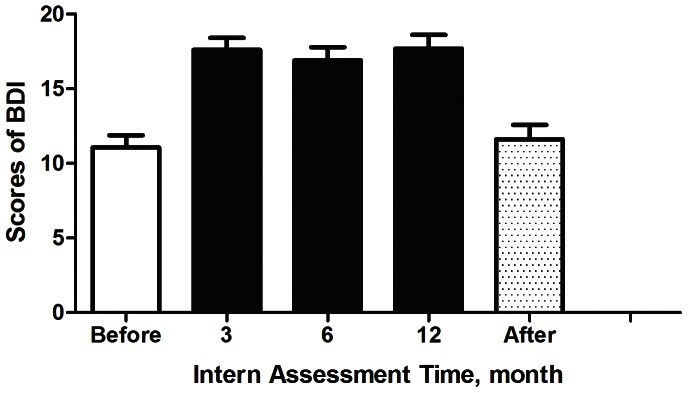
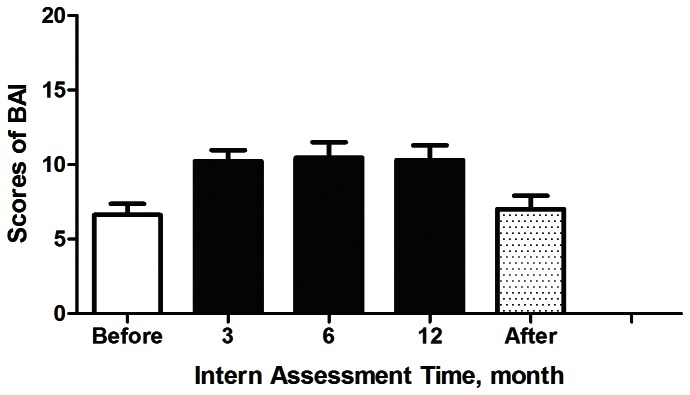
Methods: A prospective longitudinal study of 74 medical interns (46 males, 28 females; mean age, 24.8±1.2 years) was conducted using repeated investigations of the prevalence and associated factors of phantom vibration and ringing. The accompanying symptoms of anxiety and depression were evaluated with the Beck Anxiety and Depression Inventories before the internship began, and again at the third, sixth, and twelfth internship months, and two weeks after the internship ended.
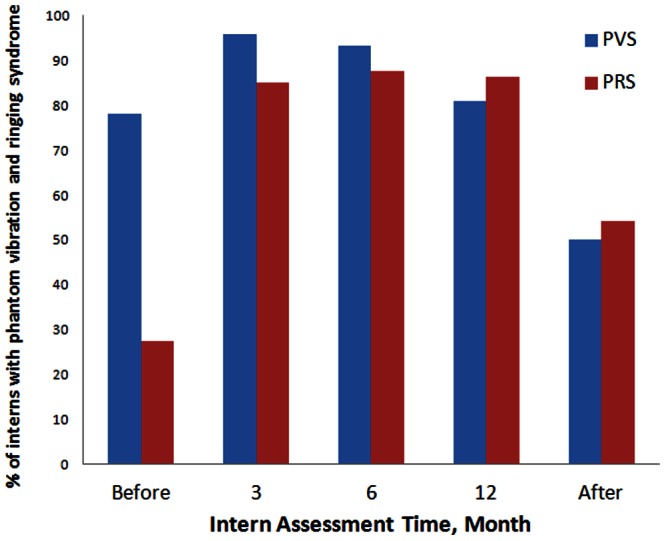
Results: The baseline prevalence of phantom vibration was 78.1%, which increased to 95.9% and 93.2% in the third and sixth internship months. The prevalence returned to 80.8% at the twelfth month and decreased to 50.0% 2 weeks after the internship ended. The baseline prevalence of phantom ringing was 27.4%, which increased to 84.9%, 87.7%, and 86.3% in the third, sixth, and twelfth internship months, respectively. This returned to 54.2% two weeks after the internship ended. The anxiety and depression scores also increased during the internship, and returned to baseline two weeks after the internship. There was no significant correlation between phantom vibration/ringing and symptoms of anxiety or depression. The incidence of both phantom vibration and ringing syndromes significantly increased during the internship, and subsequent recovery.
Conclusion: This study suggests that phantom vibration and ringing might be entities that are independent of anxiety or depression during evaluation of stress-associated experiences during medical internships.
Conflict of interest statement
Figures
References
-
- Rothberg MB, Arora A, Hermann J, Kleppel R, St Marie P, et al. (2010) Phantom vibration syndrome among medical staff: A cross sectional survey. Br Med J 341: c6914. - PubMed
-
- Baillie DW (2011) Phantom vibration syndrome. Sixty eight per cent of us hallucinate. Br Med J 342: Jan 19 342: d299 doi: 10.1136/bmj.d299 - DOI - PubMed
-
- Vellante M, Larøi F, Cella M, Raballo A, Petretto DR, et al.. (2012) Hallucination-like experiences in the nonclinical population. J Nerv Ment Dis: 310–315. - PubMed
-
- Langer AI, Cangas AJ, Serper M (2011) Analysis of the multidimensionality of hallucination-like experiences in clinical and nonclinical Spanish samples and their relation to clinical symptoms: implications for the model of continuity. Int J Psychol 46: 46–54. - PubMed
Publication types
MeSH terms
LinkOut - more resources
Full Text Sources
Other Literature Sources
Medical
