. 2013 May 1;2(5):e24270.
doi: 10.4161/onci.24270. Epub 2013 Apr 1.

The novel cancer-testis antigen A-kinase anchor protein 4 (AKAP4) is a potential target for immunotherapy of ovarian serous carcinoma

Affiliations

The novel cancer-testis antigen A-kinase anchor protein 4 (AKAP4) is a potential target for immunotherapy of ovarian serous carcinoma

Sumit Agarwal et al. Oncoimmunology. .

Erratum in

  • Correction.
    [No authors listed] [No authors listed] Oncoimmunology. 2021 May 6;10(1):1921437. doi: 10.1080/2162402X.2021.1921437. Oncoimmunology. 2021. PMID: 34026333 Free PMC article.

Abstract

Ovarian cancer is one of the neoplasms affecting the reproductive tract associated with high mortality rate because of limited therapeutic options and an elevated incidence of chemoresistance and recurrence. In this context, immunotherapy may constitute a promising approach to improve survival rates and clinical outcome, raising the need for specific target antigens. Cancer-testis antigens (CTAs) are considered promising candidates in this sense because they are aberrant expressed by various malignancies but not by non-transformed tissue, with the exception of testes. Here, we examined the expression and potential to promote humoral immune responses of a novel CTA, A-kinase anchor protein 4 (AKAP4), among 38 ovarian carcinoma patients. Our results reveal that AKAP4 was expressed at both the mRNA and protein levels in 89% (34/38) of ovarian carcinoma tissue specimens but not in 21 matched adjacent non-cancerous tissues. In addition, a humoral response against AKAP4 was detected in 58% (22/38) of ovarian carcinoma patients by ELISA. In particular, 65% (22/34) patients bearing an AKAP4-expressing tumor exhibited circulating anti-AKAP4 antibodies. Interestingly, the majority of specimens were categorized as ovarian serous adenocarcinoma and serous papillary carcinoma, of which 93% (28/30) and 100% (6/6), respectively, expressed AKAP4. A humoral response against AKAP4 was detected in 79% (19/24) and 67% (4/6) of ovarian serous adenocarcinoma and serous papillary carcinoma patients, respectively. The presence of circulating anti-AKAP4 antibodies suggests the AKAP4 is highly immunogenic in ovarian serous carcinoma patients. Our study lays the foundations for exploring AKAP4 as a potential target for the immunotherapy of ovarian cancer.

Keywords: AKAP4; cancer-testis antigen; immunotherapy; ovarian serous carcinoma; vaccine.


Figures
None
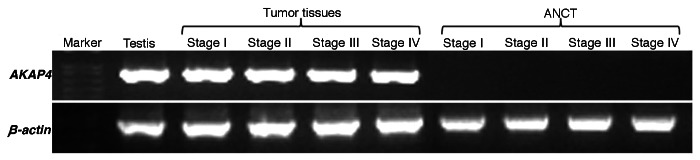
Figure 1.AKAP4 expression in representative Stage I, Stage II, Stage III and Stage IV ovarian cancer tissue specimens. Tissue samples were analyzed by RT-PCR with AKAP4-specific primers. No AKAP4 expression was detected in matched adjacent non-cancerous tissue (ANCT) specimens. Testis cDNA was used as a positive control, while β actin was quantified as an internal loading control.
None
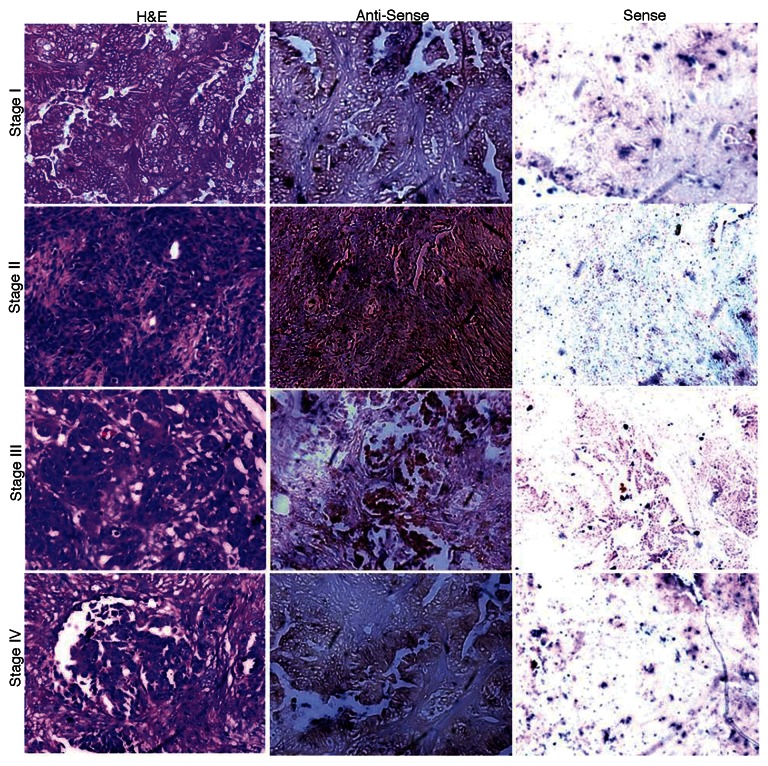
Figure 2. In situ localization of AKAP4 mRNA in representative Stage I, Stage II, Stage III and Stage IV ovarian cancer tissue specimens. Ovarian cancer samples representative of all FIGO stages were stained with hematoxylin and eosin (left panels) or with AKAP4-specific anti-sense (middle panels) or sense (right panels) riboprobes, the latter as a negative control condition. Original magnification = 200×, = objective 20×.
None
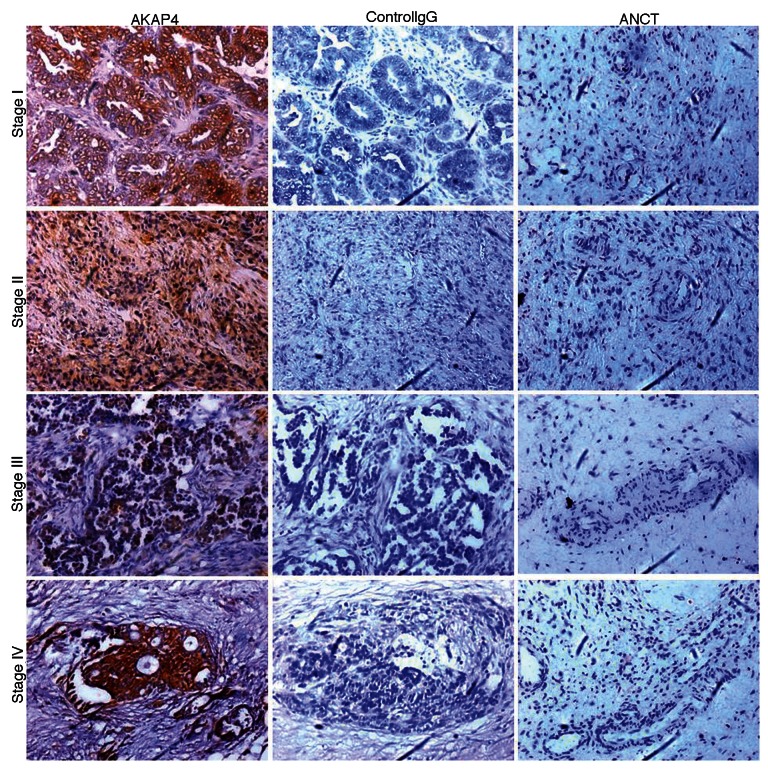
Figure 3. AKAP4 expression in representative Stage I, Stage II, Stage III and Stage IV tissue ovarian cancer specimens. Serial sections from ovarian cancer samples representative of all FIGO stages (left and middle panels) or from matched adjacent non-cancerous tissue (ANCT) specimens (right panel) were probed with polyclonal anti-AKAP4 antibodies (left and right panels) or with non-specific IgGs (central panel), as a staining control condition.
None
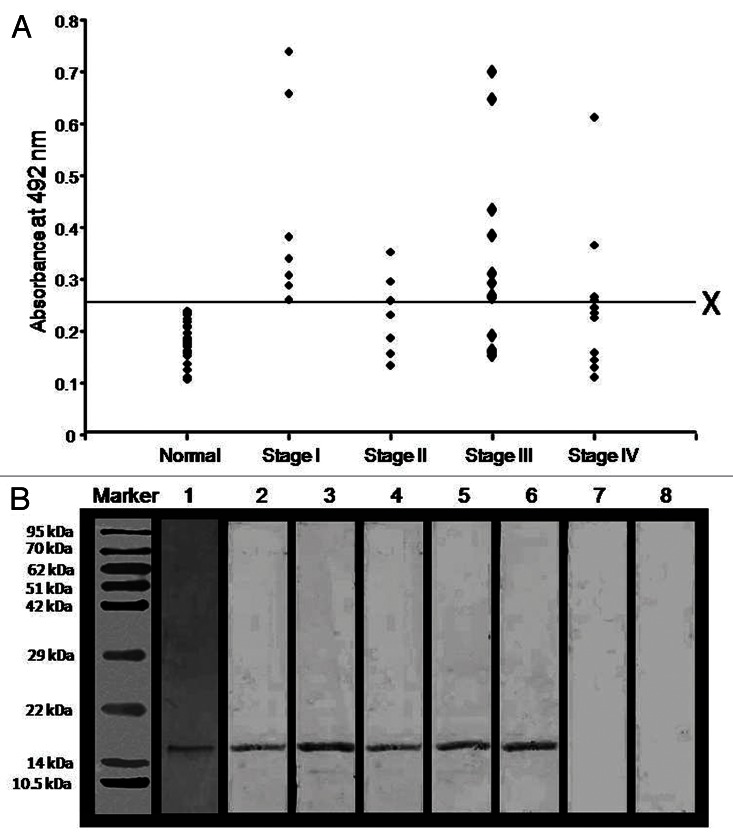
Figure 4. Humoral responses against AKAP4 in ovarian carcinoma patients. (A) Figure Humoral responses against AKAP4 in ovarian cancer specimens obtained from Stage I, Stage II, Stage III and Stage IV patients. X represents the cut-off value (calculated as the mean of antibody titers detected in healthy donors + 2SD) above which all specimens were considered as positive. (B) Immunoblotting experiments were performed to confirm anti-AKAP4 humoral responses and the specificity of circulating anti-AKAP4 antibodies was validated by neutralization experiments. Lane 1, coomassie brilliant blue stained purified recombinant AKAP4 protein; Lane 2, polyclonal anti-AKAP4 antibody showing AKAP4 immunoreactivity; Lane 3–6, AKAP4-immunoreactive bands indicative of AKAP-specific humoral responses in representative stage I, stage II, stage III and stage IV patients; Lane 7, absence of anti-AKAP4 humoral responses in the serum of a healthy donor; Lane 8, absence of AKAP4-immunoreactive bands upon the pre-incubation of the patient's serum with 15 μg/mL recombinant AKAP4.

References

    1. Siegel R, Naishadham D, Jemal A. Cancer statistics, 2012. CA Cancer J Clin. 2012;62:10–29. doi: 10.3322/caac.20138. - DOI - PubMed
    1. Suri A, Saini S, Sinha A, Agarwal S, Verma A, Parashar D, et al. Cancer testis antigens: A new paradigm for cancer therapy. Oncoimmunology. 2012;1:1194–6. doi: 10.4161/onci.20686. - DOI - PMC - PubMed
    1. Garg M, Chaurasiya D, Rana R, Jagadish N, Kanojia D, Dudha N, et al. Sperm-associated antigen 9, a novel cancer testis antigen, is a potential target for immunotherapy in epithelial ovarian cancer. Clin Cancer Res. 2007;13:1421–8. doi: 10.1158/1078-0432.CCR-06-2340. - DOI - PubMed
    1. Garg M, Kanojia D, Khosla A, Dudha N, Sati S, Chaurasiya D, et al. Sperm-associated antigen 9 is associated with tumor growth, migration, and invasion in renal cell carcinoma. Cancer Res. 2008;68:8240–8. doi: 10.1158/0008-5472.CAN-08-1708. - DOI - PubMed
    1. Kanojia D, Garg M, Gupta S, Gupta A, Suri A. Sperm-associated antigen 9, a novel biomarker for early detection of breast cancer. Cancer Epidemiol Biomarkers Prev. 2009;18:630–9. doi: 10.1158/1055-9965.EPI-08-0629. - DOI - PubMed

Publication types